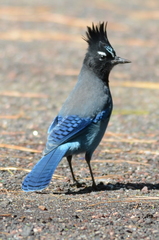
Steller's Jay

Steller's Jay

Cyanocitta stelleri

Silhouette: T. Michael Keesey (photo by Darren Swim) · PhyloPic

LCLeast ConcernNTVUENCR
Daily sighting probability ~10% · With luck
at Guadalupe Mountains National Park

In 3 days ~30% in a week ~50%

88 Verified sightings at Guadalupe Mountains National Park From 2019 to 2026
31,072 In all 20 parks
August Best month
☀️ Diurnal When it's spotted

About the Steller's Jay

Steller's jay (Cyanocitta stelleri) is a bird native to western North America and the mountains of Central America, closely related to the blue jay (C. cristata) found in eastern North America. It is the only crested jay west of the Rocky Mountains. It is also sometimes colloquially called a "blue jay" in the Pacific Northwest, but is distinct from the blue jay of eastern North America. The species inhabits pine-oak and coniferous forests.

Steller's jay was formally described in 1788 by the German naturalist Johann Friedrich Gmelin in his revised and expanded edition of Carl Linnaeus's Systema Naturae. He placed it with the crows in the genus Corvus and coined the binomial name Corvus stelleri. Gmelin based his account on "Stellers crow" that had been described in 1781 by the English ornithologist John Latham in his book A General Synopsis of Birds. Latham had examined a specimen belonging to the naturalist Joseph Banks that had been collected in Nootka Sound, Vancouver Island off the Pacific coast of Canada. The specimen was one of the birds collected on Captain James Cook's third voyage to the Pacific Ocean. During this voyage Cook visited Nootka Sound from 29 March... Wikipedia →

Sounds

Call0:04

United States · 2024

© Denis Dujardin · XC1056036 · CC BY-NC-SA 4.0

Alarm call0:41

United States · 2021

© Ron Overholtz · XC662663 · CC BY-NC-SA 4.0

Recording0:47

Nicaragua · 2017

© Liliana Chavarria-Duriaux · XC646059 · CC BY-NC-SA 4.0

Global Distribution

Parks Where Found

# Park Country Daily sighting probability
1 Yosemite National Park 🇺🇸 United States
~80%
2 Redwood National Park 🇺🇸 United States
~60%
3 Rocky Mountain National Park 🇺🇸 United States
~60%
4 Sequoia and Kings Canyon National Parks 🇺🇸 United States
~50%
5 Pacific Rim National Park Reserve 🇨🇦 Canada
~50%
6 Olympic National Park 🇺🇸 United States
~50%
7 Great Bear Rainforest 🇨🇦 Canada
~40%
8 Zion National Park 🇺🇸 United States
~30%
9 Grand Canyon National Park 🇺🇸 United States
~30%
10 Glacier National Park 🇺🇸 United States
~30%
11 Reserva de la Biosfera Mariposa Monarca 🇲🇽 Mexico
~10%
12 Celaque National Park 🇭🇳 Honduras
~10%
13 Guadalupe Mountains National Park 🇺🇸 United States
~10%
14 Grand Teton National Park 🇺🇸 United States
~10%
15 Banff National Park 🇨🇦 Canada
~10%
16 Kenai Fjords National Park 🇺🇸 United States
~10%
17 Yellowstone National Park 🇺🇸 United States
~10%
18 La Tigra National Park 🇭🇳 Honduras
~10%
19 Jasper National Park 🇨🇦 Canada
<5%
20 Saguaro National Park 🇺🇸 United States
<5%

Cities Where Found

# City Country Daily sighting probability
1 Seattle 🇺🇸 United States
~40%
2 Portland 🇺🇸 United States
~40%
3 San Francisco 🇺🇸 United States
~20%
4 Vancouver 🇨🇦 Canada
~20%
5 Anchorage 🇺🇸 United States
~20%
6 Guatemala City 🇬🇹 Guatemala
~10%
7 Salt Lake City 🇺🇸 United States
<5%
8 Mexico City 🇲🇽 México
<5%
9 Las Vegas 🇺🇸 United States
<5%
10 Phoenix 🇺🇸 United States
<5%

Zoos & Centres Where Found

# Zoo / Centre Country
1 Arizona-Sonora Desert Museum 🇺🇸 United States In captivity

Before you go

What are the chances of seeing a Steller's Jay in Guadalupe Mountains National Park?

With luck

About 10% of wildlife watchers report a Steller's Jay sighting in Guadalupe Mountains National Park on a given day, based on 88 verified sightings from GBIF citizen-science data from 2019 to 2026. It is the 66th most-seen of the 141 birds we can rate there. Over three days the chance rises to about 30%, and over a week to about 50%, if each day is a fresh chance.

When is the best time to see a Steller's Jay in Guadalupe Mountains National Park?

June and August

In those months about 20% of wildlife watchers report a Steller's Jay in Guadalupe Mountains National Park on a given day, against under 5% in April and July, the lowest months. Those are among Guadalupe Mountains National Park's wettest months, with about 35 mm of rain a month against 10 mm in April.

What time of day is best to see a Steller's Jay?

Between 11 am and 2 pm

Across all the parks we cover, that three-hour window holds the most Steller's Jay sightings with a recorded time, and nearly all of them come between 6 am and 6 pm: it is a daytime animal.

Which relatives of the Steller's Jay live in Guadalupe Mountains National Park?

Same family: Corvidae

The closest relatives of the Steller's Jay that you can see in Guadalupe Mountains National Park (family Corvidae, Crows, Jays, and Magpies) are Woodhouse's Scrub-Jay (about 50%) and Common Raven (about 20%), with each one's daily chance of a sighting.

Where does the Steller's Jay sighting chance come from?

GBIF citizen-science records

It is estimated from how often the Steller's Jay is recorded against all the birds logged in Guadalupe Mountains National Park (88 verified sightings from 2019 to 2026), calibrated against known sighting rates. Figures are rounded to the nearest 10% because citizen-science data supports honest approximations, not decimals, and months with records from fewer than five people show "—". How it works.

← Back to Guadalupe Mountains National Park