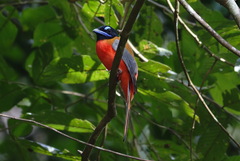
Scarlet-rumped Trogon

Scarlet-rumped Trogon

Harpactes duvaucelii

Silhouette: Keith Murdock (photo), John E. McCormack, Michael G. Harvey, Brant C. Faircloth, Nicholas G. Crawford, Travis C. Glenn, Robb T. Brumfield & T. Michael Keesey · PhyloPic

LCNTNear ThreatenedVUENCR
Daily sighting probability ~10% · With luck
at Gunung Leuser National Park

In 3 days ~30% in a week ~60%

33 Verified sightings at Gunung Leuser National Park From 2019 to 2026
1,249 In all 9 parks
February Best month
🌅 Crepuscular When it's spotted

About the Scarlet-rumped Trogon

The scarlet-rumped trogon (Harpactes duvaucelii) is a species of bird in the family Trogonidae. It has also been called the red-rumped trogon and Duvaucel's trogon. It is distinguishable from other trogons by its small size and reddish rump. This species is generally solitary except mating and raising young, which is done in pairs. It is found within certain lowland forests of Indonesia, Malaysia, Myanmar, and Thailand. It is currently considered near threatened by Red List Assessments due to habitat loss.

This species was named by Coenraad Jacob Temminck in 1824, a Dutch zoologist, in Sumatra. The common name, Duvaucel's trogon, and its species epithet duvaucelii, is in honor of Aldred Duvaucel, a naturalist and explorer. It is most closely related to the cinnamon-rumped trogon (Harpactes orrhophaeus). These two species were formerly in their own separate genus, Duvaucelius, before being moved into Harpactes. Following DNA sequencing of mitochondrial and nuclear loci done in 2010, it was determined that they were in a separate clade.

The scarlet-rumped trogon is the world's smallest trogon, with adults measuring around 23–24 cm (9.1–9.4 in) with wings... Wikipedia →

Sounds

Song0:34

Malaysia · 2025

© Étienne Leroy · XC1076681 · CC BY-NC-SA 4.0

Call0:06

Brunei · 2021

© Okamoto Keita Sin · XC665782 · CC BY-NC-SA 4.0

Song1:21

Malaysia · 2024

© Greg Irving · XC921959 · CC BY-NC-SA 4.0

Global Distribution

Parks Where Found

# Park Country Daily sighting probability
1 Way Kambas National Park 🇮🇩 Indonesia
~30%
2 Khao Luang National Park 🇹🇭 Thailand
~30%
3 Danum Valley Conservation Area 🇲🇾 Malaysia
~20%
4 Taman Negara National Park 🇲🇾 Malaysia
~20%
5 Gunung Leuser National Park 🇮🇩 Indonesia
~10%
6 Kinabatangan Wildlife Sanctuary 🇲🇾 Malaysia
~10%
7 Khao Sok National Park 🇹🇭 Thailand
<5%
8 Sepilok 🇲🇾 Malaysia
<5%
9 Kinabalu Park 🇲🇾 Malaysia
<5%

Before you go

What are the chances of seeing a Scarlet-rumped Trogon in Gunung Leuser National Park?

With luck

About 10% of wildlife watchers report a Scarlet-rumped Trogon sighting in Gunung Leuser National Park on a given day, based on 33 verified sightings from GBIF citizen-science data from 2019 to 2026. It is the 53rd most-seen of the 166 birds we can rate there. Over three days the chance rises to about 30%, and over a week to about 60%, if each day is a fresh chance.

When is the best time to see a Scarlet-rumped Trogon in Gunung Leuser National Park?

February

In that month about 40% of wildlife watchers report a Scarlet-rumped Trogon in Gunung Leuser National Park on a given day, against under 5% in July–August and December, the lowest months. That is one of Gunung Leuser National Park's driest months, with about 150 mm of rain against 700 mm in September.

What time of day is best to see a Scarlet-rumped Trogon?

Between 3 and 6 am

Across all the parks we cover, that three-hour window holds the most Scarlet-rumped Trogon sightings with a recorded time, and about 6 in 10 of them come between 6 pm and 6 am: it is most active around dawn and dusk.

Where does the Scarlet-rumped Trogon sighting chance come from?

GBIF citizen-science records

It is estimated from how often the Scarlet-rumped Trogon is recorded against all the birds logged in Gunung Leuser National Park (33 verified sightings from 2019 to 2026), calibrated against known sighting rates. Figures are rounded to the nearest 10% because citizen-science data supports honest approximations, not decimals, and months with records from fewer than five people show "—". How it works.

← Back to Gunung Leuser National Park