Hawaiian Hawk

Hawaiian Hawk

Buteo solitarius

LCNTNear ThreatenedVUENCR Endemic
Daily sighting probability ~30% · Possible
at Hawaii Volcanoes National Park

In 3 days ~70% in a week ~90%

317 Verified sightings at Hawaii Volcanoes National Park From 2019 to 2026
317 In 1 park
September Best month
☀️ Diurnal When it's spotted

About the Hawaiian Hawk

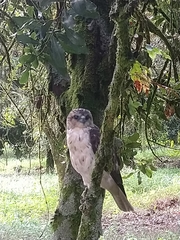
The Hawaiian hawk or ʻio (Buteo solitarius) is a raptor in the genus Buteo endemic to Hawaiʻi, currently restricted to the Big Island. The ʻio is one of two extant birds of prey that are native to Hawaiʻi, the other being the pueo (Hawaiian short-eared owl) and fossil evidence indicates that it inhabited the island of Hawaiʻi, Molokaʻi, Oʻahu, Maui and Kauaʻi at one time. Today, it is known to breed only on the Big Island, in stands of native ʻōhiʻa lehua (Metrosideros polymorpha) trees. The species was protected as an endangered species in the United States, but was delisted in 2020. However, the IUCN classifies the species as Near Threatened. NatureServe considers the species Vulnerable.

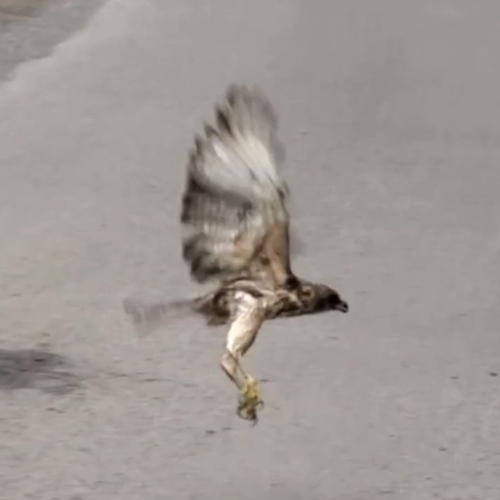
The Hawaiian hawk measures approximately 40 to 46 centimetres (16 to 18 in) in length. The female, which weighs 605 g (21.3 oz) on average, is larger than the male, which averages 441 g (15.6 oz). Two color phases exist: a dark phase (dark brown head, breast, and underwings), and a light color phase (dark head, light breast and light underwings). Feet and legs are yellowish in adults and greenish in juveniles. During breeding season one of the pair, possibly the female, has a distinctive...
Wikipedia →

Global Distribution

Parks Where Found

# Park Country Daily sighting probability
1 Hawaii Volcanoes National Park 🇺🇸 United States
~30%

More parks will be added in future updates.

Zoos & Centres Where Found

# Zoo / Centre Country
1 Zoo and Botanical Garden of Branféré 🇫🇷 France In captivity
2 Louisville Zoo 🇺🇸 United States In captivity
3 Honolulu Zoo 🇺🇸 United States In captivity
4 Pana'ewa Rainforest Zoo 🇺🇸 United States In captivity

Before you go

What are the chances of seeing a Hawaiian Hawk in Hawaii Volcanoes National Park?

Possible

About 30% of wildlife watchers report a Hawaiian Hawk sighting in Hawaii Volcanoes National Park on a given day, based on 317 verified sightings from GBIF citizen-science data from 2019 to 2026. It is the 15th most-seen of the 29 birds we can rate there. Over three days the chance rises to about 70%, and over a week to about 90%, if each day is a fresh chance.

When is the best time to see a Hawaiian Hawk in Hawaii Volcanoes National Park?

April and September

In those months about 40% of wildlife watchers report a Hawaiian Hawk in Hawaii Volcanoes National Park on a given day, against about 30% in May–August and October–March, the lowest months.

What time of day is best to see a Hawaiian Hawk?

Between noon and 3 pm

Across all the parks we cover, that three-hour window holds the most Hawaiian Hawk sightings with a recorded time, and about 9 in 10 of them come between 6 am and 6 pm: it is a daytime animal.

Where else can you see a Hawaiian Hawk?

Only Hawaii Volcanoes National Park, in our data

Hawaii Volcanoes National Park is the only park on Wallace's Line with enough records to rate Hawaiian Hawk sightings: about 30% of wildlife watchers there report one on a given day.

Where does the Hawaiian Hawk sighting chance come from?

GBIF citizen-science records

It is estimated from how often the Hawaiian Hawk is recorded against all the birds logged in Hawaii Volcanoes National Park (317 verified sightings from 2019 to 2026), calibrated against known sighting rates. Figures are rounded to the nearest 10% because citizen-science data supports honest approximations, not decimals, and months with records from fewer than five people show "—". How it works.

← Back to Hawaii Volcanoes National Park