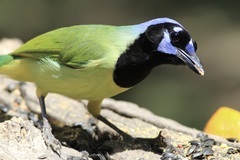
Inca Jay

Inca Jay

Cyanocorax yncas

Silhouette: Sheatherius · PhyloPic

LCLeast ConcernNTVUENCR
Daily sighting probability ~10% · With luck
at Henri Pittier National Park

In 3 days ~30% in a week ~60%

72 Verified sightings at Henri Pittier National Park From 2019 to 2026
1,629 In all 5 parks
June Best month
☀️ Diurnal When it's spotted

About the Inca Jay

The Inca jay (Cyanocorax yncas) is a bird species of the New World jays, which is native to the Andes of South America. It is widely known as querrequerre in Spanish, an onomatopoeic name derived from the bird's call. The Inca jay was described by the French polymath Georges-Louis Leclerc, Comte de Buffon in 1775 in his Histoire Naturelle des Oiseaux. The bird was also illustrated in a hand-colored plate engraved by François-Nicolas Martinet in the Planches Enluminées D'Histoire Naturelle which was produced under the supervision of Edme-Louis Daubenton to accompany Buffon's text. Neither the plate caption nor Buffon's description included a scientific name but in 1783 the Dutch naturalist Pieter Boddaert coined the binomial name Corvus yncas in his catalogue of the Planches Enluminées. Buffon's specimen came from Peru; in 1953 the American ornithologist John Todd Zimmer restricted the type location to Chilpes, Department of Junín. The Inca jay is now one of 17 species placed in the genus Cyanocorax that was introduced by the German zoologist Friedrich Boie in 1826. The name of the genus is from Ancient Greek kuanos "dark-blue" and korakos "raven". The specific epithet... Wikipedia →

Sounds

Alarm call0:17

Colombia · 2025

© Julio Delgado · XC1094123 · CC BY-NC-SA 4.0

Call0:04

Ecuador · 2022

© Paul Bourdin · XC750643 · CC BY-NC-SA 4.0

Song0:37

Colombia · 2020

© A Edwar H Guarín · XC594255 · CC BY-NC-SA 4.0

Global Distribution

Parks Where Found

# Park Country Daily sighting probability
1 Podocarpus National Park 🇪🇨 Ecuador
~30%
2 Los Nevados National Natural Park 🇨🇴 Colombia
~10%
3 Henri Pittier National Park 🇻🇪 Venezuela
~10%
4 Farallones de Cali National Natural Park 🇨🇴 Colombia
~10%
5 Chingaza National Natural Park 🇨🇴 Colombia
<5%

Cities Where Found

# City Country Daily sighting probability
1 Caracas 🇻🇪 Venezuela
<5%
2 Medellín 🇨🇴 Colombia
<5%

Zoos & Centres Where Found

# Zoo / Centre Country
1 Barcelona Zoo 🇪🇸 Spain In captivity
2 North Carolina Zoo 🇺🇸 United States In captivity
3 Walsrode World Bird Park 🇩🇪 Germany In captivity
4 Zoo Miami 🇺🇸 United States In captivity
5 Bronx Zoo 🇺🇸 United States In captivity
6 Parque Zoologico Guátika 🇨🇴 Colombia In captivity
7 San Francisco Zoo 🇺🇸 United States In captivity
8 Faunia 🇪🇸 Spain In captivity
9 Aquarama Barcelona 🇪🇸 Spain In captivity
10 Aviario Nacional de Colombia 🇨🇴 Colombia In captivity
11 Hong Kong Zoological and Botanical Gardens 🇨🇳 China In captivity
12 Parque de la Conservación 🇨🇴 Colombia In captivity
13 Papiliorama 🇨🇭 Switzerland In captivity
14 Bioparc Fuengirola 🇪🇸 Spain In captivity
15 Universeum 🇸🇪 Sweden In captivity
16 Edward Youde Aviary 🇭🇰 Hong Kong SAR China In captivity

Before you go

What are the chances of seeing an Inca Jay in Henri Pittier National Park?

With luck

About 10% of wildlife watchers report an Inca Jay sighting in Henri Pittier National Park on a given day, based on 72 verified sightings from GBIF citizen-science data from 2019 to 2026. It is the 113th most-seen of the 358 birds we can rate there. Over three days the chance rises to about 30%, and over a week to about 60%, if each day is a fresh chance.

When is the best time to see an Inca Jay in Henri Pittier National Park?

June

In that month about 30% of wildlife watchers report an Inca Jay in Henri Pittier National Park on a given day, against under 5% in February, August and October, the lowest months.

What time of day is best to see an Inca Jay?

Between 7 and 10 am

Across all the parks we cover, that three-hour window holds the most Inca Jay sightings with a recorded time, and about 9 in 10 of them come between 6 am and 6 pm: it is a daytime animal.

Is Henri Pittier National Park the best place to see an Inca Jay?

3rd of 5

Of the 5 parks where we can rate Inca Jay sightings, Henri Pittier National Park ranks 3rd at about 10%. The best odds are in Podocarpus National Park (Ecuador, about 30%) and Los Nevados National Natural Park (Colombia, about 10%).

Which relatives of the Inca Jay live in Henri Pittier National Park?

Same order: Passeriformes

The closest relatives of the Inca Jay that you can see in Henri Pittier National Park (order Passeriformes, Perching Birds) are Blue-gray Tanager (about 70%), Bay-headed Tanager (about 50%) and Pale-breasted Thrush (about 50%), with each one's daily chance of a sighting.

Where does the Inca Jay sighting chance come from?

GBIF citizen-science records

It is estimated from how often the Inca Jay is recorded against all the birds logged in Henri Pittier National Park (72 verified sightings from 2019 to 2026), calibrated against known sighting rates. Figures are rounded to the nearest 10% because citizen-science data supports honest approximations, not decimals, and months with records from fewer than five people show "—". How it works.

← Back to Henri Pittier National Park

