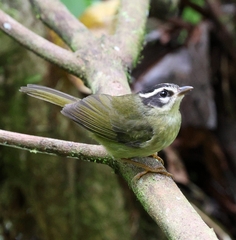
Three-striped Warbler

Three-striped Warbler

Basileuterus tristriatus

Silhouette: Andy Wilson · PhyloPic

LCLeast ConcernNTVUENCR
Daily sighting probability ~10% · With luck
at Henri Pittier National Park

In 3 days ~40% in a week ~70%

95 Verified sightings at Henri Pittier National Park From 2019 to 2026
1,226 In all 5 parks
April Best month
☀️ Diurnal When it's spotted

About the Three-striped Warbler

The three-striped warbler (Basileuterus tristriatus) is a species of bird in the family Parulidae, the New World warblers. It is found in the Andes from Venezuela to Bolivia. The three-striped warbler was formally described in 1844 by the Swiss naturalist Johann Jakob von Tschudi under the binomial Myiodioctes tristriatus. The specific epithet tristriatus is Modern Latin meaning "three-striped" or "three-streaked" from Latin tri- meaning "three-" and "striatus" meaning "striated". The type locality was corrected to Vitoc, Department of Junín, in central Peru by the Austrian ornithologist Carl Eduard Hellmayr in 1935. The three-striped warbler is now one of 12 species placed in the genus Basileuterus that was introduced in 1848 by the German ornithologist Jean Cabanis. The genus name is from Ancient Greek βασιλευτερος/basileuteros meaning "more kingly".

What are now the black-eared warbler (B. melanotis), the Tacarcuna warbler (B. tacarcunae), and the three subspecies of the Yungas warbler (B. punctipectus) were all previously treated as subspecies of the three-striped warbler. They were separated by most taxonomic systems based on studies published in... Wikipedia →

Sounds

Call0:10

Colombia · 2025

© Manuel Sánchez-Nivicela · XC1157589 · CC BY-NC-ND 4.0

Begging call0:55

Ecuador · 2023

© rudy gelis · XC833601 · CC BY-NC-SA 4.0

Duet0:57

Colombia · 2022

© David Monroy Rengifo · XC771600 · CC BY-NC-SA 4.0

Global Distribution

Parks Where Found

# Park Country Daily sighting probability
1 Farallones de Cali National Natural Park 🇨🇴 Colombia
~20%
2 Henri Pittier National Park 🇻🇪 Venezuela
~10%
3 Los Nevados National Natural Park 🇨🇴 Colombia
~10%
4 Podocarpus National Park 🇪🇨 Ecuador
<5%
5 Chingaza National Natural Park 🇨🇴 Colombia
<5%

Cities Where Found

# City Country Daily sighting probability
1 Caracas 🇻🇪 Venezuela
<5%
2 Medellín 🇨🇴 Colombia
<5%

Before you go

What are the chances of seeing a Three-striped Warbler in Henri Pittier National Park?

With luck

About 10% of wildlife watchers report a Three-striped Warbler sighting in Henri Pittier National Park on a given day, based on 95 verified sightings from GBIF citizen-science data from 2019 to 2026. It is the 88th most-seen of the 358 birds we can rate there. Over three days the chance rises to about 40%, and over a week to about 70%, if each day is a fresh chance.

When is the best time to see a Three-striped Warbler in Henri Pittier National Park?

April and August

In those months about 30% of wildlife watchers report a Three-striped Warbler in Henri Pittier National Park on a given day, against about 10% in February–March, June–July and September–November, the lowest months.

What time of day is best to see a Three-striped Warbler?

Between 6 and 9 am

Across all the parks we cover, that three-hour window holds the most Three-striped Warbler sightings with a recorded time, and about 9 in 10 of them come between 6 am and 6 pm: it is a daytime animal.

Is Henri Pittier National Park the best place to see a Three-striped Warbler?

2nd of 5

Of the 5 parks where we can rate Three-striped Warbler sightings, Henri Pittier National Park ranks 2nd at about 10%. The best odds are in Farallones de Cali National Natural Park (Colombia, about 20%).

Where does the Three-striped Warbler sighting chance come from?

GBIF citizen-science records

It is estimated from how often the Three-striped Warbler is recorded against all the birds logged in Henri Pittier National Park (95 verified sightings from 2019 to 2026), calibrated against known sighting rates. Figures are rounded to the nearest 10% because citizen-science data supports honest approximations, not decimals, and months with records from fewer than five people show "—". How it works.

← Back to Henri Pittier National Park