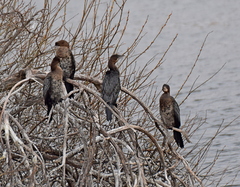
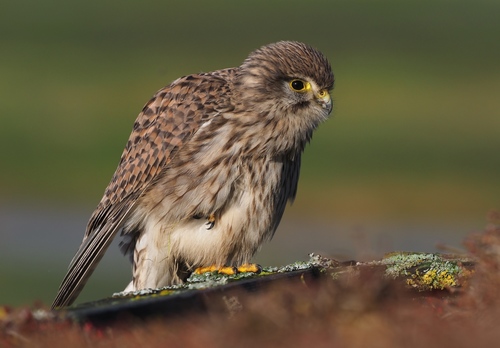
Pygmy Cormorant

Pygmy Cormorant

Microcarbo pygmaeus

Silhouette: L. Shyamal · PhyloPic

LCLeast ConcernNTVUENCR
Daily sighting probability ~60% · Likely
at Hortobágy National Park

In 3 days ~90% in a week >90%

380 Verified sightings at Hortobágy National Park From 2019 to 2026
1,330 In all 4 parks
August Best month
☀️ Diurnal When it's spotted

About the Pygmy Cormorant

The pygmy cormorant (Microcarbo pygmaeus) is a member of the Phalacrocoracidae (cormorant) family of seabirds. It breeds in south-eastern Europe and south-western Asia. It is partially migratory, with northern populations wintering further south, mostly within its breeding range. It is a rare vagrant to western Europe.

The pygmy cormorant occupies an area from the south-east of Europe (east of Italy) and the south-west of temperate Asia, east to Kazakhstan, Tajikistan, Turkmenistan, and Uzbekistan. The largest distribution is in south-east Europe, Albania, Greece, Bulgaria, Romania, the Balkan countries, Turkey, Cyprus, Iran, Iraq (namely the Tigris–Euphrates river system), Azerbaijan, Palestine, Syria.

In Romania, according to studies of Czech ornithologist Robert Ritter von Dombrowski, at the end of the 19th century, the pygmy cormorant was present in large colonies in the Danube Delta, Brăila and Ialomița Pond, on Vederoasa Lake (Constanța County), on certain pools and ponds with reeds and willows in Muntenia. The number of pygmy cormorant pairs was 10,000 without taking in account the breeding population of the Danube Delta. Populations of pygmy cormorant in Romania... Wikipedia →

Sounds

Call0:15

Hungary · 2021

© Michel Veldt · XC770338 · CC BY-NC-SA 4.0

Flight call0:05

Croatia · 2020

© Jarek Matusiak · XC671544 · CC BY-NC-ND 4.0

Begging call0:22

Romania · 2014

© Marco Dragonetti · XC296076 · CC BY-NC-ND 4.0

Global Distribution

Parks Where Found

# Park Country Daily sighting probability
1 Hortobágy National Park 🇭🇺 Hungary
~60%
2 Fertő-Hanság National Park 🇭🇺 Hungary
~40%
3 Kiskunság National Park 🇭🇺 Hungary
~30%
4 Bavarian Forest National Park 🇩🇪 Germany
<5%

Cities Where Found

# City Country Daily sighting probability
1 Bucharest 🇷🇴 Romania
~50%
2 Yerevan 🇦🇲 Armenia
~40%
3 Belgrade 🇷🇸 Serbia
~30%
4 Istanbul 🇹🇷 Turkey
~30%
5 Izmir 🇹🇷 Turkey
~20%
6 Milan 🇮🇹 Italy
~20%
7 Tel Aviv 🇮🇱 Israel
~10%
8 Kyiv 🇺🇦 Ukraine
~10%
9 Almaty 🇰🇿 Kazakhstan
<5%
10 Budapest 🇭🇺 Hungary
<5%

Before you go

What are the chances of seeing a Pygmy Cormorant in Hortobágy National Park?

Likely

About 60% of wildlife watchers report a Pygmy Cormorant sighting in Hortobágy National Park on a given day, based on 380 verified sightings from GBIF citizen-science data from 2019 to 2026. It is the 15th most-seen of the 202 birds we can rate there. Over three days the chance rises to about 90%, and over a week to over 90%, if each day is a fresh chance.

When is the best time to see a Pygmy Cormorant in Hortobágy National Park?

July–August and October

In those months about 70% of wildlife watchers report a Pygmy Cormorant in Hortobágy National Park on a given day, against about 40% in November, the lowest month.

What time of day is best to see a Pygmy Cormorant?

Between 8 and 11 am

Across all the parks we cover, that three-hour window holds the most Pygmy Cormorant sightings with a recorded time, and about 9 in 10 of them come between 6 am and 6 pm: it is a daytime animal.

Is Hortobágy National Park the best place to see a Pygmy Cormorant?

Yes

Of the 4 parks where we can rate Pygmy Cormorant sightings, Hortobágy National Park has the highest daily chance: about 60%. Next come Fertő-Hanság National Park (Hungary, about 40%) and Kiskunság National Park (Hungary, about 30%).

Where does the Pygmy Cormorant sighting chance come from?

GBIF citizen-science records

It is estimated from how often the Pygmy Cormorant is recorded against all the birds logged in Hortobágy National Park (380 verified sightings from 2019 to 2026), calibrated against known sighting rates. Figures are rounded to the nearest 10% because citizen-science data supports honest approximations, not decimals, and months with records from fewer than five people show "—". How it works.

← Back to Hortobágy National Park