Crimson-fronted Barbet

Crimson-fronted Barbet

Psilopogon rubricapillus

Silhouette: Vijay Cavale (photo), John E. McCormack, Michael G. Harvey, Brant C. Faircloth, Nicholas G. Crawford, Travis C. Glenn, Robb T. Brumfield & T. Michael Keesey · PhyloPic

LCLeast ConcernNTVUENCR Endemic
Daily sighting probability <5% · Rare
at Horton Plains National Park

In 3 days <5% in a week ~10%

7 Verified sightings at Horton Plains National Park From 2019 to 2026
860 In all 6 parks
June Best month
🌅 Crepuscular When it's spotted

About the Crimson-fronted Barbet

The crimson-fronted barbet (Psilopogon rubricapillus), also called Sri Lanka barbet, is an Asian barbet endemic to Sri Lanka where it inhabits tropical moist lowland forests up to 1,300 m (4,300 ft) elevation. The crimson-fronted barbet was formally described in 1788 by the German naturalist Johann Friedrich Gmelin in his revised and expanded edition of Carl Linnaeus's Systema Naturae. He placed it with the puffbirds in the genus Bucco and coined the binomial name Bucco rubricapillus. The specific epithet combines the Latin ruber meaning "red" with -caillus meaning "-capped" or "-crowned". Gmelin based his description on the "red-crowned barbet" that had been described and illustrated in 1776 by the English illustrator and naturalist Peter Brown. The crimson-fronted barbet is now one of 33 species placed in the genus Psilopogon that was introduced in 1836 by Salomon Müller. The species is monotypic: no subspecies are recognised.

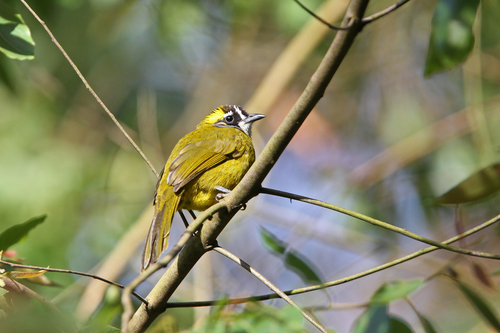
The crimson-fronted barbet has a mainly green plumage and wings, a blue band down the side of the head and neck, and a black crescent behind the eye. It is 15 cm (5.9 in) long with a short neck, large head and short tail. Its... Wikipedia →

Sounds

Song0:15

Sri Lanka · 2022

© Okamoto Keita Sin · XC756597 · CC BY-NC-SA 4.0

Call0:20

Sri Lanka · 2003

© David Farrow · XC19626 · CC BY-NC-SA 3.0

Song0:23

Sri Lanka · 2007

© Jelle Scharringa · XC777853 · CC BY-NC-SA 4.0

Global Distribution

Parks Where Found

# Park Country Daily sighting probability
1 Sinharaja Forest Reserve 🇱🇰 Sri Lanka
~30%
2 Minneriya National Park 🇱🇰 Sri Lanka
~30%
3 Wilpattu National Park 🇱🇰 Sri Lanka
~10%
4 Udawalawe National Park 🇱🇰 Sri Lanka
<5%
5 Yala National Park 🇱🇰 Sri Lanka
<5%
6 Horton Plains National Park 🇱🇰 Sri Lanka
<5%

Cities Where Found

# City Country Daily sighting probability
1 Colombo [Sri Jayawardenepura Kotte] 🇱🇰 Sri Lanka
~30%

Before you go

What are the chances of seeing a Crimson-fronted Barbet in Horton Plains National Park?

Rare

Under 5% of wildlife watchers report a Crimson-fronted Barbet sighting in Horton Plains National Park on a given day, based on 7 verified sightings from GBIF citizen-science data from 2019 to 2026. It is the 95th most-seen of the 102 birds we can rate there. Over three days the chance rises to under 5%, and over a week to about 10%, if each day is a fresh chance.

When is the best time to see a Crimson-fronted Barbet in Horton Plains National Park?

June

In that month about 20% of wildlife watchers report a Crimson-fronted Barbet in Horton Plains National Park on a given day, against under 5% in July to May, the lowest months.

What time of day is best to see a Crimson-fronted Barbet?

Between 11 am and 2 pm

Across all the parks we cover, that three-hour window holds the most Crimson-fronted Barbet sightings with a recorded time, and about 6 in 10 of them come between 6 am and 6 pm: it is most active around dawn and dusk.

Is Horton Plains National Park the best place to see a Crimson-fronted Barbet?

6th of 6

Of the 6 parks where we can rate Crimson-fronted Barbet sightings, Horton Plains National Park ranks 6th at under 5%. The best odds are in Sinharaja Forest Reserve (Sri Lanka, about 30%), Minneriya National Park (Sri Lanka, about 30%) and Wilpattu National Park (Sri Lanka, about 10%).

Where does the Crimson-fronted Barbet sighting chance come from?

GBIF citizen-science records

It is estimated from how often the Crimson-fronted Barbet is recorded against all the birds logged in Horton Plains National Park (7 verified sightings from 2019 to 2026), calibrated against known sighting rates. Figures are rounded to the nearest 10% because citizen-science data supports honest approximations, not decimals, and months with records from fewer than five people show "—". How it works.

← Back to Horton Plains National Park