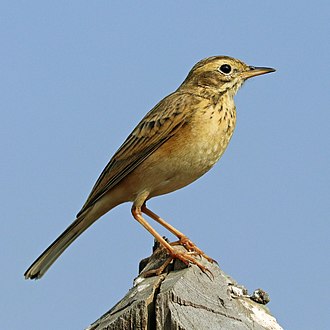
Southern Hill Myna

Southern Hill Myna

Gracula indica

Silhouette: Rafael Maia · PhyloPic

LCLeast ConcernNTVUENCR
Daily sighting probability <5% · Rare
at Horton Plains National Park

In 3 days ~10%

10 Verified sightings at Horton Plains National Park From 2019 to 2026
6,055 In all 8 parks
June Best month
🌅 Crepuscular When it's spotted

About the Southern Hill Myna

The southern hill myna (Gracula indica) is a member of the starling family. It is a resident of the forested regions of south India and Sri Lanka. This species moves around in flocks in the forest, and members of a flock keep in contact with a wide range of vocalizations.

The French word for the bird mainate is probably derived from the Indo-Portuguese mainato, from the name of a songbird living near water, and is probably a metaphor since it refers to a man whose job is to wash the clothes of others.

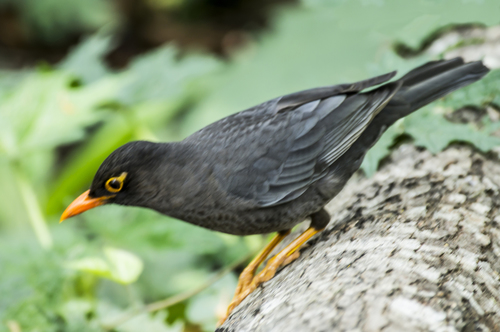
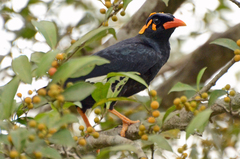
The southern hill myna has a shiny black plumage. It generally measures about twenty centimeters. It can live between 15 and 30 years. The legs are yellow, the beak is bright orange at the base and yellow at the tip. It has white spots on the primary remiges. Like other species of hill myna, the southern hill myna has yellow wattles on the head.

The southern hill myna is present in southwestern India and Sri Lanka. It inhabits tropical and subtropical dry broadleaf forests, mountains, mangrove forests and plantation areas. It is usually found high in the canopy, moving in large noisy groups of about half a dozen, in treetops... Wikipedia →

Sounds

Call0:26

India · 2023

© JISHNU KIZHAKKILLAM · XC783988 · CC BY-NC-SA 4.0

Uncertain0:34

India · 2021

© Vijay Ramesh · XC615784 · CC BY-NC-SA 4.0

Song1:02

India · 2020

© Prakash G · XC564482 · CC BY-NC-SA 4.0

Global Distribution

Parks Where Found

# Park Country Daily sighting probability
1 Periyar National Park 🇮🇳 India
~70%
2 Nagarhole National Park 🇮🇳 India
~40%
3 Bandipur National Park 🇮🇳 India
~10%
4 Sinharaja Forest Reserve 🇱🇰 Sri Lanka
~10%
5 Eravikulam National Park 🇮🇳 India
~10%
6 Mudumalai National Park 🇮🇳 India
~10%
7 Horton Plains National Park 🇱🇰 Sri Lanka
<5%
8 Yala National Park 🇱🇰 Sri Lanka
<5%

Cities Where Found

# City Country Daily sighting probability
1 Thrissur 🇮🇳 India
~10%
2 Colombo [Sri Jayawardenepura Kotte] 🇱🇰 Sri Lanka
<5%

Zoos & Centres Where Found

# Zoo / Centre Country
1 Bird Paradise 🇸🇬 Singapore In captivity
2 Rainforest Wild Asia 🇸🇬 Singapore In captivity
3 Waddesdon Aviary 🇬🇧 United Kingdom In captivity

Before you go

What are the chances of seeing a Southern Hill Myna in Horton Plains National Park?

Rare

Under 5% of wildlife watchers report a Southern Hill Myna sighting in Horton Plains National Park on a given day, based on 10 verified sightings from GBIF citizen-science data from 2019 to 2026. It is the 85th most-seen of the 102 birds we can rate there. Over three days the chance rises to about 10%, if each day is a fresh chance.

When is the best time to see a Southern Hill Myna in Horton Plains National Park?

June

In that month about 10% of wildlife watchers report a Southern Hill Myna in Horton Plains National Park on a given day, against under 5% in July to May, the lowest months.

What time of day is best to see a Southern Hill Myna?

Between 3 and 6 am

Across all the parks we cover, that three-hour window holds the most Southern Hill Myna sightings with a recorded time, and about half of them come between 6 am and 6 pm: it is most active around dawn and dusk.

Is Horton Plains National Park the best place to see a Southern Hill Myna?

7th of 8

Of the 8 parks where we can rate Southern Hill Myna sightings, Horton Plains National Park ranks 7th at under 5%. The best odds are in Periyar National Park (India, about 70%), Nagarhole National Park (India, about 40%) and Bandipur National Park (India, about 10%).

Where does the Southern Hill Myna sighting chance come from?

GBIF citizen-science records

It is estimated from how often the Southern Hill Myna is recorded against all the birds logged in Horton Plains National Park (10 verified sightings from 2019 to 2026), calibrated against known sighting rates. Figures are rounded to the nearest 10% because citizen-science data supports honest approximations, not decimals, and months with records from fewer than five people show "—". How it works.

← Back to Horton Plains National Park