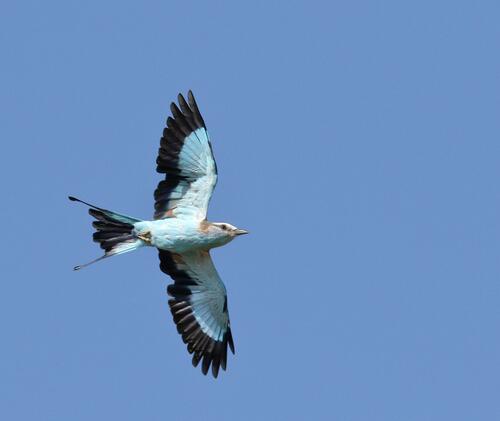
Southern Carmine Bee-eater

Southern Carmine Bee-eater

Merops nubicoides

Silhouette: Sheatherius · PhyloPic

LCLeast ConcernNTVUENCR
Daily sighting probability ~20% · Possible
at Hwange National Park

In 3 days ~50% in a week ~80%

121 Verified sightings at Hwange National Park From 2019 to 2026
2,787 In all 13 parks
January Best month
☀️ Diurnal When it's spotted

About the Southern Carmine Bee-eater

The southern carmine bee-eater (Merops nubicoides) is a species of bee-eater found across sub-equatorial Africa. It was formerly considered conspecific with the closely related northern carmine bee-eater, with the combined species then known as carmine bee-eater.

This species, like other bee-eaters, is richly coloured and is predominantly carmine in colouration, but the crown and undertail are blue. The southern carmine bee-eater occurs from KwaZulu-Natal and Namibia to Gabon, the eastern Democratic Republic of the Congo and Kenya. The bee-eater is a migratory species, spending the breeding season, between August and November, in Zimbabwe and Zambia, before moving as far south as South Africa for the summer months, and then migrating to Equatorial Africa from March to August.

Their diet is made up primarily of bees and other flying insects, and their major hunting strategy involves hawking flying insects from perch. Perches may include branches of vegetation or even the backs of large animals, such as the kori bustard. They are attracted to wildfires because of the flushed insects, and are often seen circling high in... Wikipedia →

Sounds

Song0:10

South Africa · 2023

© Albert Lastukhin · XC895528 · CC BY-NC-ND 4.0

Flight call0:15

Zambia · 2022

© Dries Van de Loock · XC758588 · CC BY-NC-ND 4.0

Call0:33

Zambia · 2017

© Peter Boesman · XC398129 · CC BY-NC-ND 4.0

Global Distribution

Parks Where Found

# Park Country Daily sighting probability
1 Mana Pools National Park 🇿🇼 Zimbabwe
~40%
2 Lower Zambezi National Park 🇿🇲 Zambia
~30%
3 South Luangwa National Park 🇿🇲 Zambia
~30%
4 Chobe National Park 🇧🇼 Botswana
~20%
5 Moremi Game Reserve 🇧🇼 Botswana
~20%
6 Hwange National Park 🇿🇼 Zimbabwe
~20%
7 Gonarezhou National Park 🇿🇼 Zimbabwe
~20%
8 Gorongosa National Park 🇲🇿 Mozambique
~20%
9 Kruger National Park 🇿🇦 South Africa
~10%
10 Liwonde National Park 🇲🇼 Malawi
~10%
11 Kafue National Park 🇿🇲 Zambia
<5%
12 Murchison Falls National Park 🇺🇬 Uganda
<5%
13 Akagera National Park 🇷🇼 Rwanda
<5%

Before you go

What are the chances of seeing a Southern Carmine Bee-eater in Hwange National Park?

Possible

About 20% of wildlife watchers report a Southern Carmine Bee-eater sighting in Hwange National Park on a given day, based on 121 verified sightings from GBIF citizen-science data from 2019 to 2026. It is the 65th most-seen of the 308 birds we can rate there. Over three days the chance rises to about 50%, and over a week to about 80%, if each day is a fresh chance.

When is the best time to see a Southern Carmine Bee-eater in Hwange National Park?

January

In that month about 80% of wildlife watchers report a Southern Carmine Bee-eater in Hwange National Park on a given day, against under 5% in May–June and August, the lowest months. That is one of Hwange National Park's wettest months, with about 150 mm of rain against almost none in July.

What time of day is best to see a Southern Carmine Bee-eater?

Between 7 and 10 am

Across all the parks we cover, that three-hour window holds the most Southern Carmine Bee-eater sightings with a recorded time, and about 9 in 10 of them come between 6 am and 6 pm: it is a daytime animal.

Which relatives of the Southern Carmine Bee-eater live in Hwange National Park?

Same genus: Merops

The closest relatives of the Southern Carmine Bee-eater that you can see in Hwange National Park (genus Merops, Typical Bee-eaters) are Swallow-tailed Bee-eater (about 30%), Little Bee-eater (about 20%) and European Bee-eater (about 20%), with each one's daily chance of a sighting.

Where does the Southern Carmine Bee-eater sighting chance come from?

GBIF citizen-science records

It is estimated from how often the Southern Carmine Bee-eater is recorded against all the birds logged in Hwange National Park (121 verified sightings from 2019 to 2026), calibrated against known sighting rates. Figures are rounded to the nearest 10% because citizen-science data supports honest approximations, not decimals, and months with records from fewer than five people show "—". How it works.

← Back to Hwange National Park