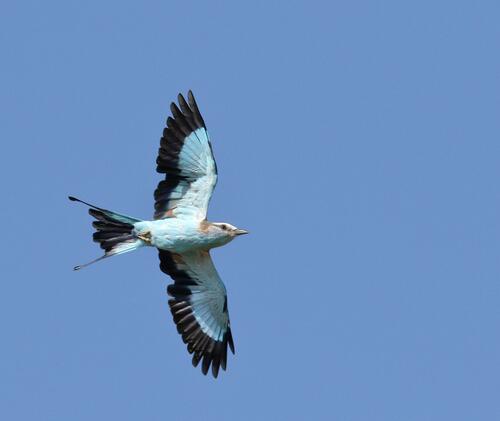
Little Bee-eater

Little Bee-eater

Merops pusillus

Silhouette: Sheatherius · PhyloPic

LCLeast ConcernNTVUENCR
Daily sighting probability ~20% · Possible
at Hwange National Park

In 3 days ~60% in a week ~90%

110 Verified sightings at Hwange National Park From 2019 to 2026
15,061 In all 43 parks
June Best month
☀️ Diurnal When it's spotted

About the Little Bee-eater

The little bee-eater (Merops pusillus) is a bird species in the bee-eater family, Meropidae. They are found in Sub-Saharan Africa. They should not be confused with the little green bee-eater (Merops orientalis). Migration is limited to seasonal movements depending on rainfall patterns. They inhabit various biomes, such as savanna, bushveld, and even marsh-like areas.

Members of this species, like other bee-eaters, are rich and brightly coloured slender birds. They have green upper parts, yellow throats, black gorgets, and rich brown upper breasts fading to buffish ochre on the belly. Their wings are green and brown. Their beaks and legs are black. Tail is square in shape with a slight fork or v-shape at the end. They reach a length of 15–17 cm, which makes them the smallest African bee-eater. Sexes are alike. Often silent, their call is a soft "seep". They are often hard to spot since their green backs and wings act as camouflage.

These are abundant and tame birds, familiar throughout their range. There have been estimated to be between 60 and 80 million little bee-eaters. They breed in open country with bushes, preferably near water. Just as the name... Wikipedia →

Sounds

Call0:34

South Africa · 2021

© Tony Archer · XC651027 · CC BY-NC-SA 4.0

Song1:01

Zimbabwe · 2019

© Meena Haribal · XC613389 · CC BY-NC-SA 4.0

Call0:46

Gambia · 2018

© Peter Boesman · XC425655 · CC BY-NC-ND 4.0

Global Distribution

Parks Where Found

# Park Country Daily sighting probability
1 Liwonde National Park 🇲🇼 Malawi
~80%
2 South Luangwa National Park 🇿🇲 Zambia
~70%
3 Arusha National Park 🇹🇿 Tanzania
~60%
4 Ruaha National Park 🇹🇿 Tanzania
~60%
5 Lower Zambezi National Park 🇿🇲 Zambia
~60%
6 Nairobi National Park 🇰🇪 Kenya
~60%
7 Lake Mburo National Park 🇺🇬 Uganda
~60%
8 Mana Pools National Park 🇿🇼 Zimbabwe
~60%
9 Samburu National Reserve 🇰🇪 Kenya
~50%
10 Moremi Game Reserve 🇧🇼 Botswana
~50%
11 Mkomazi National Park 🇹🇿 Tanzania
~40%
12 Selous Game Reserve 🇹🇿 Tanzania
~40%
13 Niokolo-Koba National Park 🇸🇳 Senegal
~40%
14 Masai Mara National Reserve 🇰🇪 Kenya
~40%
15 Lake Manyara National Park 🇹🇿 Tanzania
~40%
16 Mikumi National Park 🇹🇿 Tanzania
~40%
17 Chobe National Park 🇧🇼 Botswana
~40%
18 Serengeti National Park 🇹🇿 Tanzania
~40%
19 uMkhuze Game Reserve 🇿🇦 South Africa
~40%
20 Awash National Park 🇪🇹 Ethiopia
~40%
21 Kafue National Park 🇿🇲 Zambia
~40%
22 Tarangire National Park 🇹🇿 Tanzania
~40%
23 Hluhluwe-Imfolozi Park 🇿🇦 South Africa
~30%
24 Gonarezhou National Park 🇿🇼 Zimbabwe
~30%
25 Tsavo West National Park 🇰🇪 Kenya
~30%
26 Amboseli National Park 🇰🇪 Kenya
~30%
27 Queen Elizabeth National Park 🇺🇬 Uganda
~30%
28 Akagera National Park 🇷🇼 Rwanda
~30%
29 Kidepo Valley National Park 🇺🇬 Uganda
~30%
30 Gorongosa National Park 🇲🇿 Mozambique
~20%
31 Hwange National Park 🇿🇼 Zimbabwe
~20%
32 Meru National Park 🇰🇪 Kenya
~20%
33 Murchison Falls National Park 🇺🇬 Uganda
~20%
34 Ngorongoro Conservation Area 🇹🇿 Tanzania
~20%
35 iSimangaliso Wetland Park 🇿🇦 South Africa
~20%
36 Kruger National Park 🇿🇦 South Africa
~20%
37 Tsavo East National Park 🇰🇪 Kenya
~20%
38 Virunga National Park 🇨🇩 Democratic Republic of the Congo
~10%
39 Pilanesberg National Park 🇿🇦 South Africa
~10%
40 Lake Nakuru National Park 🇰🇪 Kenya
<5%
41 Kibale National Park 🇺🇬 Uganda
<5%
42 Bwindi Impenetrable National Park 🇺🇬 Uganda
<5%
43 Nyungwe National Park 🇷🇼 Rwanda
<5%

Cities Where Found

# City Country Daily sighting probability
1 Brazzaville 🇨🇬 Republic of the Congo
~60%
2 Dar es-Salaam 🇹🇿 Tanzania
~50%
3 Yaoundé 🇨🇲 Cameroon
~50%
4 Serrekunda 🇬🇲 Gambia
~30%
5 Dakar 🇸🇳 Senegal
~30%
6 N'Djamena 🇹🇩 Chad
~30%
7 Luanda 🇦🇴 Angola
~30%
8 Kigali 🇷🇼 Rwanda
~20%
9 Bujumbura 🇧🇮 Burundi
~20%
10 Durban 🇿🇦 South Africa
~20%

Before you go

What are the chances of seeing a Little Bee-eater in Hwange National Park?

Possible

About 20% of wildlife watchers report a Little Bee-eater sighting in Hwange National Park on a given day, based on 110 verified sightings from GBIF citizen-science data from 2019 to 2026. It is the 52nd most-seen of the 308 birds we can rate there. Over three days the chance rises to about 60%, and over a week to about 90%, if each day is a fresh chance.

When is the best time to see a Little Bee-eater in Hwange National Park?

June and December–February

In those months about 30% of wildlife watchers report a Little Bee-eater in Hwange National Park on a given day, against about 10% in April, the lowest month. Those are among Hwange National Park's wettest months, with about 100 mm of rain a month against almost none in July.

What time of day is best to see a Little Bee-eater?

Between 8 and 11 am

Across all the parks we cover, that three-hour window holds the most Little Bee-eater sightings with a recorded time, and about 9 in 10 of them come between 6 am and 6 pm: it is a daytime animal.

Where does the Little Bee-eater sighting chance come from?

GBIF citizen-science records

It is estimated from how often the Little Bee-eater is recorded against all the birds logged in Hwange National Park (110 verified sightings from 2019 to 2026), calibrated against known sighting rates. Figures are rounded to the nearest 10% because citizen-science data supports honest approximations, not decimals, and months with records from fewer than five people show "—". How it works.

← Back to Hwange National Park