Forest Flame Snake

Forest Flame Snake

Oxyrhopus petolarius

Silhouette: Beth Reinke · PhyloPic

LCLeast ConcernNTVUENCR
Daily sighting probability ~10% · With luck
at Iguazú National Park

In 3 days ~20% in a week ~40%

5 Verified sightings at Iguazú National Park From 2019 to 2026
92 In all 7 parks
October Best month
☀️🌙 Day & Night When it's spotted

About the Forest Flame Snake

Oxyrhopus petolarius, commonly known as the forest flame snake, is a species of mildly venomous snake in the subfamily Dipsadinae of the family Colubridae. The species is native to Central and South America. There are three recognized subspecies.

According to American herpetologist Jay M. Savage (2011) the correct scientific name should be Oxyrhopus petolarius. Oxyrhopus petolarius is found in central and northern South America, including Trinidad and Tobago. The preferred natural habitats of Oxyrhopus petolarius are forest and savanna, at altitudes from sea level to 2,000 m (6,600 ft).

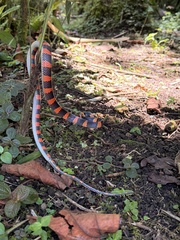
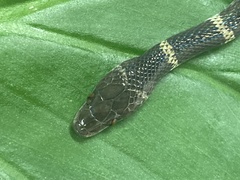
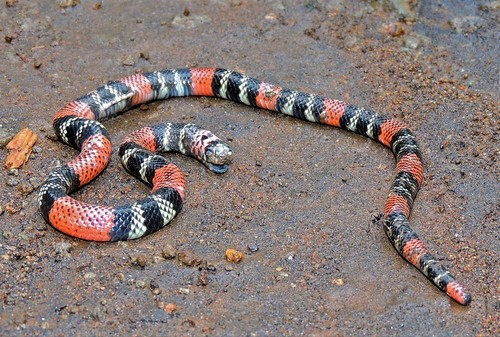
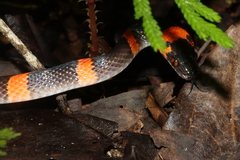
Adults of Oxyrhopus petolarius may attain a total length of 91 cm (36 in), which includes a tail 22 cm (8.7 in) long. Coloration is variable. It usually consists of some combination of red and black rings or crossbands. In some individuals the light-colored crossbands are white instead of red on the anterior part of the body.

The dorsal scales are smooth, with apical pits, and are arranged in 19 rows at midbody. Oxyrhopus petolarius is rear-fanged, and its venom is extremely toxic to anole lizards. ��2... Wikipedia →

Global Distribution

Parks Where Found

# Park Country Daily sighting probability
1 Tenorio Volcano National Park 🇨🇷 Costa Rica
~20%
2 Manu National Park 🇵🇪 Peru
~10%
3 Tambopata National Reserve 🇵🇪 Peru
~10%
4 Farallones de Cali National Natural Park 🇨🇴 Colombia
~10%
5 Arenal Volcano National Park 🇨🇷 Costa Rica
~10%
6 Braulio Carrillo National Park 🇨🇷 Costa Rica
~10%
7 Iguazú National Park 🇦🇷 Argentina
~10%

Zoos & Centres Where Found

# Zoo / Centre Country
1 Park Of İstanbul - Hayvanat Bahçesi, Mesire Alanı, Rehabilitasyon Merkezi, Kır Düğünü 🇹🇷 Türkiye In captivity

Before you go

What are the chances of seeing a Forest Flame Snake in Iguazú National Park?

With luck

About 10% of wildlife watchers report a Forest Flame Snake sighting in Iguazú National Park on a given day, based on 5 verified sightings from GBIF citizen-science data from 2019 to 2026. It is the 17th most-seen of the 18 reptiles we can rate there. Over three days the chance rises to about 20%, and over a week to about 40%, if each day is a fresh chance.

When is the best time to see a Forest Flame Snake in Iguazú National Park?

October

In that month about 20% of wildlife watchers report a Forest Flame Snake in Iguazú National Park on a given day, against under 5% in April–May, July–August and November–February, the lowest months. That is one of Iguazú National Park's wettest months, with about 240 mm of rain against 90 mm in August.

What time of day is best to see a Forest Flame Snake?

Between 7 and 10 pm

Across all the parks we cover, that three-hour window holds the most Forest Flame Snake sightings with a recorded time, and about half of them come between 6 pm and 6 am: it is seen both by day and at night.

Where does the Forest Flame Snake sighting chance come from?

GBIF citizen-science records

It is estimated from how often the Forest Flame Snake is recorded against all the reptiles logged in Iguazú National Park (5 verified sightings from 2019 to 2026), calibrated against known sighting rates. Figures are rounded to the nearest 10% because citizen-science data supports honest approximations, not decimals, and months with records from fewer than five people show "—". How it works.

← Back to Iguazú National Park