Black-capped Flycatcher

Black-capped Flycatcher

Empidonax atriceps

Silhouette: Emily Willoughby · PhyloPic

LCLeast ConcernNTVUENCR
Daily sighting probability ~50% · Likely
at Irazú Volcano National Park

In 3 days ~90% in a week >90%

376 Verified sightings at Irazú Volcano National Park From 2019 to 2026
7,407 In all 8 parks
November Best month
☀️ Diurnal When it's spotted

About the Black-capped Flycatcher

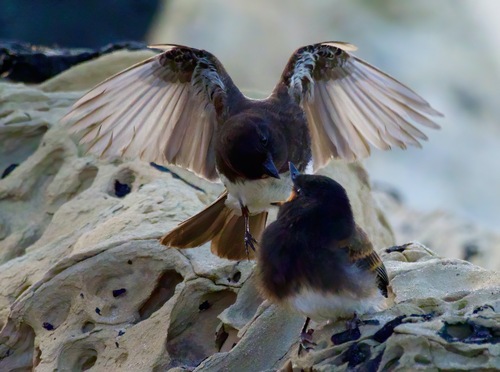
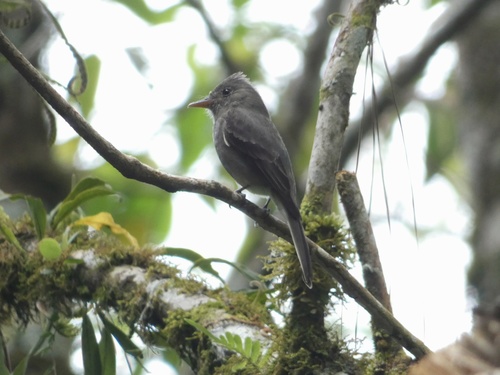
The black-capped flycatcher (Empidonax atriceps) is a very small passerine bird in the family Tyrannidae, the tyrant flycatchers. It is found in Costa Rica and Panama. The black-capped flycatcher is monotypic. The black-capped flycatcher is 10 to 12 cm (3.9 to 4.7 in) long and weighs about 9 g (0.32 oz). The sexes are alike. Adults have a black crown with a short crest and a bold white eye-ring that is wider behind the eye on an otherwise brownish olive face. These features by themselves set it apart from all other Empidonax. Their nape and upperparts are also brownish olive. Their tail is dusky with white outer webs on the outer feathers. Their wings are dusky with pale brown edges on the secondaries and tertials. The wing coverts are dusky with pale brown tips that show as two wing bars. Their throat is white and their breast and belly pale buffish cinnamon. They have a dark iris, a black maxilla, an orange-yellow mandible with a dark tip, and blackish legs and feet. Juveniles have a slightly duller black cap than adults with browner upperparts, buffy edges and tips on the wing feathers, and a paler belly. Wikipedia →

Sounds

Song0:05

Costa Rica · 2010

© Peter Boesman · XC274693 · CC BY-NC-ND 4.0

Call0:09

Costa Rica · 2011

© Andrew Spencer · XC72344 · CC BY-NC-ND 2.5

Dawn song1:01

Costa Rica · 1992

© Allen T. Chartier · XC8907 · CC BY-NC-SA 3.0

Global Distribution

Parks Where Found

# Park Country Daily sighting probability
1 Irazú Volcano National Park 🇨🇷 Costa Rica
~50%
2 Los Quetzales National Park 🇨🇷 Costa Rica
~30%
3 Tapantí-Macizo de la Muerte National Park 🇨🇷 Costa Rica
~30%
4 Volcán Barú National Park 🇵🇦 Panama
~10%
5 Poás Volcano National Park 🇨🇷 Costa Rica
<5%
6 Chirripó National Park 🇨🇷 Costa Rica
<5%
7 Braulio Carrillo National Park 🇨🇷 Costa Rica
<5%
8 La Amistad International Park (Panama) 🇵🇦 Panama
<5%

Cities Where Found

# City Country Daily sighting probability
1 San José 🇨🇷 Costa Rica
<5%

Before you go

What are the chances of seeing a Black-capped Flycatcher in Irazú Volcano National Park?

Likely

About 50% of wildlife watchers report a Black-capped Flycatcher sighting in Irazú Volcano National Park on a given day, based on 376 verified sightings from GBIF citizen-science data from 2019 to 2026. It is the 17th most-seen of the 121 birds we can rate there. Over three days the chance rises to about 90%, and over a week to over 90%, if each day is a fresh chance.

When is the best time to see a Black-capped Flycatcher in Irazú Volcano National Park?

November

In that month about 70% of wildlife watchers report a Black-capped Flycatcher in Irazú Volcano National Park on a given day, against about 30% in February, the lowest month. That is one of Irazú Volcano National Park's wettest months, with about 500 mm of rain against 140 mm in March.

What time of day is best to see a Black-capped Flycatcher?

Between 10 am and 1 pm

Across all the parks we cover, that three-hour window holds the most Black-capped Flycatcher sightings with a recorded time, and about 9 in 10 of them come between 6 am and 6 pm: it is a daytime animal.

Is Irazú Volcano National Park the best place to see a Black-capped Flycatcher?

Yes

Of the 8 parks where we can rate Black-capped Flycatcher sightings, Irazú Volcano National Park has the highest daily chance: about 50%. Next come Los Quetzales National Park (Costa Rica, about 30%) and Tapantí-Macizo de la Muerte National Park (Costa Rica, about 30%).

Where does the Black-capped Flycatcher sighting chance come from?

GBIF citizen-science records

It is estimated from how often the Black-capped Flycatcher is recorded against all the birds logged in Irazú Volcano National Park (376 verified sightings from 2019 to 2026), calibrated against known sighting rates. Figures are rounded to the nearest 10% because citizen-science data supports honest approximations, not decimals, and months with records from fewer than five people show "—". How it works.

← Back to Irazú Volcano National Park