Mesoamerican Bumble Bee

Mesoamerican Bumble Bee

Bombus ephippiatus

Daily sighting probability ~70% · Very likely
at Irazú Volcano National Park

In 3 days >90%

42 Verified sightings at Irazú Volcano National Park From 2019 to 2026
545 In all 9 parks
November Best month
☀️ Diurnal When it's spotted

About the Mesoamerican Bumble Bee

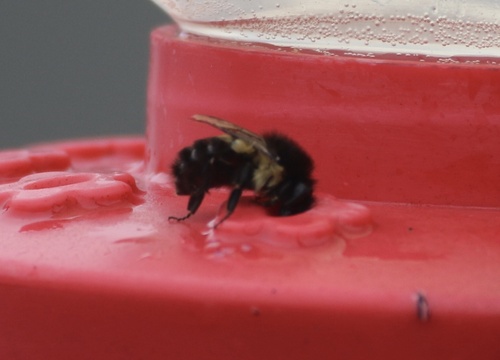
Bombus ephippiatus is a species of bumblebee native to Mexico and Central America. This is a variable species. There are a number of color polymorphisms, with body hairs in shades of white, yellow, orange, red, brown, and black. Its species boundaries are not entirely clear. Some forms are similar to Bombus wilmattae, which may actually be the same species. There may also be some similar specimens in the area that are an as yet undescribed species.

This bee feeds on many kinds of flowers. It is active year-round in some areas. It generally occupies pine-oak forest and other kinds of mountain forest habitat. Its restriction to high-elevation regions may have produced physical isolation that led to its many color polymorphisms.

It is an efficient pollinator of tomato plants. The overcollection of queens from the wild for use in agricultural operations is a potential threat to the species. Wikipedia →
Global Distribution

Parks Where Found

# Park Country Daily sighting probability
1 Irazú Volcano National Park 🇨🇷 Costa Rica
~70%
2 Reserva de la Biosfera Mariposa Monarca 🇲🇽 Mexico
~50%
3 Los Quetzales National Park 🇨🇷 Costa Rica
~40%
4 Tapantí-Macizo de la Muerte National Park 🇨🇷 Costa Rica
~30%
5 Volcán Barú National Park 🇵🇦 Panama
~30%
6 Poás Volcano National Park 🇨🇷 Costa Rica
~30%
7 Chirripó National Park 🇨🇷 Costa Rica
~10%
8 La Amistad International Park (Panama) 🇵🇦 Panama
~10%
9 Braulio Carrillo National Park 🇨🇷 Costa Rica
~10%

Cities Where Found

# City Country Daily sighting probability
1 Toluca 🇲🇽 México
~20%
2 Mexico City 🇲🇽 México
~10%

Closest Relatives at Irazú Volcano National Park

No species of the same family or order lives in Irazú Volcano National Park, so these are its closest relatives here: other insects.

Before you go

What are the chances of seeing a Mesoamerican Bumble Bee in Irazú Volcano National Park?

Very likely

About 70% of wildlife watchers report a Mesoamerican Bumble Bee sighting in Irazú Volcano National Park on a given day, based on 42 verified sightings from GBIF citizen-science data from 2019 to 2026. Over three days the chance rises to over 90%, if each day is a fresh chance.

When is the best time to see a Mesoamerican Bumble Bee in Irazú Volcano National Park?

January, April–May, July and November

In those months about 80% of wildlife watchers report a Mesoamerican Bumble Bee in Irazú Volcano National Park on a given day, against about 10% in October, the lowest month.

What time of day is best to see a Mesoamerican Bumble Bee?

Between 9 am and noon

Across all the parks we cover, that three-hour window holds the most Mesoamerican Bumble Bee sightings with a recorded time, and about 9 in 10 of them come between 6 am and 6 pm: it is a daytime animal.

Where does the Mesoamerican Bumble Bee sighting chance come from?

GBIF citizen-science records

It is estimated from how often the Mesoamerican Bumble Bee is recorded against all the insects logged in Irazú Volcano National Park (42 verified sightings from 2019 to 2026), calibrated against known sighting rates. Figures are rounded to the nearest 10% because citizen-science data supports honest approximations, not decimals, and months with records from fewer than five people show "—". How it works.

← Back to Irazú Volcano National Park