African Cuckoo-Hawk

African Cuckoo-Hawk

Aviceda cuculoides

Silhouette: Sheatherius · PhyloPic

LCLeast ConcernNTVUENCR
Daily sighting probability ~10% · With luck
at iSimangaliso Wetland Park

In 3 days ~20% in a week ~40%

155 Verified sightings at iSimangaliso Wetland Park From 2019 to 2026
362 In all 17 parks
November Best month
☀️ Diurnal When it's spotted

About the African Cuckoo-Hawk

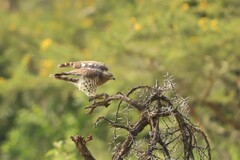
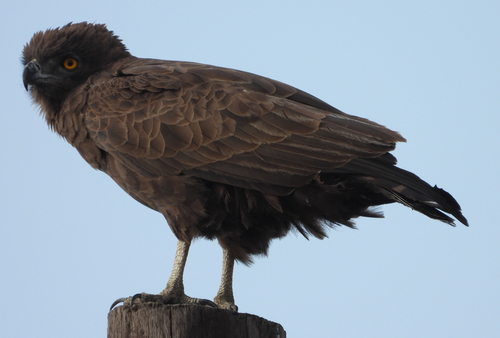
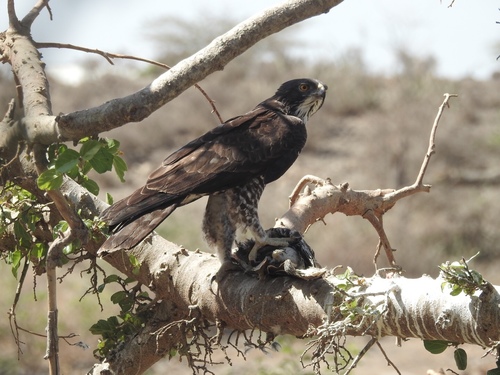
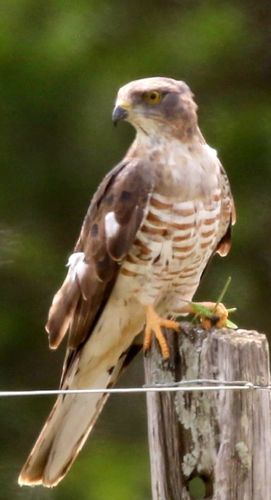
The African cuckoo-hawk, or African baza (Aviceda cuculoides), is a medium-sized raptor in the family Accipitridae so named because it resembles the common cuckoo. It is found in sub-Saharan Africa and along the eastern parts of Southern Africa, preferring dense woodland and forest of either indigenous or exotic trees.

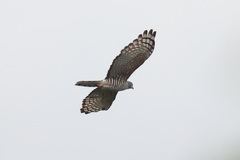
The African cuckoo-hawk weighs 220–296 grams (0.48–0.65 lb) and has a wingspan of 91 cm (35 inches). The male is blackish-brown above with a grey mantle and chest with a blackish crest, the underparts are white marked with broad chestnut bars. The tail is black with three grey bars and grey and white tip. The females are browner with paler chestnut bars on the underparts. Distinctive in flight as a small raptor with a small head with broad, narrowly rounded wings and a medium length tail. Wingspan is just over double the body length, females are slightly larger than males.

The African cuckoo-hawk is found across much of sub-Saharan Africa, and the following subspecies are recognised: A. c. subsp. cuculoides – Senegal to southwestern Ethiopia and northern DRC A. c. subsp. batesi – Sierra Leone to Uganda and northern... Wikipedia →

Sounds

Call0:28

Ghana · 2023

© Alain Verneau · XC788596 · CC BY-NC-SA 4.0

Call0:42

Ghana · 2022

© Peter Boesman · XC718866 · CC BY-NC-ND 4.0

Call0:09

Tanzania · 2012

© David C. Moyer · XC96409 · CC BY-NC-ND 2.5

Global Distribution

Parks Where Found

# Park Country Daily sighting probability
1 Odzala-Kokoua National Park 🇨🇬 Republic of the Congo
~20%
2 Meru National Park 🇰🇪 Kenya
~10%
3 iSimangaliso Wetland Park 🇿🇦 South Africa
~10%
4 Liwonde National Park 🇲🇼 Malawi
<5%
5 Ruaha National Park 🇹🇿 Tanzania
<5%
6 uMkhuze Game Reserve 🇿🇦 South Africa
<5%
7 Aberdare National Park 🇰🇪 Kenya
<5%
8 Mana Pools National Park 🇿🇼 Zimbabwe
<5%
9 Lake Nakuru National Park 🇰🇪 Kenya
<5%
10 Murchison Falls National Park 🇺🇬 Uganda
<5%
11 Garden Route National Park 🇿🇦 South Africa
<5%
12 Queen Elizabeth National Park 🇺🇬 Uganda
<5%
13 Akagera National Park 🇷🇼 Rwanda
<5%
14 Lake Mburo National Park 🇺🇬 Uganda
<5%
15 Kruger National Park 🇿🇦 South Africa
<5%
16 Serengeti National Park 🇹🇿 Tanzania
<5%
17 Ngorongoro Conservation Area 🇹🇿 Tanzania
<5%

Cities Where Found

# City Country Daily sighting probability
1 Accra 🇬🇭 Ghana
<5%
2 Kampala 🇺🇬 Uganda
<5%
3 Harare 🇿🇼 Zimbabwe
<5%

Before you go

What are the chances of seeing an African Cuckoo-Hawk in iSimangaliso Wetland Park?

With luck

About 10% of wildlife watchers report an African Cuckoo-Hawk sighting in iSimangaliso Wetland Park on a given day, based on 155 verified sightings from GBIF citizen-science data from 2019 to 2026. It is the 173rd most-seen of the 351 birds we can rate there. Over three days the chance rises to about 20%, and over a week to about 40%, if each day is a fresh chance.

When is the best time to see an African Cuckoo-Hawk in iSimangaliso Wetland Park?

January–March, June and September–November

In those months about 10% of wildlife watchers report an African Cuckoo-Hawk in iSimangaliso Wetland Park on a given day, against under 5% in April–May, July–August and December, the lowest months.

What time of day is best to see an African Cuckoo-Hawk?

Between 7 and 10 am

Across all the parks we cover, that three-hour window holds the most African Cuckoo-Hawk sightings with a recorded time, and about 9 in 10 of them come between 6 am and 6 pm: it is a daytime animal.

Is iSimangaliso Wetland Park the best place to see an African Cuckoo-Hawk?

3rd of 17

Of the 17 parks where we can rate African Cuckoo-Hawk sightings, iSimangaliso Wetland Park ranks 3rd at about 10%. The best odds are in Odzala-Kokoua National Park (Republic of the Congo, about 20%) and Meru National Park (Kenya, about 10%).

Which relatives of the African Cuckoo-Hawk live in iSimangaliso Wetland Park?

Same family: Accipitridae

The closest relatives of the African Cuckoo-Hawk that you can see in iSimangaliso Wetland Park (family Accipitridae, Hawks, Eagles, and Kites) are Black Kite (about 40%), African Fish-Eagle (about 30%) and Brown Snake Eagle (about 20%), with each one's daily chance of a sighting.

Where does the African Cuckoo-Hawk sighting chance come from?

GBIF citizen-science records

It is estimated from how often the African Cuckoo-Hawk is recorded against all the birds logged in iSimangaliso Wetland Park (155 verified sightings from 2019 to 2026), calibrated against known sighting rates. Figures are rounded to the nearest 10% because citizen-science data supports honest approximations, not decimals, and months with records from fewer than five people show "—". How it works.
← Back to iSimangaliso Wetland Park