
Crested Black-Tyrant

Crested Black-Tyrant

Knipolegus lophotes

Silhouette: Emily Willoughby · PhyloPic

LCLeast ConcernNTVUENCR
Daily sighting probability <5% · Rare
at Itatiaia National Park

In 3 days ~10% in a week ~20%

70 Verified sightings at Itatiaia National Park From 2019 to 2026
444 In all 3 parks
October Best month
☀️ Diurnal When it's spotted

About the Crested Black-Tyrant

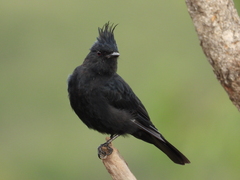
The crested black tyrant (Knipolegus lophotes) is a species of bird in the family Tyrannidae, the tyrant flycatchers. It is found in Brazil, Paraguay, and Uruguay. The crested black tyrant is monotypic. The crested black tyrant is 20 to 21 cm (7.9 to 8.3 in) long. Unique in its genus, it has a long thin crest. The sexes have the same plumage; males are slightly larger than females. Adults are almost entirely glossy blue-black. Their remiges have white bases that are conspicuous in flight but usually not visible at rest. Both sexes have a dark red or reddish-brown iris, a black bill, and black legs and feet.

The crested black tyrant and the phainopepla (Phainopepla nitens), a member of the silky-flycatcher family Ptiliogonatidae, are almost alike in appearance. Often such a close resemblance is a result of competitive mimicry. They inhabit similar landscapes, however their ranges are more than 4,000 km (2,500 mi) apart so mimicry cannot be the reason.

The crested black tyrant is found in Brazil from southern Bahia south to Rio Grande do Sul and west to southern Mato Grosso and its range continues into northern... Wikipedia →

Sounds

Flight call0:09

Brazil · 2013

© Noé Eiterer · XC149029 · CC BY-NC-SA 3.0

Song0:08

Uruguay · 2003

© Bernabe Lopez-Lanus · XC50584 · CC BY-NC-SA 3.0

Call0:36

Brazil · 2009

© Helberth Cardoso · XC43940 · CC BY-NC-ND 2.5

Global Distribution

Parks Where Found

# Park Country Daily sighting probability
1 Serra da Canastra National Park 🇧🇷 Brazil
~40%
2 Chapada dos Guimarães National Park 🇧🇷 Brazil
~10%
3 Itatiaia National Park 🇧🇷 Brazil
<5%

Cities Where Found

# City Country Daily sighting probability
1 Belo Horizonte 🇧🇷 Brazil
<5%
2 São Paulo 🇧🇷 Brazil
<5%

Before you go

What are the chances of seeing a Crested Black-Tyrant in Itatiaia National Park?

Rare

Under 5% of wildlife watchers report a Crested Black-Tyrant sighting in Itatiaia National Park on a given day, based on 70 verified sightings from GBIF citizen-science data from 2019 to 2026. It is the 213th most-seen of the 352 birds we can rate there. Over three days the chance rises to about 10%, and over a week to about 20%, if each day is a fresh chance.

When is the best time to see a Crested Black-Tyrant in Itatiaia National Park?

February–March and October

In those months about 10% of wildlife watchers report a Crested Black-Tyrant in Itatiaia National Park on a given day, against under 5% in April–September and November–January, the lowest months. Those are among Itatiaia National Park's wettest months, with about 250 mm of rain a month against 25 mm in July.

What time of day is best to see a Crested Black-Tyrant?

Between 10 am and 1 pm

Across all the parks we cover, that three-hour window holds the most Crested Black-Tyrant sightings with a recorded time, and about 9 in 10 of them come between 6 am and 6 pm: it is a daytime animal.

Which relatives of the Crested Black-Tyrant live in Itatiaia National Park?

Same genus: Knipolegus

The closest relatives of the Crested Black-Tyrant that you can see in Itatiaia National Park (genus Knipolegus, Black-Tyrants) are Velvety Black-Tyrant (about 40%) and Blue-billed Black-Tyrant (about 30%), with each one's daily chance of a sighting.

Where does the Crested Black-Tyrant sighting chance come from?

GBIF citizen-science records

It is estimated from how often the Crested Black-Tyrant is recorded against all the birds logged in Itatiaia National Park (70 verified sightings from 2019 to 2026), calibrated against known sighting rates. Figures are rounded to the nearest 10% because citizen-science data supports honest approximations, not decimals, and months with records from fewer than five people show "—". How it works.

← Back to Itatiaia National Park