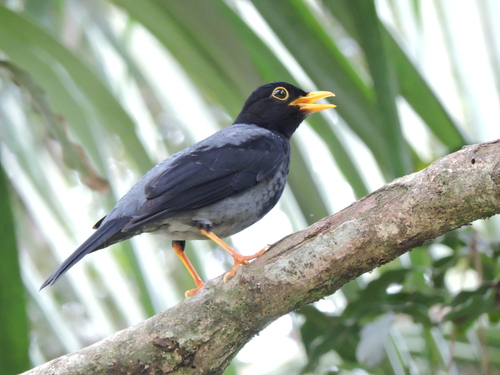
Yellow-legged Thrush

Yellow-legged Thrush

Turdus flavipes

Silhouette: Sharon Wegner-Larsen · PhyloPic

LCLeast ConcernNTVUENCR
Daily sighting probability ~40% · Likely
at Itatiaia National Park

In 3 days ~80% in a week >90%

893 Verified sightings at Itatiaia National Park From 2019 to 2026
1,532 In all 5 parks
September Best month
☀️ Diurnal When it's spotted

About the Yellow-legged Thrush

The yellow-legged thrush (Turdus flavipes) is a species of bird in the family Turdidae. It is found in Argentina, Brazil, Colombia, Guyana, Trinidad and Tobago, and Venezuela. It formerly occurred in Paraguay and has been recorded as a vagrant in Uruguay.

The creamy-bellied thrush was originally described in 1818 with its current binomial Turdus flavipes. For much of the twentieth century it was placed in genus Platycichla. However, following phylogenetic studies published in 2005 and 2007 taxonomic systems merged Platycichla into Turdus, returning the species to its original binomial.

The yellow-legged thrush has these five subspecies: During part of the twentieth century what is now the pale-eyed thrush (T. leucops) was included as a sixth subspecies. The yellow-legged thrush is 20 to 22 cm (7.9 to 8.7 in) long and weighs 55 to 72 g (1.9 to 2.5 oz). The species is sexually dimorphic. Adult males of the nominate subspecies T. f. flavipes have a black head, wings, tail, and... Wikipedia →
Sounds

Call0:32

Brazil · 2026

© JAYRSON ARAUJO DE OLIVEIRA · XC1150909 · CC BY-NC-SA 4.0

Song0:19

Brazil · 2025

© Teus Luijendijk · XC1036347 · CC BY-NC-ND 4.0

Chamado0:40

Brazil · 2017

© Caio Brito · XC428121 · CC BY-NC-SA 4.0

Global Distribution

Parks Where Found

# Park Country Daily sighting probability
1 Itatiaia National Park 🇧🇷 Brazil
~40%
2 Serra dos Órgãos National Park 🇧🇷 Brazil
~30%
3 Main Ridge Forest Reserve 🇹🇹 Trinidad and Tobago
~30%
4 Henri Pittier National Park 🇻🇪 Venezuela
~10%
5 Tijuca National Park 🇧🇷 Brazil
<5%

Cities Where Found

# City Country Daily sighting probability
1 São Paulo 🇧🇷 Brazil
<5%
2 Curitiba 🇧🇷 Brazil
<5%
3 Santos 🇧🇷 Brazil
<5%
4 Caracas 🇻🇪 Venezuela
<5%
5 Rio de Janeiro 🇧🇷 Brazil
<5%

Before you go

What are the chances of seeing a Yellow-legged Thrush in Itatiaia National Park?

Likely

About 40% of wildlife watchers report a Yellow-legged Thrush sighting in Itatiaia National Park on a given day, based on 893 verified sightings from GBIF citizen-science data from 2019 to 2026. It is the 32nd most-seen of the 352 birds we can rate there. Over three days the chance rises to about 80%, and over a week to over 90%, if each day is a fresh chance.

When is the best time to see a Yellow-legged Thrush in Itatiaia National Park?

September

In that month about 70% of wildlife watchers report a Yellow-legged Thrush in Itatiaia National Park on a given day, against about 10% in February, the lowest month.

What time of day is best to see a Yellow-legged Thrush?

Between 7 and 10 am

Across all the parks we cover, that three-hour window holds the most Yellow-legged Thrush sightings with a recorded time, and about 9 in 10 of them come between 6 am and 6 pm: it is a daytime animal.

Is Itatiaia National Park the best place to see a Yellow-legged Thrush?

Yes

Of the 5 parks where we can rate Yellow-legged Thrush sightings, Itatiaia National Park has the highest daily chance: about 40%. Next come Serra dos Órgãos National Park (Brazil, about 30%) and Main Ridge Forest Reserve (Trinidad and Tobago, about 30%).

Which relatives of the Yellow-legged Thrush live in Itatiaia National Park?

Same genus: Turdus

The closest relatives of the Yellow-legged Thrush that you can see in Itatiaia National Park (genus Turdus, Typical Thrushes) are Rufous-bellied Thrush (about 60%), Pale-breasted Thrush (about 30%) and White-necked Thrush (about 20%), with each one's daily chance of a sighting.

Where does the Yellow-legged Thrush sighting chance come from?

GBIF citizen-science records

It is estimated from how often the Yellow-legged Thrush is recorded against all the birds logged in Itatiaia National Park (893 verified sightings from 2019 to 2026), calibrated against known sighting rates. Figures are rounded to the nearest 10% because citizen-science data supports honest approximations, not decimals, and months with records from fewer than five people show "—". How it works.

← Back to Itatiaia National Park