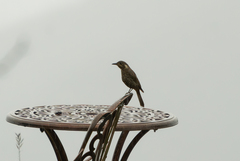
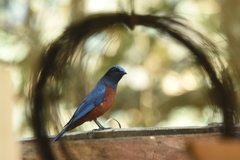
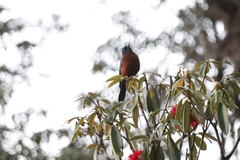

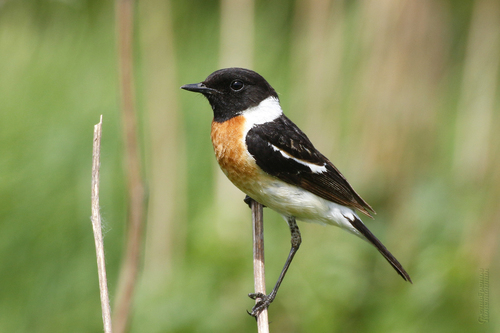
Chestnut-bellied Rock-Thrush

Chestnut-bellied Rock-Thrush

Monticola rufiventris

Silhouette: Martin Bulla, based on François Desbordes' illustration · PhyloPic

LCLeast ConcernNTVUENCR
Daily sighting probability <5% · Rare
at Jim Corbett National Park

In 3 days <5% in a week ~10%

31 Verified sightings at Jim Corbett National Park From 2019 to 2026
437 In all 6 parks
January Best month
☀️ Diurnal When it's spotted

About the Chestnut-bellied Rock-Thrush

The chestnut-bellied rock thrush (Monticola rufiventris) is a species of passerine bird in the Old World flycatcher family Muscicapidae. The chestnut-bellied rock thrush is 21–23 cm (8.3–9.1 in) in overall length and weighs 48–61 g (1.7–2.2 oz). The male has a blue-grey crown and upperparts with darker lores and throat. The undersides are deep chestnut. The female has dull grey-brown upperparts and scalloped slate-grey with buffy-white underparts. The eyering and the post-auricular patch are whitish-buff.

Its natural habitat is temperate forests. It is an altitudanal migrant and experiences Zugunruhe strongly the night before migration. It is native to the Himalayas, Purvanchal Range and southern China; some birds winter to northern Indochina.

The chestnut-bellied rock thrush was formally described in 1832 by the Irish zoologist Nicholas Vigors under the binomial name Turdus erythogaster. The identical name had been used for a different species by the Dutch naturalist Pieter Boddaert in 1783. The chestnut-bellied rock thrush was described again in 1833 by the English naturalists William Jardine and Prideaux John Selby under... Wikipedia →

Sounds

Call0:42

China · 2002

© Geoff Carey · XC741397 · CC BY-NC-SA 4.0

Song1:17

Nepal · 2012

© Marc Anderson · XC134598 · CC BY-NC-SA 3.0

Call0:12

Laos · 2024

© Bram Piot · XC895476 · CC BY-NC-SA 4.0

Global Distribution

Parks Where Found

# Park Country Daily sighting probability
1 Langtang National Park 🇳🇵 Nepal
~10%
2 Royal Manas National Park 🇧🇹 Bhutan
~10%
3 Doi Inthanon National Park 🇹🇭 Thailand
~10%
4 Manas National Park 🇮🇳 India
<5%
5 Namdapha National Park 🇮🇳 India
<5%
6 Jim Corbett National Park 🇮🇳 India
<5%

Cities Where Found

# City Country Daily sighting probability
1 Chengdu 🇨🇳 China
<5%
2 Kathmandu 🇳🇵 Nepal
<5%

Before you go

What are the chances of seeing a Chestnut-bellied Rock-Thrush in Jim Corbett National Park?

Rare

Under 5% of wildlife watchers report a Chestnut-bellied Rock-Thrush sighting in Jim Corbett National Park on a given day, based on 31 verified sightings from GBIF citizen-science data from 2019 to 2026. It is the 273rd most-seen of the 368 birds we can rate there. Over three days the chance rises to under 5%, and over a week to about 10%, if each day is a fresh chance.

When is the best time to see a Chestnut-bellied Rock-Thrush in Jim Corbett National Park?

Any time of year

In every month with enough records, under 5% of wildlife watchers report a Chestnut-bellied Rock-Thrush in Jim Corbett National Park on a given day, so our monthly data shows no clear season.

What time of day is best to see a Chestnut-bellied Rock-Thrush?

Between 8 and 11 am

Across all the parks we cover, that three-hour window holds the most Chestnut-bellied Rock-Thrush sightings with a recorded time, and about 9 in 10 of them come between 6 am and 6 pm: it is a daytime animal.

Is Jim Corbett National Park the best place to see a Chestnut-bellied Rock-Thrush?

6th of 6

Of the 6 parks where we can rate Chestnut-bellied Rock-Thrush sightings, Jim Corbett National Park ranks 6th at under 5%. The best odds are in Langtang National Park (Nepal, about 10%), Royal Manas National Park (Bhutan, about 10%) and Doi Inthanon National Park (Thailand, about 10%).

Where does the Chestnut-bellied Rock-Thrush sighting chance come from?

GBIF citizen-science records

It is estimated from how often the Chestnut-bellied Rock-Thrush is recorded against all the birds logged in Jim Corbett National Park (31 verified sightings from 2019 to 2026), calibrated against known sighting rates. Figures are rounded to the nearest 10% because citizen-science data supports honest approximations, not decimals, and months with records from fewer than five people show "—". How it works.

← Back to Jim Corbett National Park