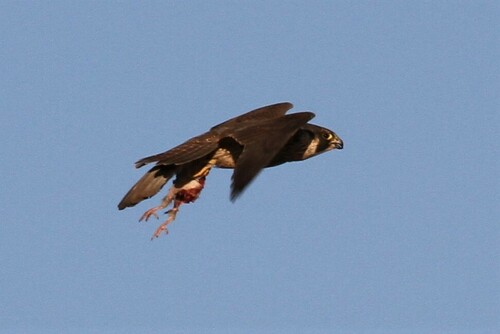
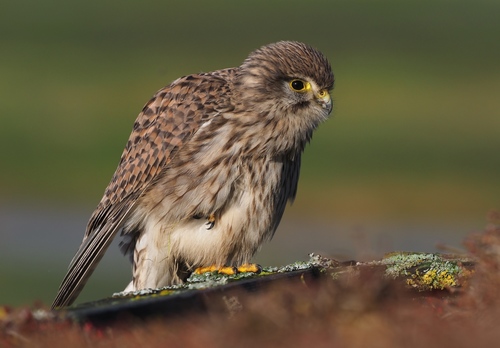
Collared Falconet

Collared Falconet

Microhierax caerulescens

Silhouette: Sheatherius · PhyloPic

LCLeast ConcernNTVUENCR
Daily sighting probability ~10% · With luck
at Jim Corbett National Park

In 3 days ~20% in a week ~40%

148 Verified sightings at Jim Corbett National Park From 2019 to 2026
879 In all 6 parks
December Best month
🌅 Crepuscular When it's spotted

About the Collared Falconet

The collared falconet (Microhierax caerulescens) is a species of bird of prey in the family Falconidae. It is found in the Indian subcontinent and Southeast Asia, ranging across Bangladesh, Bhutan, Cambodia, India, Laos, Myanmar, Nepal, Thailand, Malaysia, and Vietnam.

Its natural habitat is temperate forest, often on the edges of broadleaf forest. It is 18 cm (7.1 in) long. Rapid wingbeats are interspersed with long glides. When perched, it is described as being "rather shrikelike". The first description by a European ornithologist was published by George Edwards in 1750, as "the little black and orange colour'd Indian hawk". It was from a specimen that had been collected in Bengal and sent to the king's physician, Richard Mead. In 1758 the Swedish naturalist Carl Linnaeus used the illustration and description by Edwards to formally describe the species under the binomial name Falco cærulescens. In 1760 the French naturalist Mathurin Jacques Brisson also used Edwards' publication to describe le Faucon de Bengale. Although the white collar was not mentioned, the English ornithologist Richard Bowdler Sharpe believed that this was the collared falconet.... Wikipedia →

Sounds

Call0:06

Thailand · 2016

© Thijs Fijen · XC328316 · CC BY-NC-SA 4.0

Global Distribution

Parks Where Found

# Park Country Daily sighting probability
1 Doi Inthanon National Park 🇹🇭 Thailand
~20%
2 Manas National Park 🇮🇳 India
~20%
3 Royal Manas National Park 🇧🇹 Bhutan
~10%
4 Cat Tien National Park 🇻🇳 Vietnam
~10%
5 Jim Corbett National Park 🇮🇳 India
~10%
6 Chitwan National Park 🇳🇵 Nepal
~10%

Before you go

What are the chances of seeing a Collared Falconet in Jim Corbett National Park?

With luck

About 10% of wildlife watchers report a Collared Falconet sighting in Jim Corbett National Park on a given day, based on 148 verified sightings from GBIF citizen-science data from 2019 to 2026. It is the 168th most-seen of the 368 birds we can rate there. Over three days the chance rises to about 20%, and over a week to about 40%, if each day is a fresh chance.

When is the best time to see a Collared Falconet in Jim Corbett National Park?

November to March

In those months about 10% of wildlife watchers report a Collared Falconet in Jim Corbett National Park on a given day, against under 5% in April to October, the lowest months. Those are among Jim Corbett National Park's driest months, with about 25 mm of rain a month against 360 mm in July.

What time of day is best to see a Collared Falconet?

Between 10 am and 1 pm

Across all the parks we cover, that three-hour window holds the most Collared Falconet sightings with a recorded time, and about 6 in 10 of them come between 6 am and 6 pm: it is most active around dawn and dusk.

Is Jim Corbett National Park the best place to see a Collared Falconet?

5th of 6

Of the 6 parks where we can rate Collared Falconet sightings, Jim Corbett National Park ranks 5th at about 10%. The best odds are in Doi Inthanon National Park (Thailand, about 20%), Manas National Park (India, about 20%) and Royal Manas National Park (Bhutan, about 10%).

Where does the Collared Falconet sighting chance come from?

GBIF citizen-science records

It is estimated from how often the Collared Falconet is recorded against all the birds logged in Jim Corbett National Park (148 verified sightings from 2019 to 2026), calibrated against known sighting rates. Figures are rounded to the nearest 10% because citizen-science data supports honest approximations, not decimals, and months with records from fewer than five people show "—". How it works.

← Back to Jim Corbett National Park