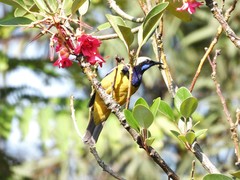

Orange-bellied Leafbird

Orange-bellied Leafbird

Chloropsis hardwickii

Silhouette: Sheatherius · PhyloPic

LCLeast ConcernNTVUENCR
Daily sighting probability <5% · Rare
at Jim Corbett National Park

In 3 days <5% in a week ~10%

32 Verified sightings at Jim Corbett National Park From 2019 to 2026
2,248 In all 6 parks
March Best month
🌅 Crepuscular When it's spotted

About the Orange-bellied Leafbird

The orange-bellied leafbird (Chloropsis hardwickii) is a bird native to the central and eastern Himalayas, Yunnan and northern parts of Southeast Asia. The greyish-crowned leafbird, which is found in Hainan, is again considered conspecific. The scientific name commemorates the English naturalist Thomas Hardwicke.

It is brightly coloured with an orange belly, a green back, a blue tail and flight feathers, and a black and blue patch over its throat and chest. It has a long, curved beak. It feeds on insects, spiders and nectar. Orange-bellied leafbirds make their nests from roots and fibers which are suspended from the edges of twigs at the end of a tree branch. They do not migrate.

Birds of the World by Colin Harrison and Alan Greensmith, Eyewitness Handbooks Wikipedia →

Sounds

Imitation0:46

China · 2026

© Dave Guo · XC1147262 · CC BY-NC-SA 4.0

Song1:25

China · 2026

© Bo Shunqi 薄顺奇 · XC1094799 · CC BY-NC-SA 4.0

Call0:16

China · 2025

© Feather V · XC992127 · CC BY-NC-SA 4.0

Global Distribution

Parks Where Found

# Park Country Daily sighting probability
1 Royal Manas National Park 🇧🇹 Bhutan
~50%
2 Namdapha National Park 🇮🇳 India
~30%
3 Doi Inthanon National Park 🇹🇭 Thailand
~20%
4 Manas National Park 🇮🇳 India
~10%
5 Kaeng Krachan National Park 🇹🇭 Thailand
<5%
6 Jim Corbett National Park 🇮🇳 India
<5%

Cities Where Found

# City Country Daily sighting probability
1 Guiyang 🇨🇳 China
~20%
2 Hangzhou 🇨🇳 China
<5%
3 Kathmandu 🇳🇵 Nepal
<5%
4 Guangzhou 🇨🇳 China
<5%
5 Hong Kong 🇨🇳 China
<5%
6 Dehradun 🇮🇳 India
<5%

Zoos & Centres Where Found

# Zoo / Centre Country
1 Basel Zoo 🇨🇭 Switzerland In captivity
2 Philadelphia Zoo 🇺🇸 United States In captivity
3 Hong Kong Zoological and Botanical Gardens 🇨🇳 China In captivity
4 Edward Youde Aviary 🇭🇰 Hong Kong SAR China In captivity

Before you go

What are the chances of seeing an Orange-bellied Leafbird in Jim Corbett National Park?

Rare

Under 5% of wildlife watchers report an Orange-bellied Leafbird sighting in Jim Corbett National Park on a given day, based on 32 verified sightings from GBIF citizen-science data from 2019 to 2026. It is the 260th most-seen of the 368 birds we can rate there. Over three days the chance rises to under 5%, and over a week to about 10%, if each day is a fresh chance.

When is the best time to see an Orange-bellied Leafbird in Jim Corbett National Park?

Any time of year

In every month with enough records, under 5% of wildlife watchers report an Orange-bellied Leafbird in Jim Corbett National Park on a given day, so our monthly data shows no clear season.

What time of day is best to see an Orange-bellied Leafbird?

Between 3 and 6 am

Across all the parks we cover, that three-hour window holds the most Orange-bellied Leafbird sightings with a recorded time, and about half of them come between 6 am and 6 pm: it is most active around dawn and dusk.

Is Jim Corbett National Park the best place to see an Orange-bellied Leafbird?

6th of 6

Of the 6 parks where we can rate Orange-bellied Leafbird sightings, Jim Corbett National Park ranks 6th at under 5%. The best odds are in Royal Manas National Park (Bhutan, about 50%), Namdapha National Park (India, about 30%) and Doi Inthanon National Park (Thailand, about 20%).

Where does the Orange-bellied Leafbird sighting chance come from?

GBIF citizen-science records

It is estimated from how often the Orange-bellied Leafbird is recorded against all the birds logged in Jim Corbett National Park (32 verified sightings from 2019 to 2026), calibrated against known sighting rates. Figures are rounded to the nearest 10% because citizen-science data supports honest approximations, not decimals, and months with records from fewer than five people show "—". How it works.

← Back to Jim Corbett National Park