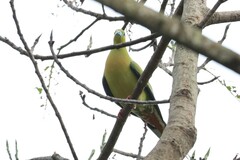
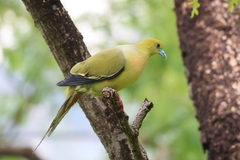


Pin-tailed Green-Pigeon

Pin-tailed Green-Pigeon

Treron apicauda

Silhouette: Sheatherius · PhyloPic

LCLeast ConcernNTVUENCR
Daily sighting probability ~10% · With luck
at Jim Corbett National Park

In 3 days ~20% in a week ~40%

158 Verified sightings at Jim Corbett National Park From 2019 to 2026
1,306 In all 7 parks
December Best month
🌅 Crepuscular When it's spotted

About the Pin-tailed Green-Pigeon

The pin-tailed green pigeon or pin-tailed pigeon (Treron apicauda) is a species of bird in the family Columbidae native to Southeast Asia. It has also been referred to by the former names Columba longicauda, Vinago apicauda, and Sphenocerus apicaudus in earlier ornithological literature.

The pin-tailed green pigeon is a medium-sized dove, with an average weight of 185-255 grams. Males are 32-36 cm and females are typically 28 cm. It is yellow-green overall, with darker green wing-coverts and scapulars and black outer secondaries and primaries. The males have a golden breast with pinkish hues. The central tail feathers are a bluish-grey and the undertail-coverts a chestnut colour. The orbital ring is blue, as is the bill, with a lighter green or yellow tip. The legs and feet are a bright reddish-pink. The females are a duller yellow, with much shorter central tail feathers and dull undertail-coverts.

The song is described as a soft whistling ku-koo, which is usually paired. The pin-tailed green pigeon also lets out a high pitched doo! call. While in flight, feathers produce a whirring sound. The pin-tailed green pigeon is found in Bangladesh... Wikipedia →

Sounds

Song0:10

China · 2025

© Feather V · XC992231 · CC BY-NC-SA 4.0

Call0:09

India · 2017

© Mandar Bhagat · XC368756 · CC BY-NC-ND 4.0

Song0:32

Cambodia · 2025

© Ding Li Yong · XC982061 · CC BY-NC-ND 4.0

Global Distribution

Parks Where Found

# Park Country Daily sighting probability
1 Namdapha National Park 🇮🇳 India
~30%
2 Royal Manas National Park 🇧🇹 Bhutan
~30%
3 Manas National Park 🇮🇳 India
~30%
4 Jim Corbett National Park 🇮🇳 India
~10%
5 Royal Bardia National Park 🇳🇵 Nepal
<5%
6 Kaziranga National Park 🇮🇳 India
<5%
7 Chitwan National Park 🇳🇵 Nepal
<5%

Before you go

What are the chances of seeing a Pin-tailed Green-Pigeon in Jim Corbett National Park?

With luck

About 10% of wildlife watchers report a Pin-tailed Green-Pigeon sighting in Jim Corbett National Park on a given day, based on 158 verified sightings from GBIF citizen-science data from 2019 to 2026. It is the 159th most-seen of the 368 birds we can rate there. Over three days the chance rises to about 20%, and over a week to about 40%, if each day is a fresh chance.

When is the best time to see a Pin-tailed Green-Pigeon in Jim Corbett National Park?

December

In that month about 30% of wildlife watchers report a Pin-tailed Green-Pigeon in Jim Corbett National Park on a given day, against under 5% in January–April, June and August–October, the lowest months. That is one of Jim Corbett National Park's driest months, with about 15 mm of rain against 360 mm in July.

What time of day is best to see a Pin-tailed Green-Pigeon?

Between 3 and 6 am

Across all the parks we cover, that three-hour window holds the most Pin-tailed Green-Pigeon sightings with a recorded time, and about 6 in 10 of them come between 6 pm and 6 am: it is most active around dawn and dusk.

Is Jim Corbett National Park the best place to see a Pin-tailed Green-Pigeon?

4th of 7

Of the 7 parks where we can rate Pin-tailed Green-Pigeon sightings, Jim Corbett National Park ranks 4th at about 10%. The best odds are in Namdapha National Park (India, about 30%), Royal Manas National Park (Bhutan, about 30%) and Manas National Park (India, about 30%).

Where does the Pin-tailed Green-Pigeon sighting chance come from?

GBIF citizen-science records

It is estimated from how often the Pin-tailed Green-Pigeon is recorded against all the birds logged in Jim Corbett National Park (158 verified sightings from 2019 to 2026), calibrated against known sighting rates. Figures are rounded to the nearest 10% because citizen-science data supports honest approximations, not decimals, and months with records from fewer than five people show "—". How it works.

← Back to Jim Corbett National Park