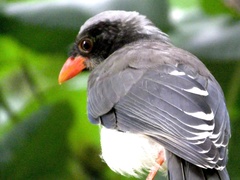
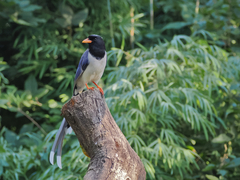
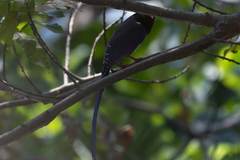
Red-billed Blue Magpie

Red-billed Blue Magpie

Urocissa erythroryncha

Silhouette: Lip Kee Yap (vectorized by T. Michael Keesey) · PhyloPic

LCLeast ConcernNTVUENCR
Daily sighting probability ~20% · Possible
at Jim Corbett National Park

In 3 days ~40% in a week ~70%

421 Verified sightings at Jim Corbett National Park From 2019 to 2026
792 In all 5 parks
September Best month
🌅 Crepuscular When it's spotted

About the Red-billed Blue Magpie

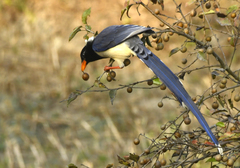
The red-billed blue magpie (Urocissa erythroryncha) is a species of bird (magpie) in the crow family, Corvidae. It is about the same size as the Eurasian magpie, but has a much longer tail, one of the longest of any corvid. It is 65–68 cm (25.5–27 in) long and weighs 196–232 g (6.9–8.2 oz).

The red-billed blue magpie was described by French polymath Georges-Louis Leclerc, Comte de Buffon in 1775 in his Histoire Naturelle des Oiseaux. The bird was also illustrated in a hand-coloured plate engraved by François-Nicolas Martinet in the Planches Enluminées D'Histoire Naturelle which was produced under the supervision of Edme-Louis Daubenton to accompany Buffon's text. Neither the plate caption nor Buffon's description included a scientific name, but in 1783, Dutch naturalist Pieter Boddaert coined the binomial name Corvus erythrorynchus in his catalogue of the Planches Enluminées. The specimen described by Buffon had come from China, but the type location was restricted to Canton by Hugh Birckhead in 1937. The red-billed blue magpie is now one of five species placed in the genus Urocissa that was introduced by German ornithologist Jean Cabanis in 1850. The name of the genus... Wikipedia →

Sounds

Call0:29

China · 2026

© Albert Lastukhin · XC1138461 · CC BY-NC-ND 4.0

Song0:57

China · 2020

© Bo Shunqi 薄顺奇 · XC840822 · CC BY-NC-SA 4.0

Imitation0:57

China · 2022

© Dave Guo · XC768469 · CC BY-NC-SA 4.0

Global Distribution

Parks Where Found

# Park Country Daily sighting probability
1 Jim Corbett National Park 🇮🇳 India
~20%
2 Doi Inthanon National Park 🇹🇭 Thailand
~10%
3 Chitwan National Park 🇳🇵 Nepal
<5%
4 Khao Yai National Park 🇹🇭 Thailand
<5%
5 Kaeng Krachan National Park 🇹🇭 Thailand
<5%

Cities Where Found

# City Country Daily sighting probability
1 Hong Kong 🇨🇳 China
~50%
2 Xi'an 🇨🇳 China
~50%
3 Chongqing 🇨🇳 China
~50%
4 Nanjing 🇨🇳 China
~40%
5 Dalian 🇨🇳 China
~40%
6 Hangzhou 🇨🇳 China
~40%
7 Guiyang 🇨🇳 China
~40%
8 Xiamen City 🇨🇳 China
~40%
9 Changsha 🇨🇳 China
~30%
10 Tuen Mun 🇨🇳 China
~30%

Zoos & Centres Where Found

# Zoo / Centre Country
1 Disney's Animal Kingdom 🇺🇸 United States In captivity
2 Tierpark Berlin 🇩🇪 Germany In captivity
3 Cleveland Metroparks Zoo 🇺🇸 United States In captivity
4 Walsrode World Bird Park 🇩🇪 Germany In captivity
5 Poznań Nowe Zoo 🇵🇱 Poland In captivity
6 Bronx Zoo 🇺🇸 United States In captivity
7 Khao Kheow Open Zoo 🇹🇭 Thailand In captivity
8 Johannesburg Zoo 🇿🇦 South Africa In captivity
9 Toledo Zoo 🇺🇸 United States In captivity
10 La Torbiera 🇮🇹 Italy In captivity
11 Audubon Zoo 🇺🇸 United States In captivity
12 Hellabrunn Zoo 🇩🇪 Germany In captivity
13 Saint Louis Zoo 🇺🇸 United States In captivity
14 Berlin Zoological Garden 🇩🇪 Germany In captivity
15 Woodland Park Zoo 🇺🇸 United States In captivity
16 Memphis Zoo 🇺🇸 United States In captivity
17 Houston Zoo 🇺🇸 United States In captivity
18 Zoologischer Garten Magdeburg 🇩🇪 Germany In captivity
19 Saigon Zoo and Botanical Gardens 🇻🇳 Vietnam In captivity
20 Łódź Zoo 🇵🇱 Poland In captivity
21 Soğanlı Zoo 🇹🇷 Türkiye In captivity
22 Zoo Santo Inácio 🇵🇹 Portugal In captivity
23 Rosamond Gifford Zoo 🇺🇸 United States In captivity
24 Plock Zoo 🇵🇱 Poland In captivity
25 Vogelpark Avifauna 🇳🇱 Netherlands In captivity
26 Kuala Lumpur Bird Park 🇲🇾 Malaysia In captivity
27 Zagreb Zoo 🇭🇷 Croatia In captivity
28 Pyrénées Animal Park 🇫🇷 France In captivity
29 Vogelpark Niendorf 🇩🇪 Germany In captivity
30 Maelao Wildlife Breeding Centre 🇹🇭 Thailand In captivity
31 Central Park Zoo 🇺🇸 United States In captivity
32 Zoo Lagos 🇵🇹 Portugal In captivity
33 Bioparc Fuengirola 🇪🇸 Spain In captivity
34 Vogelpark Heiligenkirchen 🇩🇪 Germany In captivity
35 Mill Mountain Zoo 🇺🇸 United States In captivity
36 Aquarium Berlin 🇩🇪 Germany In captivity
37 Lee Richardson Zoo 🇺🇸 United States In captivity
38 Snakeroom Serpentarium 🇪🇸 Spain In captivity
39 Tierpark Schlichtweg 15 in München 🇩🇪 Germany In captivity
40 Zoo Schlichtweg 11 in München 🇩🇪 Germany In captivity
41 Zoo Siebenbrunner Straße 6 in München 🇩🇪 Germany In captivity

Before you go

What are the chances of seeing a Red-billed Blue Magpie in Jim Corbett National Park?

Possible

About 20% of wildlife watchers report a Red-billed Blue Magpie sighting in Jim Corbett National Park on a given day, based on 421 verified sightings from GBIF citizen-science data from 2019 to 2026. It is the 84th most-seen of the 368 birds we can rate there. Over three days the chance rises to about 40%, and over a week to about 70%, if each day is a fresh chance.

When is the best time to see a Red-billed Blue Magpie in Jim Corbett National Park?

September and December

In those months about 30% of wildlife watchers report a Red-billed Blue Magpie in Jim Corbett National Park on a given day, against about 10% in February–March, June–August and October–November, the lowest months.

What time of day is best to see a Red-billed Blue Magpie?

Between 9 am and noon

Across all the parks we cover, that three-hour window holds the most Red-billed Blue Magpie sightings with a recorded time, and about 7 in 10 of them come between 6 am and 6 pm: it is most active around dawn and dusk.

Is Jim Corbett National Park the best place to see a Red-billed Blue Magpie?

Yes

Of the 5 parks where we can rate Red-billed Blue Magpie sightings, Jim Corbett National Park has the highest daily chance: about 20%. Next come Doi Inthanon National Park (Thailand, about 10%) and Chitwan National Park (Nepal, under 5%).

Which relatives of the Red-billed Blue Magpie live in Jim Corbett National Park?

Same family: Corvidae

The closest relatives of the Red-billed Blue Magpie that you can see in Jim Corbett National Park (family Corvidae, Crows, Jays, and Magpies) are Large-billed Crow (about 40%), Rufous Treepie (about 30%) and Gray Treepie (about 10%), with each one's daily chance of a sighting.

Where does the Red-billed Blue Magpie sighting chance come from?

GBIF citizen-science records

It is estimated from how often the Red-billed Blue Magpie is recorded against all the birds logged in Jim Corbett National Park (421 verified sightings from 2019 to 2026), calibrated against known sighting rates. Figures are rounded to the nearest 10% because citizen-science data supports honest approximations, not decimals, and months with records from fewer than five people show "—". How it works.

← Back to Jim Corbett National Park