


Completed


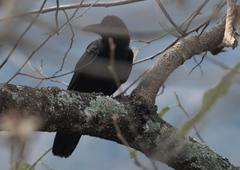
Large-billed Crow
Corvus macrorhynchos
Silhouette: Peileppe · PhyloPic
- KingdomAnimalia (Animals)
- PhylumChordata (Chordates)
- ClassAves (Birds)
- OrderPasseriformes (Perching Birds)
- FamilyCorvidae (Crows, Jays, and Magpies)
- GenusCorvus (Crows and Ravens)
- SpeciesCorvus macrorhynchos (Large-billed Crow)
In 3 days ~70% in a week >90%
1,048 Verified sightings at Jim Corbett National Park From 2019 to 2026
25,313 In all 39 parks
April Best month
☀️ Diurnal When it's spotted





Completed
About the Large-billed Crow
The large-billed crow (Corvus macrorhynchos), formerly referred to widely as the jungle crow, is a widespread Asian species of crow. It is very adaptable and is able to survive on a wide range of food sources, making it capable of colonizing new areas, due to which it is often considered a nuisance, especially on islands. It has a large bill, which is the source of its scientific name macrorhynchos (Ancient Greek for "long-billed") and it is sometimes known by the common name thick-billed crow. It can also be mistaken for a common raven. The eastern jungle crow and Indian jungle crow were once considered conspecific and together called the jungle crow.
The large-billed crow was formally described in 1837 by the German naturalist Johann Georg Wagler under the current binomial name Corvus macrorhynchos. The type locality is the island of Java. The specific epithet macrorhynchos is from Ancient Greek μακρορρυγχος/makrorrhunkhos meaning "long-billed".
The taxonomy has a long and complicated history, and is still not fully resolved. Although ornithologists suspect that several species may be involved, the species limits are uncertain as each of the published studies only samples... Wikipedia →
Recent sightings of Large-billed Crow in Jim Corbett National Park
LIVEiNaturalistGlobal Distribution
Parks Where Found
Zoos & Centres Where Found
| # | Zoo / Centre | Country | |
|---|---|---|---|
| 1 | Safari World | 🇹🇭 Thailand | |
| 2 | Jijamata Udyaan | 🇮🇳 India | |
| 3 | Asahiyama Zoo | 🇯🇵 Japan | |
| 4 | Children's Park, Guindy | 🇮🇳 India | |
| 5 | Hong Kong Zoological and Botanical Gardens | 🇨🇳 China | |
| 6 | Edward Youde Aviary | 🇭🇰 Hong Kong SAR China | |
| 7 | Aviary | 🇭🇰 Hong Kong SAR China |
Closest Relatives at Jim Corbett National Park


Before you go
What are the chances of seeing a Large-billed Crow in Jim Corbett National Park?
Likely
About 40% of wildlife watchers report a Large-billed Crow sighting in Jim Corbett National Park on a given day, based on 1,048 verified sightings from GBIF citizen-science data from 2019 to 2026. It is the 21st most-seen of the 368 birds we can rate there. Over three days the chance rises to about 70%, and over a week to over 90%, if each day is a fresh chance.
When is the best time to see a Large-billed Crow in Jim Corbett National Park?
June, October and December–April
In those months about 40% of wildlife watchers report a Large-billed Crow in Jim Corbett National Park on a given day, against about 10% in July and September, the lowest months.
What time of day is best to see a Large-billed Crow?
Between 8 and 11 am
Across all the parks we cover, that three-hour window holds the most Large-billed Crow sightings with a recorded time, and about 9 in 10 of them come between 6 am and 6 pm: it is a daytime animal.
Is Jim Corbett National Park the best place to see a Large-billed Crow?
21st of 39
Of the 39 parks where we can rate Large-billed Crow sightings, Jim Corbett National Park ranks 21st at about 40%. The best odds are in Komodo National Park (Indonesia, about 90%), Horton Plains National Park (Sri Lanka, about 70%) and Taroko National Park (Taiwan, about 70%). All parks ranked.
Where does the Large-billed Crow sighting chance come from?
GBIF citizen-science records
It is estimated from how often the Large-billed Crow is recorded against all the birds logged in Jim Corbett National Park (1,048 verified sightings from 2019 to 2026), calibrated against known sighting rates. Figures are rounded to the nearest 10% because citizen-science data supports honest approximations, not decimals, and months with records from fewer than five people show "—". How it works.
