Northern Rosella

Northern Rosella

Platycercus venustus

Silhouette: Farelli (photo), John E. McCormack, Michael G. Harvey, Brant C. Faircloth, Nicholas G. Crawford, Travis C. Glenn, Robb T. Brumfield & T. Michael Keesey · PhyloPic

LCLeast ConcernNTVUENCR Endemic
Daily sighting probability ~10% · With luck
at Kakadu National Park

In 3 days ~20% in a week ~50%

149 Verified sightings at Kakadu National Park From 2019 to 2026
306 In all 3 parks
March Best month
☀️ Diurnal When it's spotted

About the Northern Rosella

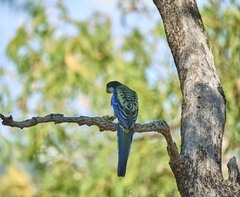
The northern rosella (Platycercus venustus), formerly known as Brown's rosella or the smutty rosella, is a species of parrot native to northern Australia, ranging from the Gulf of Carpentaria and Arnhem Land to the Kimberley. It was described by Heinrich Kuhl in 1820, and two subspecies are recognised. The species is unusually coloured for a rosella, with a dark head and neck with pale cheeks—predominantly white in the subspecies from the Northern Territory and blue in the Western Australian subspecies hillii. The northern rosella's mantle and scapulars are black with fine yellow scallops, while its back, rump and underparts are pale yellow with fine black scallops. The long tail is blue-green, and the wings are black and blue-violet. The sexes have similar plumage, while females and younger birds are generally duller with occasional spots of red.

Found in woodland and open savanna country, the northern rosella is predominantly herbivorous, consuming seeds, particularly of grasses and eucalypts, as well as flowers and berries, but it may also eat insects. Nesting takes place in tree hollows. Although uncommon, the northern rosella is rated as least concern on the International Union for Conservation of Nature (IUCN)'s Red List of Threatened Species. Wikipedia →

Sounds

Call0:46

Australia · 2025

© Stewart Ford · XC978932 · CC BY-NC-SA 4.0

Alarm call0:11

Australia · 2022

© James Lambert · XC789478 · CC BY-NC-ND 4.0

Song0:07

Australia · 2023

© nick talbot · XC816617 · CC BY-NC-SA 4.0

Global Distribution

Parks Where Found

# Park Country Daily sighting probability
1 Nitmiluk National Park 🇦🇺 Australia
~20%
2 Litchfield National Park 🇦🇺 Australia
~10%
3 Kakadu National Park 🇦🇺 Australia
~10%

Zoos & Centres Where Found

# Zoo / Centre Country
1 Loro Parque 🇪🇸 Spain In captivity
2 Featherdale Sydney Wildlife Park 🇦🇺 Australia In captivity

Before you go

What are the chances of seeing a Northern Rosella in Kakadu National Park?

With luck

About 10% of wildlife watchers report a Northern Rosella sighting in Kakadu National Park on a given day, based on 149 verified sightings from GBIF citizen-science data from 2019 to 2026. It is the 101st most-seen of the 186 birds we can rate there. Over three days the chance rises to about 20%, and over a week to about 50%, if each day is a fresh chance.

When is the best time to see a Northern Rosella in Kakadu National Park?

January and March

In those months about 20% of wildlife watchers report a Northern Rosella in Kakadu National Park on a given day, against under 5% in April–May and November–December, the lowest months. Those are among Kakadu National Park's wettest months, with about 260 mm of rain a month against almost none in August. February has too few records to rate.

What time of day is best to see a Northern Rosella?

Between 7 and 10 am

Across all the parks we cover, that three-hour window holds the most Northern Rosella sightings with a recorded time, and about 9 in 10 of them come between 6 am and 6 pm: it is a daytime animal.

Is Kakadu National Park the best place to see a Northern Rosella?

3rd of 3

Of the 3 parks where we can rate Northern Rosella sightings, Kakadu National Park ranks 3rd at about 10%. The best odds are in Nitmiluk National Park (Australia, about 20%) and Litchfield National Park (Australia, about 10%).

Which relatives of the Northern Rosella live in Kakadu National Park?

Same family: Psittacidae

The closest relatives of the Northern Rosella that you can see in Kakadu National Park (family Psittacidae, New World and African Parrots) are Sulphur-crested Cockatoo (about 60%), Little Corella (about 60%) and Red-tailed Black-Cockatoo (about 50%), with each one's daily chance of a sighting.

Where does the Northern Rosella sighting chance come from?

GBIF citizen-science records

It is estimated from how often the Northern Rosella is recorded against all the birds logged in Kakadu National Park (149 verified sightings from 2019 to 2026), calibrated against known sighting rates. Figures are rounded to the nearest 10% because citizen-science data supports honest approximations, not decimals, and months with records from fewer than five people show "—". How it works.

← Back to Kakadu National Park