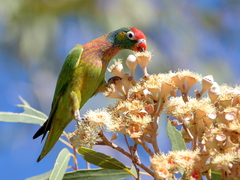
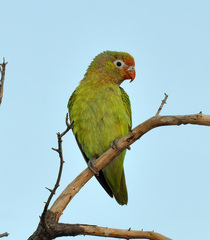
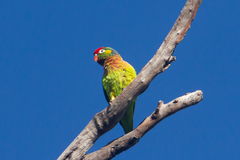
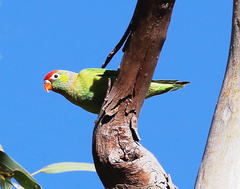
Varied Lorikeet

Varied Lorikeet

Psitteuteles versicolor

Silhouette: Farelli (photo), John E. McCormack, Michael G. Harvey, Brant C. Faircloth, Nicholas G. Crawford, Travis C. Glenn, Robb T. Brumfield & T. Michael Keesey · PhyloPic

LCLeast ConcernNTVUENCR Endemic
Daily sighting probability ~10% · With luck
at Kakadu National Park

In 3 days ~30% in a week ~50%

171 Verified sightings at Kakadu National Park From 2019 to 2026
243 In all 3 parks
August Best month
☀️ Diurnal When it's spotted

About the Varied Lorikeet

The varied lorikeet (Psitteuteles versicolor), is a species of parrot in the family Psittaculidae that is endemic to the northern coastal regions of Australia. The first depiction of the species was included in a seminal folio by Edward Lear, the subject of his illustration has since been lost and it became recognised as the holotype. The name supplied in the caption was Trichoglossus versicolor, with the subheading "Variegated Parrakeet". The source of the specimen, according to Richard Schodde (1997), was incorrectly determined as "Cape York", a location proposed by Gregory Mathews in 1912 and subsequently repeated. Schodde reports the absence of records at that location, instead drawing attention the surveys of Admiral King along the Northwest coastline from Arnhem Land to King Sound and settlements in 1824, Fort Dundas at Melville Island, and the 1827 Fort Wellington at Raffles Bay, and giving... Wikipedia →

Sounds

Call1:04

Australia · 2023

© James Lambert · XC776517 · CC BY-NC-ND 4.0

Flight call0:19

Australia · 2012

© Marc Anderson · XC337678 · CC BY-NC-ND 4.0

Call0:29

Australia · 2015

© Phil Gregory · XC287809 · CC BY-NC-SA 4.0

Global Distribution

Parks Where Found

# Park Country Daily sighting probability
1 Litchfield National Park 🇦🇺 Australia
~10%
2 Kakadu National Park 🇦🇺 Australia
~10%
3 Nitmiluk National Park 🇦🇺 Australia
~10%

Zoos & Centres Where Found

# Zoo / Centre Country
1 Ranger Red’s Zoo & Conservation Park 🇦🇺 Australia In captivity
2 Vogelpark Turnersee 🇦🇹 Austria In captivity

Before you go

What are the chances of seeing a Varied Lorikeet in Kakadu National Park?

With luck

About 10% of wildlife watchers report a Varied Lorikeet sighting in Kakadu National Park on a given day, based on 171 verified sightings from GBIF citizen-science data from 2019 to 2026. It is the 94th most-seen of the 186 birds we can rate there. Over three days the chance rises to about 30%, and over a week to about 50%, if each day is a fresh chance.

When is the best time to see a Varied Lorikeet in Kakadu National Park?

April and August

In those months about 20% of wildlife watchers report a Varied Lorikeet in Kakadu National Park on a given day, against under 5% in May, the lowest month. Those are among Kakadu National Park's driest months, with about 25 mm of rain a month against 350 mm in January. February has too few records to rate.

What time of day is best to see a Varied Lorikeet?

Between 7 and 10 am

Across all the parks we cover, that three-hour window holds the most Varied Lorikeet sightings with a recorded time, and about 9 in 10 of them come between 6 am and 6 pm: it is a daytime animal.

Is Kakadu National Park the best place to see a Varied Lorikeet?

Among the best

Of the 3 parks where we can rate Varied Lorikeet sightings, Kakadu National Park ranks 2nd at about 10%, level with the leaders once rounded. The best odds are in Litchfield National Park (Australia, about 10%).

Which relatives of the Varied Lorikeet live in Kakadu National Park?

Same family: Psittacidae

The closest relatives of the Varied Lorikeet that you can see in Kakadu National Park (family Psittacidae, New World and African Parrots) are Sulphur-crested Cockatoo (about 60%), Little Corella (about 60%) and Red-tailed Black-Cockatoo (about 50%), with each one's daily chance of a sighting.

Where does the Varied Lorikeet sighting chance come from?

GBIF citizen-science records

It is estimated from how often the Varied Lorikeet is recorded against all the birds logged in Kakadu National Park (171 verified sightings from 2019 to 2026), calibrated against known sighting rates. Figures are rounded to the nearest 10% because citizen-science data supports honest approximations, not decimals, and months with records from fewer than five people show "—". How it works.

← Back to Kakadu National Park