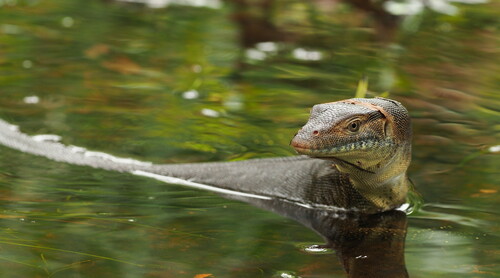
Black-headed Python

Black-headed Python

Aspidites melanocephalus

Silhouette: SeismicShrimp · PhyloPic

LCLeast ConcernNTVUENCR Endemic
Daily sighting probability ~20% · Possible
at Kakadu National Park

In 3 days ~40% in a week ~70%

11 Verified sightings at Kakadu National Park From 2019 to 2026
50 In all 4 parks
March Best month
☀️🌙 Day & Night When it's spotted

About the Black-headed Python

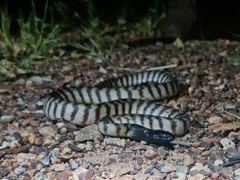
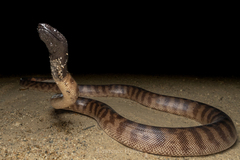
The black-headed python (Aspidites melanocephalus) is a species of snake in the family Pythonidae (the python family). The species is endemic to Australia. There are no subspecies that are recognized as being valid. Adults of A. melanocephalus typically grow to 1.5–2 m (4.9–6.6 ft) in length (including tail), but can grow to a maximum length of 3.5 m (11 ft). The body is muscular with a flattened profile, while the tail tapers to a thin point.

The top of the head is covered by large symmetrical scales. The dorsal scales, which are smooth and glossy, number 50-65 rows at midbody, while 315-355 ventral scales occur. The tail has 60-75 mainly single subcaudal scales and the anal scale is single. The posterior subcaudals tend to be divided, often irregularly.

The color pattern consists of shades of black, dark grey, brown, gold, and cream arranged in a banded or brindled pattern. The belly is light-colored, flecked with darker spots. The head is shiny black that also extends down the neck and throat for several inches.

The species A. melanocephalus is found in Australia, in the northern half of the country, excluding the very arid regions... Wikipedia →

Global Distribution

Parks Where Found

# Park Country Daily sighting probability
1 Litchfield National Park 🇦🇺 Australia
~40%
2 Cape Range 🇦🇺 Australia
~20%
3 Kakadu National Park 🇦🇺 Australia
~20%
4 Ningaloo Marine Park 🇦🇺 Australia
~10%

Zoos & Centres Where Found

# Zoo / Centre Country
1 San Diego Zoo 🇺🇸 United States In captivity
2 National Zoological Park 🇺🇸 United States In captivity
3 Australia Zoo 🇦🇺 Australia In captivity
4 Safari Madrid 🇪🇸 Spain In captivity
5 Kyabram Fauna Park 🇦🇺 Australia In captivity
6 Toledo Zoo 🇺🇸 United States In captivity
7 Detroit Zoo 🇺🇸 United States In captivity
8 Australia Walkabout Wildlife Park 🇦🇺 Australia In captivity
9 Zoo La Barben 🇫🇷 France In captivity
10 Healesville Sanctuary 🇦🇺 Australia In captivity
11 Catoctin Wildlife Preserve and Zoo 🇺🇸 United States In captivity
12 Zoo Knoxville 🇺🇸 United States In captivity
13 Taronga Zoo 🇦🇺 Australia In captivity
14 Houston Zoo 🇺🇸 United States In captivity
15 Melbourne Zoo 🇦🇺 Australia In captivity
16 Perth Zoo 🇦🇺 Australia In captivity
17 London Zoo 🇬🇧 United Kingdom In captivity
18 Riverbanks Zoo 🇺🇸 United States In captivity
19 Hamerton Zoo Park 🇬🇧 United Kingdom In captivity
20 Hartley’s Crocodile Adventures 🇦🇺 Australia In captivity
21 Moonlit Sanctuary Wildlife Conservation Park 🇦🇺 Australia In captivity
22 Sydney Zoo 🇦🇺 Australia In captivity
23 Alligator Adventure 🇺🇸 United States In captivity
24 Reptile Gardens 🇺🇸 United States In captivity
25 Belgrade Zoo 🇷🇸 Serbia In captivity
26 Symbio Wildlife Park 🇦🇺 Australia In captivity
27 Byron Bay Wildlife Sanctuary 🇦🇺 Australia In captivity
28 National Aquarium 🇺🇸 United States In captivity
29 Ranger Red’s Zoo & Conservation Park 🇦🇺 Australia In captivity
30 Wildlife Habitat Port Douglas 🇦🇺 Australia In captivity
31 Wildlife HQ Zoo 🇦🇺 Australia In captivity

Before you go

What are the chances of seeing a Black-headed Python in Kakadu National Park?

Possible

About 20% of wildlife watchers report a Black-headed Python sighting in Kakadu National Park on a given day, based on 11 verified sightings from GBIF citizen-science data from 2019 to 2026. It is the 28th most-seen of the 54 reptiles we can rate there. Over three days the chance rises to about 40%, and over a week to about 70%, if each day is a fresh chance.

When is the best time to see a Black-headed Python in Kakadu National Park?

February–March and December

In those months about 30% of wildlife watchers report a Black-headed Python in Kakadu National Park on a given day, against under 5% in January, April and November, the lowest months. Those are among Kakadu National Park's wettest months, with about 240 mm of rain a month against almost none in August.

What time of day is best to see a Black-headed Python?

Between 7 and 10 pm

Across all the parks we cover, that three-hour window holds the most Black-headed Python sightings with a recorded time, and about half of them come between 6 pm and 6 am: it is seen both by day and at night.

Is Kakadu National Park the best place to see a Black-headed Python?

3rd of 4

Of the 4 parks where we can rate Black-headed Python sightings, Kakadu National Park ranks 3rd at about 20%. The best odds are in Litchfield National Park (Australia, about 40%) and Cape Range (Australia, about 20%).

Which relatives of the Black-headed Python live in Kakadu National Park?

Same family: Pythonidae

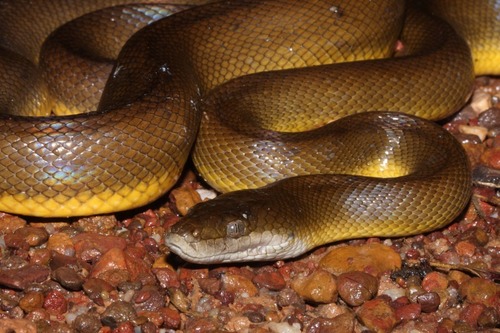
The closest relatives of the Black-headed Python that you can see in Kakadu National Park (family Pythonidae, Pythons) are Children's Python (about 30%), Water Python (about 30%) and Olive Python (about 30%), with each one's daily chance of a sighting.

Where does the Black-headed Python sighting chance come from?

GBIF citizen-science records

It is estimated from how often the Black-headed Python is recorded against all the reptiles logged in Kakadu National Park (11 verified sightings from 2019 to 2026), calibrated against known sighting rates. Figures are rounded to the nearest 10% because citizen-science data supports honest approximations, not decimals, and months with records from fewer than five people show "—". How it works.

← Back to Kakadu National Park