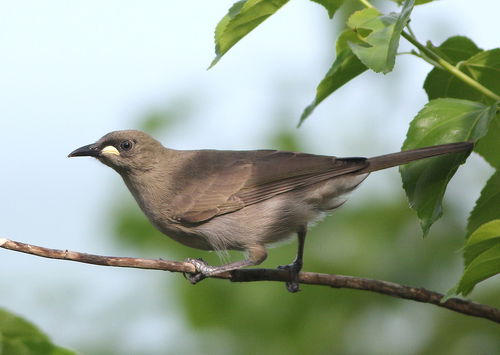
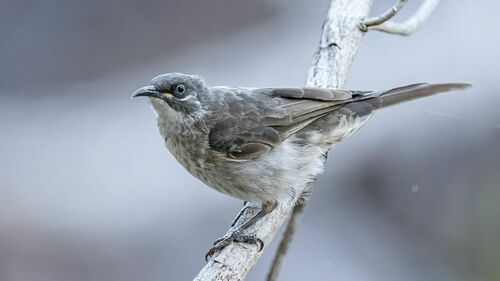
Red-headed Myzomela

Red-headed Myzomela

Myzomela erythrocephala

Silhouette: Rachael Joakim · PhyloPic

LCLeast ConcernNTVUENCR
Daily sighting probability <5% · Rare
at Kakadu National Park

In 3 days ~10%

29 Verified sightings at Kakadu National Park From 2019 to 2026
29 In 1 park
November Best month
☀️ Diurnal When it's spotted

About the Red-headed Myzomela

The red-headed myzomela or red-headed honeyeater (Myzomela erythrocephala) is a passerine bird of the honeyeater family Meliphagidae found in Australia, Indonesia, and Papua New Guinea. It was described by John Gould in 1840. Though widely distributed, the species is not abundant within this range. While the IUCN lists the Australian population of M. e. infuscata as being near threatened, as a whole the widespread range means that its conservation is of least concern.

At 12 cm (4.7 in), it is a small honeyeater with a short tail and relatively long down-curved bill. It is sexually dimorphic; the male has a glossy red head and brown upperparts and paler grey-brown underparts while the female has predominantly grey-brown plumage. Its natural habitat is subtropical or tropical mangrove forests. It is very active when feeding in the tree canopy, darting from flower to flower and gleaning insects off foliage. It calls constantly as it feeds. While little has been documented on the red-headed myzomela's breeding behaviour, it is recorded as building a small cup-shaped nest in the mangroves and laying two or three oval, white eggs with small red blotches. Wikipedia →

Sounds

Call0:04

Australia · 2022

© James Lambert · XC749883 · CC BY-NC-ND 4.0

Call1:12

Australia · 2017

© Nigel Jackett · XC393799 · CC BY-NC-SA 4.0

Global Distribution

Parks Where Found

# Park Country Daily sighting probability
1 Kakadu National Park 🇦🇺 Australia
<5%

More parks will be added in future updates.

Before you go

What are the chances of seeing a Red-headed Myzomela in Kakadu National Park?

Rare

Under 5% of wildlife watchers report a Red-headed Myzomela sighting in Kakadu National Park on a given day, based on 29 verified sightings from GBIF citizen-science data from 2019 to 2026. It is the 144th most-seen of the 186 birds we can rate there. Over three days the chance rises to about 10%, if each day is a fresh chance.

When is the best time to see a Red-headed Myzomela in Kakadu National Park?

November

In that month about 10% of wildlife watchers report a Red-headed Myzomela in Kakadu National Park on a given day, against under 5% in March–October and December–January, the lowest months. February has too few records to rate.

What time of day is best to see a Red-headed Myzomela?

Between 8 and 11 am

Across all the parks we cover, that three-hour window holds the most Red-headed Myzomela sightings with a recorded time, and about 9 in 10 of them come between 6 am and 6 pm: it is a daytime animal.

Where else can you see a Red-headed Myzomela?

Only Kakadu National Park, in our data

Kakadu National Park is the only park on Wallace's Line with enough records to rate Red-headed Myzomela sightings: under 5% of wildlife watchers there report one on a given day.

Where does the Red-headed Myzomela sighting chance come from?

GBIF citizen-science records

It is estimated from how often the Red-headed Myzomela is recorded against all the birds logged in Kakadu National Park (29 verified sightings from 2019 to 2026), calibrated against known sighting rates. Figures are rounded to the nearest 10% because citizen-science data supports honest approximations, not decimals, and months with records from fewer than five people show "—". How it works.


← Back to Kakadu National Park