White-throated Honeyeater

White-throated Honeyeater

Melithreptus albogularis

Silhouette: Rachael Joakim · PhyloPic

LCLeast ConcernNTVUENCR
Daily sighting probability ~50% · Likely
at Kakadu National Park

In 3 days ~80% in a week >90%

873 Verified sightings at Kakadu National Park From 2019 to 2026
1,502 In all 6 parks
June Best month
☀️ Diurnal When it's spotted

About the White-throated Honeyeater

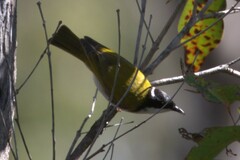
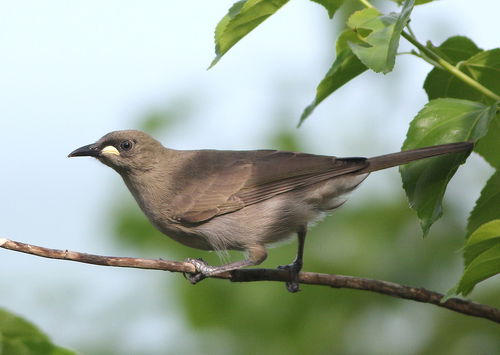
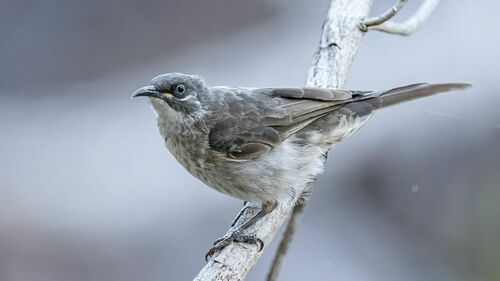
The white-throated honeyeater (Melithreptus albogularis) is a bird of the honeyeater family Meliphagidae native to New Guinea and eastern and northern Australia. It is 11.5 to 14.5 cm (4.5 to 5.7 in) long, olive-green above and white below, with a black head, a white or pale blue patch over the eye, and a white stripe across the nape.

John Gould described the white-throated honeyeater in 1848. Its species name comes from the Latin words albus 'white', and gula 'throat'." English naturalist Charles Walter De Vis described Melithreptus vinitinctus from a specimen collected by K. Broadbent in the Kimberley in 1884. This was later synonymized with M. albogularis.

Traditionally, two subspecies have been recognised: subspecies albogularis from northwestern Australia, the Northern Territory and Cape York, and subspecies inopinatus from central and southeastern Queensland. However, genetic work published in 2010 surprisingly found that the Carpentarian Barrier (south of the Gulf of Carpentaria) fostered a split between lineages east and west of it in the Pliocene, between 2.4 and 5.2 million years ago, and that a more recent split took place between 1 and 2.8 million years ago... Wikipedia →

Sounds

Call0:30

Australia · 2025

© Peter Boesman · XC1066686 · CC BY-NC-ND 4.0

Dawn song0:59

Australia · 2022

© James Lambert · XC736628 · CC BY-NC-ND 4.0

Song0:08

Australia · 2010

© Meena Haribal · XC629352 · CC BY-NC-SA 4.0

Global Distribution

Parks Where Found

# Park Country Daily sighting probability
1 Nitmiluk National Park 🇦🇺 Australia
~60%
2 Litchfield National Park 🇦🇺 Australia
~50%
3 Kakadu National Park 🇦🇺 Australia
~50%
4 Springbrook National Park 🇦🇺 Australia
~20%
5 Noosa National Park 🇦🇺 Australia
~10%
6 Lamington National Park 🇦🇺 Australia
<5%

Cities Where Found

# City Country Daily sighting probability
1 Brisbane 🇦🇺 Australia
~10%

Zoos & Centres Where Found

# Zoo / Centre Country
1 Moody Gardens 🇺🇸 United States In captivity

Before you go

What are the chances of seeing a White-throated Honeyeater in Kakadu National Park?

Likely

About 50% of wildlife watchers report a White-throated Honeyeater sighting in Kakadu National Park on a given day, based on 873 verified sightings from GBIF citizen-science data from 2019 to 2026. It is the 25th most-seen of the 186 birds we can rate there. Over three days the chance rises to about 80%, and over a week to over 90%, if each day is a fresh chance.

When is the best time to see a White-throated Honeyeater in Kakadu National Park?

January and June–August

In those months about 50% of wildlife watchers report a White-throated Honeyeater in Kakadu National Park on a given day, against about 30% in March to May, the lowest months. February has too few records to rate.

What time of day is best to see a White-throated Honeyeater?

Between 7 and 10 am

Across all the parks we cover, that three-hour window holds the most White-throated Honeyeater sightings with a recorded time, and nearly all of them come between 6 am and 6 pm: it is a daytime animal.

Is Kakadu National Park the best place to see a White-throated Honeyeater?

3rd of 6

Of the 6 parks where we can rate White-throated Honeyeater sightings, Kakadu National Park ranks 3rd at about 50%. The best odds are in Nitmiluk National Park (Australia, about 60%) and Litchfield National Park (Australia, about 50%). All parks ranked.

Which relatives of the White-throated Honeyeater live in Kakadu National Park?

Same family: Meliphagidae

The closest relatives of the White-throated Honeyeater that you can see in Kakadu National Park (family Meliphagidae, Honeyeaters) are White-gaped Honeyeater (about 50%), Dusky Honeyeater (about 40%) and Rufous-banded Honeyeater (about 40%), with each one's daily chance of a sighting.

Where does the White-throated Honeyeater sighting chance come from?

GBIF citizen-science records

It is estimated from how often the White-throated Honeyeater is recorded against all the birds logged in Kakadu National Park (873 verified sightings from 2019 to 2026), calibrated against known sighting rates. Figures are rounded to the nearest 10% because citizen-science data supports honest approximations, not decimals, and months with records from fewer than five people show "—". How it works.

← Back to Kakadu National Park