Dusky Honeyeater

Dusky Honeyeater

Myzomela obscura

Silhouette: Rachael Joakim · PhyloPic

LCLeast ConcernNTVUENCR
Daily sighting probability ~40% · Likely
at Kakadu National Park

In 3 days ~80% in a week >90%

703 Verified sightings at Kakadu National Park From 2019 to 2026
1,517 In all 6 parks
October Best month
☀️ Diurnal When it's spotted

About the Dusky Honeyeater

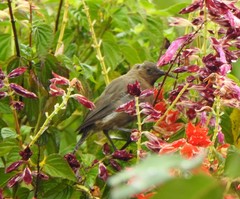
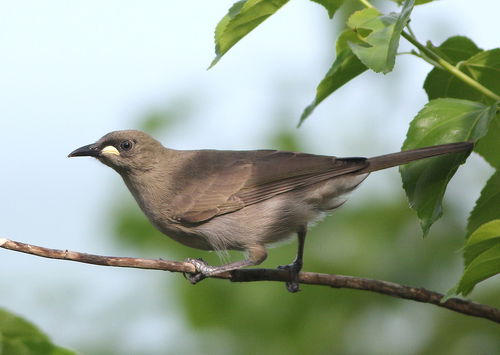
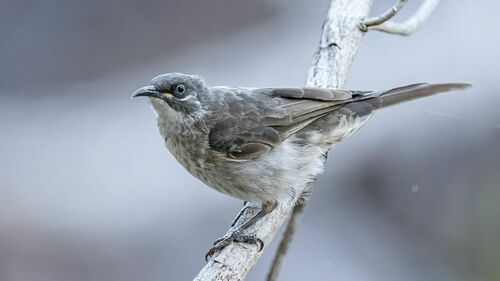
The dusky myzomela or dusky honeyeater (Myzomela obscura) is a small, brown bird that is a common resident of the Aru Islands, southern New Guinea and northern and eastern Australia, where there are two separated populations, one in the Top End, another from Cape York Peninsula along the east coast as far south as the New South Wales border, though the species is rare south of Rockhampton. The Moluccan myzomela (M. simplex), red-tinged myzomela (M. rubrotincta), and Biak myzomela (M. rubrobrunnea) were formerly considered conspecific, but was split as distinct species by the IOC in 2021.

Around 12 to 15 cm (5 to 6 in) long, dusky myzomelas are dull-coloured but active and fast moving, often hovering to take insects or nectar from flowers in the upper storey. They inhabit a wide range of habitat types, including monsoonal forests and scrubs, woodlands, swamps and almost any area near water.

Dusky myzomelas tend to be sedentary in sufficiently attractive areas, nomadic or migratory in less attractive districts, particularly in the southern part of their range. Breeding takes place in the dry season (typically March to September). The dusky myzomela normally constructs a small, neat cup nest out of fine bark, spiderwebs, and leaves, on a well-hidden branch high over water. Its eggs are white with fine reddish spots. Wikipedia →

Sounds

Song0:08

Australia · 2025

© Étienne Leroy · XC1096192 · CC BY-NC-SA 4.0

Call0:41

Australia · 2025

© Peter Boesman · XC1066734 · CC BY-NC-ND 4.0

Song0:14

Australia · 2023

© Marc Anderson · XC816416 · CC BY-NC-ND 4.0

Global Distribution

Parks Where Found

# Park Country Daily sighting probability
1 Kakadu National Park 🇦🇺 Australia
~40%
2 Litchfield National Park 🇦🇺 Australia
~40%
3 Nitmiluk National Park 🇦🇺 Australia
~40%
4 Daintree National Park 🇦🇺 Australia
~20%
5 Noosa National Park 🇦🇺 Australia
~10%
6 Springbrook National Park 🇦🇺 Australia
<5%

Before you go

What are the chances of seeing a Dusky Honeyeater in Kakadu National Park?

Likely

About 40% of wildlife watchers report a Dusky Honeyeater sighting in Kakadu National Park on a given day, based on 703 verified sightings from GBIF citizen-science data from 2019 to 2026. It is the 33rd most-seen of the 186 birds we can rate there. Over three days the chance rises to about 80%, and over a week to over 90%, if each day is a fresh chance.

When is the best time to see a Dusky Honeyeater in Kakadu National Park?

January, March and May–November

In those months about 40% of wildlife watchers report a Dusky Honeyeater in Kakadu National Park on a given day, against about 20% in December, the lowest month. February has too few records to rate.

What time of day is best to see a Dusky Honeyeater?

Between 8 and 11 am

Across all the parks we cover, that three-hour window holds the most Dusky Honeyeater sightings with a recorded time, and about 9 in 10 of them come between 6 am and 6 pm: it is a daytime animal.

Is Kakadu National Park the best place to see a Dusky Honeyeater?

Yes

Of the 6 parks where we can rate Dusky Honeyeater sightings, Kakadu National Park has the highest daily chance: about 40%. Next come Litchfield National Park (Australia, about 40%) and Nitmiluk National Park (Australia, about 40%). All parks ranked.

Where does the Dusky Honeyeater sighting chance come from?

GBIF citizen-science records

It is estimated from how often the Dusky Honeyeater is recorded against all the birds logged in Kakadu National Park (703 verified sightings from 2019 to 2026), calibrated against known sighting rates. Figures are rounded to the nearest 10% because citizen-science data supports honest approximations, not decimals, and months with records from fewer than five people show "—". How it works.

← Back to Kakadu National Park