Yellow-throated Miner

Yellow-throated Miner

Manorina flavigula

Silhouette: Rachael Joakim · PhyloPic

LCLeast ConcernNTVUENCR Endemic
Daily sighting probability ~10% · With luck
at Kakadu National Park

In 3 days ~20% in a week ~40%

100 Verified sightings at Kakadu National Park From 2019 to 2026
1,241 In all 7 parks
October Best month
☀️ Diurnal When it's spotted

About the Yellow-throated Miner

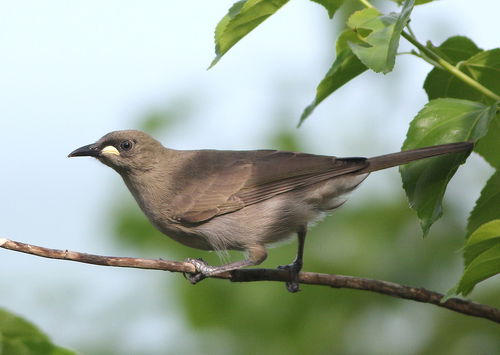
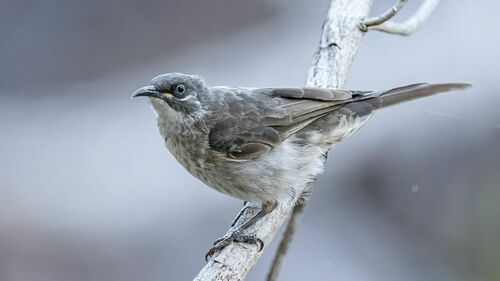
The yellow-throated miner (Manorina flavigula) is a species of colonial honeyeater, endemic to Australia. It is also known as the white-rumped miner. The distinctive white rump is easy to observe in the field and distinguishes it from the other miner species. Yellow-throated miners are medium-sized, grey passerines with yellow throat markings, legs, and bare patches around the eye. The common name 'miner' is an alternative spelling of the word myna, mynah or minah, and is shared with other members of the genus Manorina. Though miners were originally named due to their resemblance to the common myna of South and Southeast Asia that shares similar yellow eye-patch and legs, common mynas are from the starling family and are not closely related to the honeyeater family. Common mynas are an aggressive introduced pest in Australia, which causes some confusion with the native aggressive miners.

Yellow-throated miners feed on invertebrates, nectar, pollen, lerps, and seeds. They are the most widely distributed of the genus Manorina and inhabit open woodlands and scrublands across most of Australia. Yellow-throated miners live in groups, are social, noisy, and defend territory or resources from other avian species. Their behavior is generally compared to their close relative the noisy miner as they share postures, calls and interactions, though yellow-throated miners are not as well studied. Wikipedia →

Sounds

Call0:26

Australia · 2025

© Peter Boesman · XC1066667 · CC BY-NC-ND 4.0

Dawn song1:25

Australia · 2021

© James Lambert · XC671007 · CC BY-NC-ND 4.0

Uncertain0:08

Australia · 2020

© Liam Manderson · XC605836 · CC BY-NC-SA 4.0

Global Distribution

Parks Where Found

# Park Country Daily sighting probability
1 Flinders Ranges National Park 🇦🇺 Australia
~80%
2 Uluru-Kata Tjuta National Park 🇦🇺 Australia
~60%
3 Ningaloo Marine Park 🇦🇺 Australia
~20%
4 Hattah-Kulkyne National Park 🇦🇺 Australia
~10%
5 Cape Range 🇦🇺 Australia
~10%
6 Kakadu National Park 🇦🇺 Australia
~10%
7 Nitmiluk National Park 🇦🇺 Australia
<5%

Cities Where Found

# City Country Daily sighting probability
1 Perth 🇦🇺 Australia
<5%

Zoos & Centres Where Found

# Zoo / Centre Country
1 Alice Springs Desert Park 🇦🇺 Australia In captivity

Before you go

What are the chances of seeing a Yellow-throated Miner in Kakadu National Park?

With luck

About 10% of wildlife watchers report a Yellow-throated Miner sighting in Kakadu National Park on a given day, based on 100 verified sightings from GBIF citizen-science data from 2019 to 2026. It is the 110th most-seen of the 186 birds we can rate there. Over three days the chance rises to about 20%, and over a week to about 40%, if each day is a fresh chance.

When is the best time to see a Yellow-throated Miner in Kakadu National Park?

August to October

In those months about 10% of wildlife watchers report a Yellow-throated Miner in Kakadu National Park on a given day, against under 5% in March–July and November–January, the lowest months. Those are among Kakadu National Park's driest months, with about 20 mm of rain a month against 350 mm in January. February has too few records to rate.

What time of day is best to see a Yellow-throated Miner?

Between 3 and 6 pm

Across all the parks we cover, that three-hour window holds the most Yellow-throated Miner sightings with a recorded time, and about 9 in 10 of them come between 6 am and 6 pm: it is a daytime animal.

Which relatives of the Yellow-throated Miner live in Kakadu National Park?

Same family: Meliphagidae

The closest relatives of the Yellow-throated Miner that you can see in Kakadu National Park (family Meliphagidae, Honeyeaters) are White-gaped Honeyeater (about 50%), White-throated Honeyeater (about 50%) and Dusky Honeyeater (about 40%), with each one's daily chance of a sighting.

Where does the Yellow-throated Miner sighting chance come from?

GBIF citizen-science records

It is estimated from how often the Yellow-throated Miner is recorded against all the birds logged in Kakadu National Park (100 verified sightings from 2019 to 2026), calibrated against known sighting rates. Figures are rounded to the nearest 10% because citizen-science data supports honest approximations, not decimals, and months with records from fewer than five people show "—". How it works.

← Back to Kakadu National Park