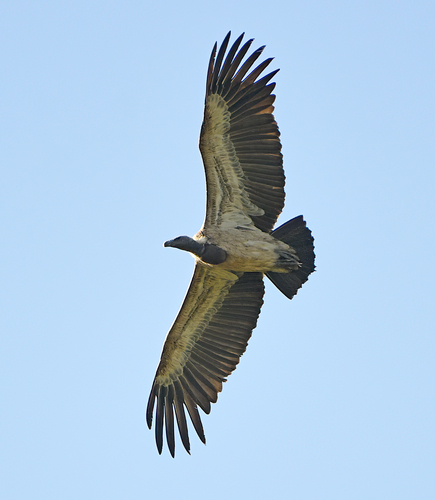
About the Indian White-rumped Vulture
The white-rumped vulture (Gyps bengalensis) is an Old World vulture native to South and Southeast Asia. It has been listed as Critically Endangered on the IUCN Red List since 2000, as the population severely declined. White-rumped vultures are threatened by diclofenac poisoning, which kills them by causing kidney failure.
As of 2021, the global population was estimated at less than 6,000 mature individuals. In comparison, during the 1980s, the global population was estimated at several million individuals, and it was thought to be "the most abundant large bird of prey in the world".
It is closely related to the European griffon vulture (Gyps fulvus). At one time it was believed to be closer to the white-backed vulture of Africa and was known as the Oriental white-backed vulture. The white-rumped vulture was formally described in 1788 by the German naturalist Johann Friedrich Gmelin in his revised and expanded edition of Carl Linnaeus's Systema Naturae. He placed it with the vultures in the genus Vultur and coined the binomial name Vultur bengalensis.
Gmelin based his description on the "Bengal vulture" that had been described and illustrated in 1781 by the English ornithologist... Wikipedia →