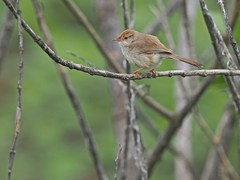
Rufous-fronted Prinia

Rufous-fronted Prinia

Prinia buchanani

Silhouette: Sheatherius · PhyloPic

LCLeast ConcernNTVUENCR
Daily sighting probability <5% · Rare
at Keoladeo National Park

In 3 days ~10%

40 Verified sightings at Keoladeo National Park From 2019 to 2026
224 In all 2 parks
August Best month
☀️ Diurnal When it's spotted

About the Rufous-fronted Prinia

The rufous-fronted prinia (Prinia buchanani) is a species of bird in the family Cisticolidae. It is found in India and Pakistan. Its natural habitat is subtropical or tropical dry forest. The species was described by Edward Blyth on the basis of an illustration of the bird from Bengal in the collections of Buchanan Hamilton.

The rufous-fronted prinia is a small stocky bird, generally 12 cm long and weighing between 5 and 6 grams. The upper parts are sandy color. The lower parts are off-white. The legs and toes are pink. Remiges and tail feathers are also sandy color. The underside of the tail is creamy white. The head is olive brown, and the bird has a pale eyebrow and a thin red eye circle. The beak is a classic insectivore, thin and slightly curved, and the eyes are reddish-orange.

The nest is made of strips of grass woven together. It is built at one or two meters from the ground. The female generally lays between two and four eggs. The rufous-fronted prinia is located in India and Pakistan. The species inhabits subtropical or tropical dry forest. It is also present in rocky areas, artificial land areas and dry open... Wikipedia →

Sounds

Song0:21

India · 2025

© Peter Boesman · XC1030806 · CC BY-NC-ND 4.0

Call0:05

India · 2012

© Jelle Scharringa · XC641460 · CC BY-NC-SA 4.0

Song0:31

India · 2019

© Ramesh Desai · XC511043 · CC BY-NC-SA 4.0

Global Distribution

Parks Where Found

# Park Country Daily sighting probability
1 Ranthambore National Park 🇮🇳 India
~10%
2 Keoladeo National Park 🇮🇳 India
<5%

Cities Where Found

# City Country Daily sighting probability
1 Jodhpur 🇮🇳 India
~10%
2 Jaipur 🇮🇳 India
<5%
3 New Delhi 🇮🇳 India
<5%

Before you go

What are the chances of seeing a Rufous-fronted Prinia in Keoladeo National Park?

Rare

Under 5% of wildlife watchers report a Rufous-fronted Prinia sighting in Keoladeo National Park on a given day, based on 40 verified sightings from GBIF citizen-science data from 2019 to 2026. It is the 202nd most-seen of the 278 birds we can rate there. Over three days the chance rises to about 10%, if each day is a fresh chance.

When is the best time to see a Rufous-fronted Prinia in Keoladeo National Park?

Any time of year

In every month with enough records, under 5% of wildlife watchers report a Rufous-fronted Prinia in Keoladeo National Park on a given day, so our monthly data shows no clear season.

What time of day is best to see a Rufous-fronted Prinia?

Between 8 and 11 am

Across all the parks we cover, that three-hour window holds the most Rufous-fronted Prinia sightings with a recorded time, and about 9 in 10 of them come between 6 am and 6 pm: it is a daytime animal.

Is Keoladeo National Park the best place to see a Rufous-fronted Prinia?

2nd of 2

Of the 2 parks where we can rate Rufous-fronted Prinia sightings, Keoladeo National Park ranks 2nd at under 5%. The best odds are in Ranthambore National Park (India, about 10%).

Which relatives of the Rufous-fronted Prinia live in Keoladeo National Park?

Same genus: Prinia

The closest relatives of the Rufous-fronted Prinia that you can see in Keoladeo National Park (genus Prinia, Prinias) are Ashy Prinia (about 60%) and Plain Prinia (about 50%), with each one's daily chance of a sighting.

Where does the Rufous-fronted Prinia sighting chance come from?

GBIF citizen-science records

It is estimated from how often the Rufous-fronted Prinia is recorded against all the birds logged in Keoladeo National Park (40 verified sightings from 2019 to 2026), calibrated against known sighting rates. Figures are rounded to the nearest 10% because citizen-science data supports honest approximations, not decimals, and months with records from fewer than five people show "—". How it works.

← Back to Keoladeo National Park