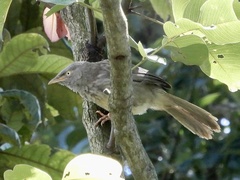
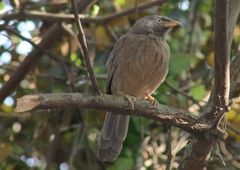
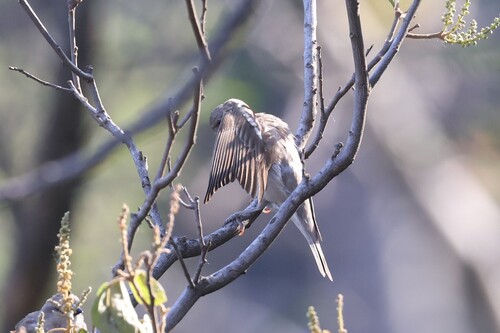
Jungle Babbler

Jungle Babbler

Turdoides striata

Silhouette: Jiekun He · PhyloPic

Daily sighting probability ~80% · Very likely
at Keoladeo National Park

In 3 days >90%

2,143 Verified sightings at Keoladeo National Park From 2019 to 2026
23,821 In all 18 parks
May Best month
☀️ Diurnal When it's spotted

About the Jungle Babbler

The jungle babbler (Argya striata) is a member of the family Leiothrichidae found in the Indian subcontinent. Jungle babblers are gregarious birds that forage in small groups of six to ten birds, a habit that has given them the popular name of "seven sisters" in urban Northern India, and (seven brothers) in Bengali, with cognates in other regional languages which also mean "seven brothers".

The jungle babbler is a common resident breeding bird in most parts of the Indian subcontinent and is often seen in gardens within large cities as well as in forested areas. In the past, the orange-billed babbler Argya rufescens of Sri Lanka was considered to be a subspecies of jungle babbler, but has now been elevated to a species.

The jungle babbler was described by the French zoologist Charles Dumont de Sainte Croix in 1823, based on specimens from Bengal. He coined the binomial name Cossyphus striatus. This babbler was formerly placed in the genus Turdoides but following the publication of a comprehensive molecular phylogenetic study in 2018, it was moved to the resurrected genus Argya.

There are several named geographically isolated subspecies that show plumage shade differences... Wikipedia →

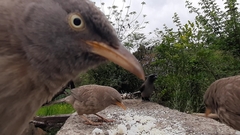
Sounds

Recording0:24

India · 2021

© Ashitha. K. A · iNaturalist · CC BY-NC 4.0

Recording0:17

India · 2023

© Zach DuFran · iNaturalist · CC BY-NC 4.0

Recording0:30

India · 2024

© Ashwin A · iNaturalist · CC BY 4.0

Global Distribution

Parks Where Found

# Park Country Daily sighting probability
1 Keoladeo National Park 🇮🇳 India
~80%
2 Ranthambore National Park 🇮🇳 India
~80%
3 Bandhavgarh National Park 🇮🇳 India
~70%
4 Kanha National Park 🇮🇳 India
~60%
5 Jim Corbett National Park 🇮🇳 India
~60%
6 Gir National Park 🇮🇳 India
~60%
7 Satpura National Park 🇮🇳 India
~60%
8 Periyar National Park 🇮🇳 India
~50%
9 Nagarhole National Park 🇮🇳 India
~40%
10 Chitwan National Park 🇳🇵 Nepal
~40%
11 Royal Bardia National Park 🇳🇵 Nepal
~40%
12 Mudumalai National Park 🇮🇳 India
~30%
13 Bandipur National Park 🇮🇳 India
~30%
14 Manas National Park 🇮🇳 India
~30%
15 Sundarbans National Park 🇮🇳 India
~10%
16 Eravikulam National Park 🇮🇳 India
~10%
17 Royal Manas National Park 🇧🇹 Bhutan
<5%
18 Kaziranga National Park 🇮🇳 India
<5%

Cities Where Found

# City Country Daily sighting probability
1 Jalandhar 🇮🇳 India
~90%
2 Tamluk 🇮🇳 India
~80%
3 Bhubaneshwar 🇮🇳 India
~80%
4 Ahmedabad 🇮🇳 India
~80%
5 Bareilly 🇮🇳 India
~80%
6 Prayagraj 🇮🇳 India
~80%
7 Hajipur 🇮🇳 India
~70%
8 Vadodara 🇮🇳 India
~70%
9 Aligarh 🇮🇳 India
~70%
10 New Delhi 🇮🇳 India
~70%

Before you go

What are the chances of seeing a Jungle Babbler in Keoladeo National Park?

Very likely

About 80% of wildlife watchers report a Jungle Babbler sighting in Keoladeo National Park on a given day, based on 2,143 verified sightings from GBIF citizen-science data from 2019 to 2026. It is the 7th most-seen of the 278 birds we can rate there. Over three days the chance rises to over 90%, if each day is a fresh chance.

When is the best time to see a Jungle Babbler in Keoladeo National Park?

May

In that month about 90% of wildlife watchers report a Jungle Babbler in Keoladeo National Park on a given day, against about 60% in July, the lowest month. That is one of Keoladeo National Park's driest months, with about 20 mm of rain against 240 mm in July.

What time of day is best to see a Jungle Babbler?

Between 7 and 10 am

Across all the parks we cover, that three-hour window holds the most Jungle Babbler sightings with a recorded time, and about 9 in 10 of them come between 6 am and 6 pm: it is a daytime animal.

Which relatives of the Jungle Babbler live in Keoladeo National Park?

Same genus: Turdoides

The closest relatives of the Jungle Babbler that you can see in Keoladeo National Park (genus Turdoides, Turdoides Babblers) are Large Grey Babbler (about 30%) and Common Babbler (about 30%), with each one's daily chance of a sighting.

Where does the Jungle Babbler sighting chance come from?

GBIF citizen-science records

It is estimated from how often the Jungle Babbler is recorded against all the birds logged in Keoladeo National Park (2,143 verified sightings from 2019 to 2026), calibrated against known sighting rates. Figures are rounded to the nearest 10% because citizen-science data supports honest approximations, not decimals, and months with records from fewer than five people show "—". How it works.

← Back to Keoladeo National Park