Whiskered Treeswift

Whiskered Treeswift

Hemiprocne comata

Silhouette: Sheatherius · PhyloPic

LCLeast ConcernNTVUENCR
Daily sighting probability ~20% · Possible
at Khao Luang National Park

In 3 days ~50% in a week ~80%

123 Verified sightings at Khao Luang National Park From 2019 to 2026
1,352 In all 9 parks
October Best month
🌅 Crepuscular When it's spotted

About the Whiskered Treeswift

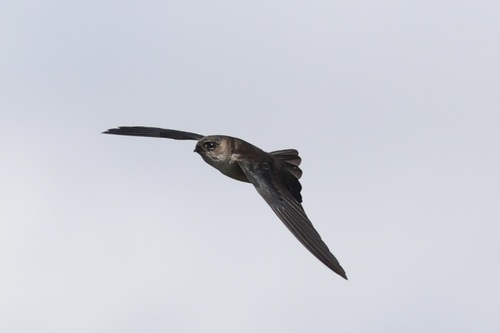
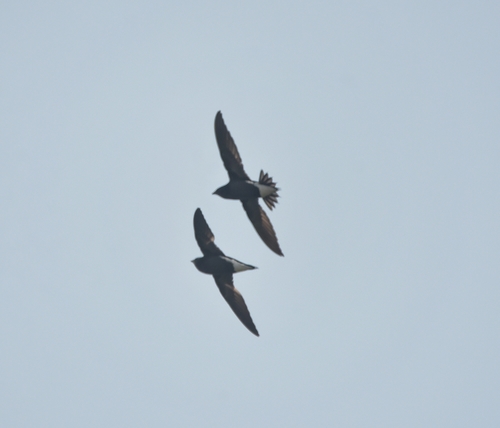
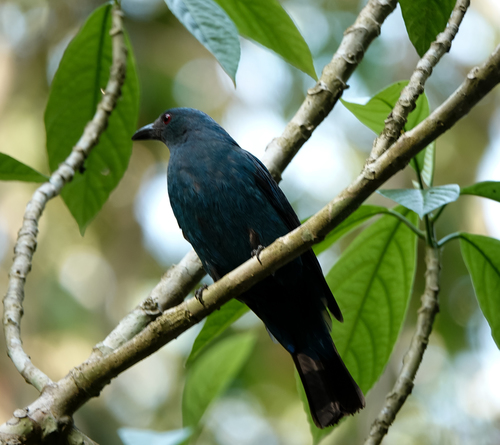
The whiskered treeswift (Hemiprocne comata) is a species of bird in the family Hemiprocnidae. It is the smallest of 4 species in genus Hemiprocne and is found in Brunei, Indonesia, Malaysia, Myanmar, the Philippines, Singapore, and Thailand.

Its natural habitats are subtropical or tropical moist lowland forest, subtropical or tropical mangrove forest, and subtropical or tropical moist montane forest. Medium, unique white elongated 'whiskers' above and below eye, shaggy crest, deeply forked tail, sexes similar. Male lores black; two elongated white 'whiskers', one above eye from forehead extending past nape; ear chestnut; rest of head and throat, tail, upper and underwing coverts, and primaries dark metallic blue. Each secondary has a large white spot on inner web; back to uppertail coverts, breast and upper belly bronze olive; lower belly and undertail coverts white. Female lacks chestnut ear. Immature plumage not known. Bill black; eye dark brown; legs purplish brown.

Whiskered treeswifts are usually 14-16cm long with 13cm wings. Due to their small size, their nesting habitats have been observed to be composed of small feathers. These feathers are shaped... Wikipedia →

Sounds

Song0:23

Philippines · 2024

© Greg Irving · XC897540 · CC BY-NC-SA 4.0

Call0:24

Philippines · 2020

© Frank Lambert · XC616494 · CC BY-NC-ND 4.0

Recording0:04

Malaysia · 2025

© Nick Talbot · XC1036852 · CC BY-NC-SA 4.0

Global Distribution

Parks Where Found

# Park Country Daily sighting probability
1 Danum Valley Conservation Area 🇲🇾 Malaysia
~50%
2 Khao Luang National Park 🇹🇭 Thailand
~20%
3 Khao Sok National Park 🇹🇭 Thailand
~10%
4 Kerinci Seblat National Park 🇮🇩 Indonesia
~10%
5 Way Kambas National Park 🇮🇩 Indonesia
~10%
6 Gunung Leuser National Park 🇮🇩 Indonesia
~10%
7 Taman Negara National Park 🇲🇾 Malaysia
~10%
8 Sepilok 🇲🇾 Malaysia
<5%
9 Kaeng Krachan National Park 🇹🇭 Thailand
<5%

Cities Where Found

# City Country Daily sighting probability
1 Kuala Lumpur 🇲🇾 Malaysia
<5%

Before you go

What are the chances of seeing a Whiskered Treeswift in Khao Luang National Park?

Possible

About 20% of wildlife watchers report a Whiskered Treeswift sighting in Khao Luang National Park on a given day, based on 123 verified sightings from GBIF citizen-science data from 2019 to 2026. It is the 81st most-seen of the 215 birds we can rate there. Over three days the chance rises to about 50%, and over a week to about 80%, if each day is a fresh chance.

When is the best time to see a Whiskered Treeswift in Khao Luang National Park?

October

In that month about 40% of wildlife watchers report a Whiskered Treeswift in Khao Luang National Park on a given day, against about 10% in January, June–July and November, the lowest months. That is one of Khao Luang National Park's wettest months, with about 290 mm of rain against 65 mm in March.

What time of day is best to see a Whiskered Treeswift?

Between 9 am and noon

Across all the parks we cover, that three-hour window holds the most Whiskered Treeswift sightings with a recorded time, and about half of them come between 6 am and 6 pm: it is most active around dawn and dusk.

Is Khao Luang National Park the best place to see a Whiskered Treeswift?

2nd of 9

Of the 9 parks where we can rate Whiskered Treeswift sightings, Khao Luang National Park ranks 2nd at about 20%. The best odds are in Danum Valley Conservation Area (Malaysia, about 50%).

Where does the Whiskered Treeswift sighting chance come from?

GBIF citizen-science records

It is estimated from how often the Whiskered Treeswift is recorded against all the birds logged in Khao Luang National Park (123 verified sightings from 2019 to 2026), calibrated against known sighting rates. Figures are rounded to the nearest 10% because citizen-science data supports honest approximations, not decimals, and months with records from fewer than five people show "—". How it works.

← Back to Khao Luang National Park