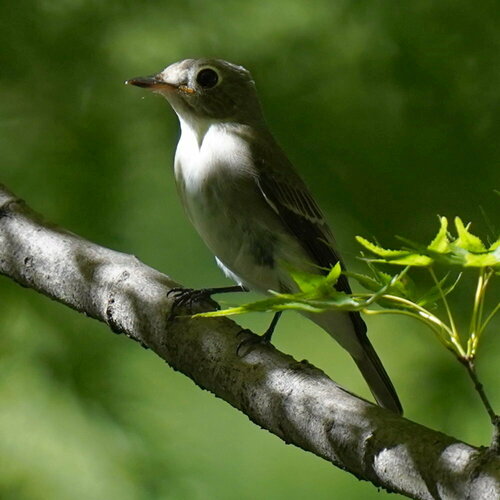
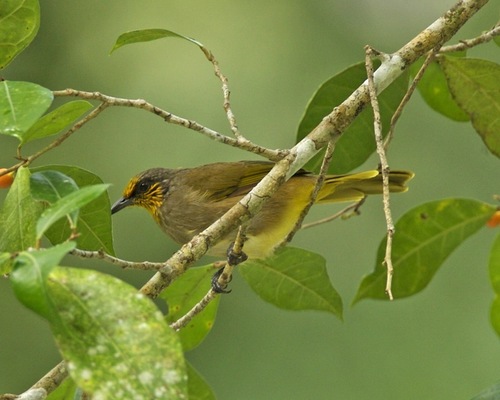
Banded Broadbill

Banded Broadbill

Eurylaimus javanicus

Silhouette: Sheatherius · PhyloPic

LCLeast ConcernNTVUENCR
Daily sighting probability <5% · Rare
at Khao Sok National Park

In 3 days ~10% in a week ~20%

22 Verified sightings at Khao Sok National Park From 2019 to 2026
2,353 In all 12 parks
May Best month
🌅 Crepuscular When it's spotted

About the Banded Broadbill

The banded broadbill (Eurylaimus javanicus) is a species of bird in the typical broadbill family Eurylaimidae found in Mainland Southeast Asia and the Greater Sunda Islands. It is sometimes split into two species, one including only the nominate subspecies, E. j. javanicus, and one including all the remaining subspecies. It inhabits a variety of forests, along with forest edge, rubber plantations and Falcataria falcata groves, mainly in lowland areas. A striking, large-bodied bird with a length of 21.5–23.0 cm (8.5–9.1 in), it is unlikely to be mistaken for another species. The broadbill is mostly purplish-red, with yellow-streaked black wings, a bright blue beak, a blackish face and greyish chin and upper breast. Females can be told apart from males by their lack of a black neckband, although these are indistinct in Bornean and Javan males. Despite its conspicuous appearance, the bird is usually hard to see due to its sluggishness and is usually only noticed when it vocalises.

The species mainly eats arthropods such as orthopterans (grasshoppers, katydids and crickets), true bugs and beetles, but has also been recorded feeding on snails, lizards, frogs and figs. On the mainland, breeding generally occurs during the dry season; populations in the Greater Sundas have a longer breeding season lasting from March to November. On Java, the broadbill is thought to breed year-round. Their large, raggedy nests are hung from trees at a height of 6–21 m (20–69 ft) over clearings or water bodies. Clutches have two or three eggs. The eggs are usually dull white with dark purple or reddish-brown flecks, but those from West Java are dirty white with dense rusty-brown to lavender-grey markings. The International Union for Conservation of Nature, which splits the banded broadbill into two species, classifies javanicus as being near-threatened and the other subspecies as being of least concern. Wikipedia →

Sounds

Call0:05

Vietnam · 2026

© Tim Dinh / Annambirding · XC1157102 · CC BY-NC-SA 4.0

Duet0:31

Cambodia · 2026

© JJSUN · XC1103657 · CC BY-NC-SA 4.0

Song0:16

Thailand · 2016

© Thijs Fijen · XC327415 · CC BY-NC-SA 4.0

Global Distribution

Parks Where Found

# Park Country Daily sighting probability
1 Way Kambas National Park 🇮🇩 Indonesia
~40%
2 Khao Luang National Park 🇹🇭 Thailand
~30%
3 Kaeng Krachan National Park 🇹🇭 Thailand
~20%
4 Danum Valley Conservation Area 🇲🇾 Malaysia
~20%
5 Cat Tien National Park 🇻🇳 Vietnam
~20%
6 Khao Yai National Park 🇹🇭 Thailand
~10%
7 Taman Negara National Park 🇲🇾 Malaysia
~10%
8 Sepilok 🇲🇾 Malaysia
<5%
9 Khao Sok National Park 🇹🇭 Thailand
<5%
10 Kerinci Seblat National Park 🇮🇩 Indonesia
<5%
11 Kinabatangan Wildlife Sanctuary 🇲🇾 Malaysia
<5%
12 Kinabalu Park 🇲🇾 Malaysia
<5%

Cities Where Found

# City Country Daily sighting probability
1 Kuala Lumpur 🇲🇾 Malaysia
~10%

Before you go

What are the chances of seeing a Banded Broadbill in Khao Sok National Park?

Rare

Under 5% of wildlife watchers report a Banded Broadbill sighting in Khao Sok National Park on a given day, based on 22 verified sightings from GBIF citizen-science data from 2019 to 2026. It is the 157th most-seen of the 213 birds we can rate there. Over three days the chance rises to about 10%, and over a week to about 20%, if each day is a fresh chance.

When is the best time to see a Banded Broadbill in Khao Sok National Park?

May

In that month about 20% of wildlife watchers report a Banded Broadbill in Khao Sok National Park on a given day, against under 5% in June to April, the lowest months.

What time of day is best to see a Banded Broadbill?

Between 2 and 5 am

Across all the parks we cover, that three-hour window holds the most Banded Broadbill sightings with a recorded time, and about 6 in 10 of them come between 6 pm and 6 am: it is most active around dawn and dusk.

Where does the Banded Broadbill sighting chance come from?

GBIF citizen-science records

It is estimated from how often the Banded Broadbill is recorded against all the birds logged in Khao Sok National Park (22 verified sightings from 2019 to 2026), calibrated against known sighting rates. Figures are rounded to the nearest 10% because citizen-science data supports honest approximations, not decimals, and months with records from fewer than five people show "—". How it works.

← Back to Khao Sok National Park