
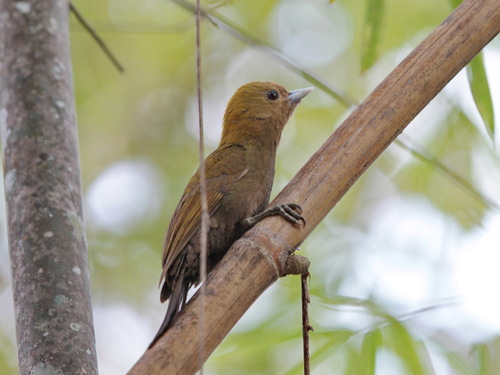
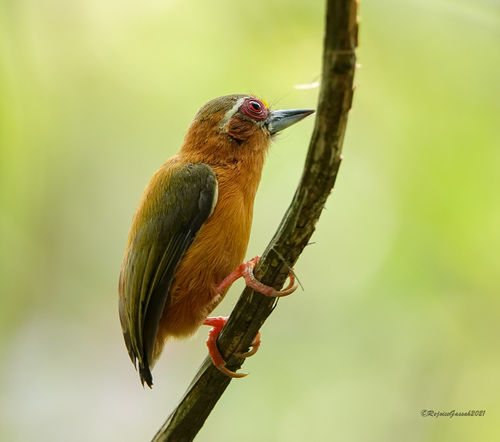
Banded Woodpecker

Banded Woodpecker

Chrysophlegma miniaceum

Silhouette: Pepe Reigada · PhyloPic

LCLeast ConcernNTVUENCR
Daily sighting probability ~20% · Possible
at Khao Sok National Park

In 3 days ~50% in a week ~80%

142 Verified sightings at Khao Sok National Park From 2019 to 2026
1,421 In all 10 parks
March Best month
🌅 Crepuscular When it's spotted

About the Banded Woodpecker

The banded woodpecker (Chrysophlegma miniaceum) or the banded red woodpecker is a species of bird in the family Picidae. It is found in Brunei, Indonesia, Malaysia, Myanmar, Singapore, and Thailand. Its natural habitats are subtropical or tropical moist lowland forests and subtropical or tropical mangrove forests.

The upper parts of the banded woodpecker are predominantly rufous-brown. The mantle is dull olive scaled with buff and the rump is yellow. The tail is chocolate-brown. The head is mostly rufous-brown with a shaggy yellowish nape. The chin, neck and throat are reddish-brown, the breast reddish barred with olive and the belly whitish, heavily barred with brownish-black. The sexes differ slightly; the male has a redder face and throat while the female's face and throat are browner, flecked with white. Both sexes have a dark beak, a chestnut eye with a bluish orbital ring, and greenish legs. Adult birds are about 26 cm (10 in) long.

The species is native to tropical southeastern Asia. Its range extends from southern Myanmar through the Malay Peninsula, Sumatra and Borneo to Java. It is a sedentary, non-migratory species and is mainly... Wikipedia →

Sounds

Call1:07

Malaysia · 2025

© Ding Li Yong · XC991998 · CC BY-NC-ND 4.0

Call0:15

Malaysia · 2023

© Lim Ying Hien · XC822484 · CC BY-NC-ND 4.0

Call1:10

Singapore · 2022

© James Lambert · XC764720 · CC BY-NC-ND 4.0

Global Distribution

Parks Where Found

# Park Country Daily sighting probability
1 Way Kambas National Park 🇮🇩 Indonesia
~50%
2 Khao Sok National Park 🇹🇭 Thailand
~20%
3 Khao Luang National Park 🇹🇭 Thailand
~20%
4 Sepilok 🇲🇾 Malaysia
~20%
5 Taman Negara National Park 🇲🇾 Malaysia
~20%
6 Gunung Leuser National Park 🇮🇩 Indonesia
~10%
7 Kinabatangan Wildlife Sanctuary 🇲🇾 Malaysia
~10%
8 Kerinci Seblat National Park 🇮🇩 Indonesia
<5%
9 Danum Valley Conservation Area 🇲🇾 Malaysia
<5%
10 Kinabalu Park 🇲🇾 Malaysia
<5%

Cities Where Found

# City Country Daily sighting probability
1 Kuala Lumpur 🇲🇾 Malaysia
~30%
2 Singapore 🇸🇬 Singapore
~20%
3 Kuching 🇲🇾 Malaysia
~10%
4 Johor Bahru 🇲🇾 Malaysia
~10%

Before you go

What are the chances of seeing a Banded Woodpecker in Khao Sok National Park?

Possible

About 20% of wildlife watchers report a Banded Woodpecker sighting in Khao Sok National Park on a given day, based on 142 verified sightings from GBIF citizen-science data from 2019 to 2026. It is the 48th most-seen of the 213 birds we can rate there. Over three days the chance rises to about 50%, and over a week to about 80%, if each day is a fresh chance.

When is the best time to see a Banded Woodpecker in Khao Sok National Park?

March

In that month about 40% of wildlife watchers report a Banded Woodpecker in Khao Sok National Park on a given day, against under 5% in July, the lowest month. That is one of Khao Sok National Park's driest months, with about 55 mm of rain against 280 mm in October.

What time of day is best to see a Banded Woodpecker?

Between 1 and 4 am

Across all the parks we cover, that three-hour window holds the most Banded Woodpecker sightings with a recorded time, and about 6 in 10 of them come between 6 pm and 6 am: it is most active around dawn and dusk.

Is Khao Sok National Park the best place to see a Banded Woodpecker?

2nd of 10

Of the 10 parks where we can rate Banded Woodpecker sightings, Khao Sok National Park ranks 2nd at about 20%. The best odds are in Way Kambas National Park (Indonesia, about 50%). All parks ranked.

Where does the Banded Woodpecker sighting chance come from?

GBIF citizen-science records

It is estimated from how often the Banded Woodpecker is recorded against all the birds logged in Khao Sok National Park (142 verified sightings from 2019 to 2026), calibrated against known sighting rates. Figures are rounded to the nearest 10% because citizen-science data supports honest approximations, not decimals, and months with records from fewer than five people show "—". How it works.

← Back to Khao Sok National Park