
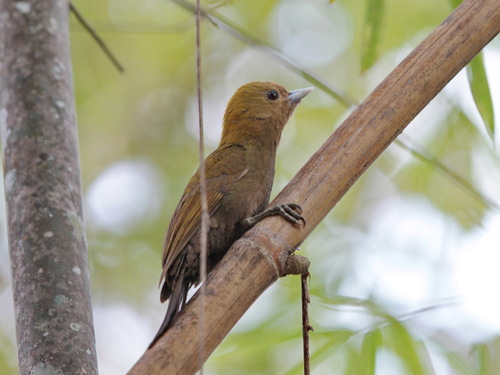
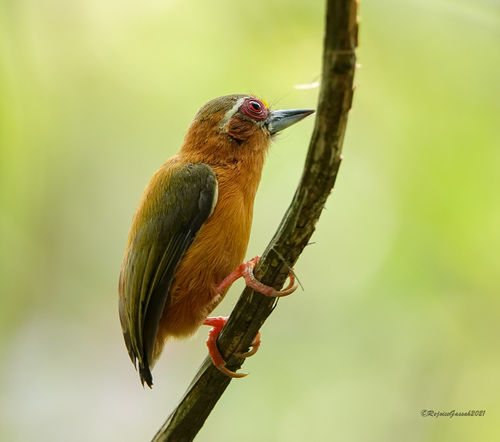
White-rumped Woodpecker

White-rumped Woodpecker

Meiglyptes tristis

Silhouette: Pepe Reigada · PhyloPic

LCNTVUENEndangeredCR
Daily sighting probability <5% · Rare
at Khao Sok National Park

In 3 days ~10% in a week ~30%

41 Verified sightings at Khao Sok National Park From 2019 to 2026
1,455 In all 11 parks
April Best month
🌙 Nocturnal When it's spotted

About the White-rumped Woodpecker

The zebra woodpecker (Meiglyptes tristis) is a species of bird in the family Picidae. It is found in Java. Its natural habitats are subtropical or tropical dry forests and subtropical or tropical moist lowland forests. It is considered endangered.

The zebra woodpecker was described by the American naturalist Thomas Horsfield in 1821 under the binomial name Picus tristis from a specimen collected in Java. The specific epithet tristis is Latin for "sad" or "gloomy". The species is now placed in the genus Meiglyptes that was introduced by the English naturalist William Swainson in 1837.

The zebra woodpecker is a monotypic species, but it was previously considered conspecific with the buff-rumped woodpecker as two subspecies. It is found in plantations of coconuts, rubber, and silk plants; villages that border secondary forest; mangroves; and polyculture areas. It is known to access disturbed habitats. It is disputed whether zebra woodpeckers are found within primary and secondary forests.

Image at ADW Archived 2008-10-11 at the Wayback Machine Wikipedia →

Sounds

Call0:36

Malaysia · 2026

© Ding Li Yong · XC1153553 · CC BY-NC-ND 4.0

Song0:40

Malaysia · 2016

© Frank Lambert · XC523387 · CC BY-NC-ND 4.0

Drumming0:50

Malaysia · 2010

© Rolf A. de By · XC65341 · CC BY-NC-ND 2.5

Global Distribution

Parks Where Found

# Park Country Daily sighting probability
1 Khao Luang National Park 🇹🇭 Thailand
~30%
2 Way Kambas National Park 🇮🇩 Indonesia
~20%
3 Danum Valley Conservation Area 🇲🇾 Malaysia
~20%
4 Taman Negara National Park 🇲🇾 Malaysia
~20%
5 Sepilok 🇲🇾 Malaysia
~10%
6 Tanjung Puting National Park 🇮🇩 Indonesia
~10%
7 Kaeng Krachan National Park 🇹🇭 Thailand
~10%
8 Khao Sok National Park 🇹🇭 Thailand
<5%
9 Gunung Leuser National Park 🇮🇩 Indonesia
<5%
10 Kinabatangan Wildlife Sanctuary 🇲🇾 Malaysia
<5%
11 Kinabalu Park 🇲🇾 Malaysia
<5%

Cities Where Found

# City Country Daily sighting probability
1 Kuala Lumpur 🇲🇾 Malaysia
<5%

Before you go

What are the chances of seeing a White-rumped Woodpecker in Khao Sok National Park?

Rare

Under 5% of wildlife watchers report a White-rumped Woodpecker sighting in Khao Sok National Park on a given day, based on 41 verified sightings from GBIF citizen-science data from 2019 to 2026. It is the 130th most-seen of the 213 birds we can rate there. Over three days the chance rises to about 10%, and over a week to about 30%, if each day is a fresh chance.

When is the best time to see a White-rumped Woodpecker in Khao Sok National Park?

February to May

In those months about 10% of wildlife watchers report a White-rumped Woodpecker in Khao Sok National Park on a given day, against under 5% in June to January, the lowest months.

What time of day is best to see a White-rumped Woodpecker?

Between 1 and 4 am

Across all the parks we cover, that three-hour window holds the most White-rumped Woodpecker sightings with a recorded time, and about 7 in 10 of them come between 6 pm and 6 am: it is mostly seen at night.

Which relatives of the White-rumped Woodpecker live in Khao Sok National Park?

Same family: Picidae

The closest relatives of the White-rumped Woodpecker that you can see in Khao Sok National Park (family Picidae, Woodpeckers) are Banded Woodpecker (about 20%), Grey-capped Woodpecker (about 20%) and Maroon Woodpecker (about 10%), with each one's daily chance of a sighting.

Where does the White-rumped Woodpecker sighting chance come from?

GBIF citizen-science records

It is estimated from how often the White-rumped Woodpecker is recorded against all the birds logged in Khao Sok National Park (41 verified sightings from 2019 to 2026), calibrated against known sighting rates. Figures are rounded to the nearest 10% because citizen-science data supports honest approximations, not decimals, and months with records from fewer than five people show "—". How it works.

← Back to Khao Sok National Park