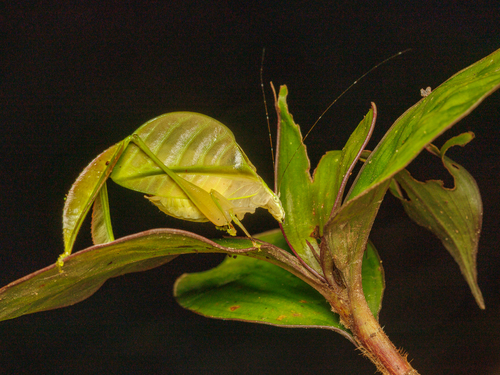
Javanese Grasshopper

Javanese Grasshopper

Valanga nigricornis

Daily sighting probability ~10% · With luck
at Kinabalu Park

In 3 days ~40% in a week ~70%

13 Verified sightings at Kinabalu Park From 2019 to 2026
24 In all 2 parks
July Best month
☀️ Diurnal When it's spotted

About the Javanese Grasshopper

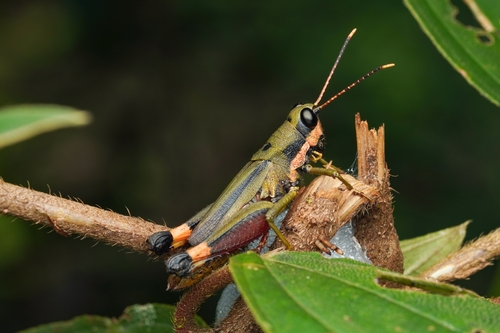
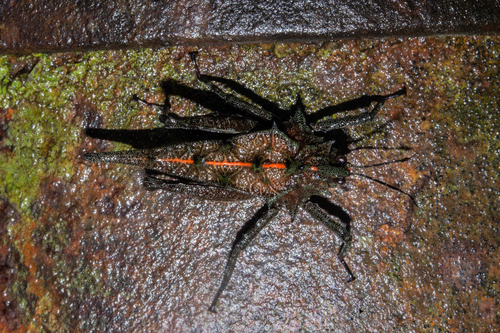
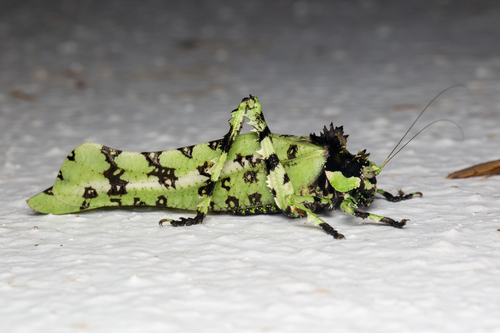
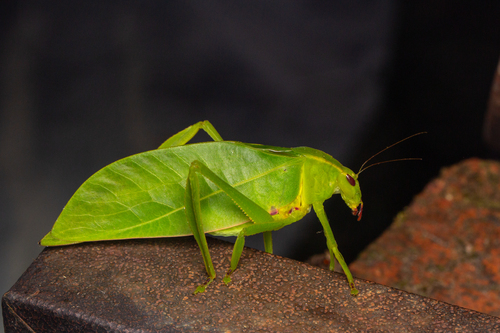
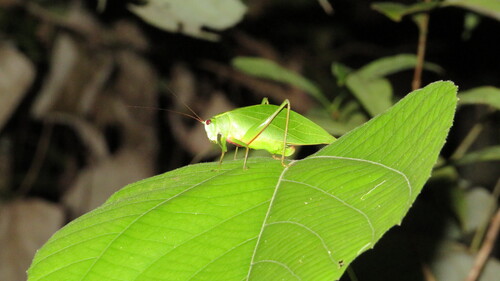
Valanga nigricornis, the Javanese grasshopper (also known as the Javanese bird grasshopper), is a species of grasshopper in the subfamily Cyrtacanthacridinae of the family Acrididae. It is found in southeastern Asia, the type location being Singapore. It was first described by the German zoologist Hermann Burmeister in 1838. There are more than twenty subspecies, most of which are endemic to different island groups; the subspecies V. nigricornis nigricornis is the type for the genus Valanga.

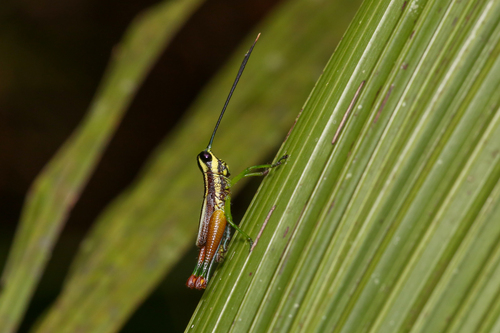
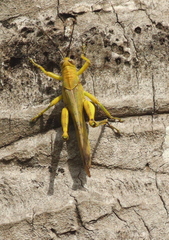
There is considerable sexual dimorphism in this species with the males measuring 45 to 55 millimetres (1+3⁄4 to 2+1⁄8 in) in length and the females 15 to 75 mm (5⁄8 to 3 in). The adults are yellowish-brown, yellowish or green with bluish-black markings. The hind wings, which are visible in flight, are rose red. The nymphs are pale green with dark markings.

The Javanese grasshopper is native to Brunei, Cambodia, Indonesia, Malaysia, Papua New Guinea, the Philippines, Singapore, the Solomon Islands, Thailand, and Vietnam. It is mainly a woodland species and is found in forest clearings, on trees and shrubs. It can be a serious pest in oil palm and rubber plantations... Wikipedia →

Global Distribution

Parks Where Found

# Park Country Daily sighting probability
1 Raja Ampat 🇮🇩 Indonesia
~20%
2 Kinabalu Park 🇲🇾 Malaysia
~10%

Cities Where Found

# City Country Daily sighting probability
1 Yogyakarta 🇮🇩 Indonesia
~40%
2 Tasikmalaya 🇮🇩 Indonesia
~40%
3 Johor Bahru 🇲🇾 Malaysia
~30%
4 Kuala Lumpur 🇲🇾 Malaysia
~30%
5 Jakarta 🇮🇩 Indonesia
~30%
6 Singapore 🇸🇬 Singapore
~20%
7 Semarang 🇮🇩 Indonesia
~20%
8 Surakarta 🇮🇩 Indonesia
~20%
9 Denpasar 🇮🇩 Indonesia
~20%
10 Kuching 🇲🇾 Malaysia
~20%

Before you go

What are the chances of seeing a Javanese Grasshopper in Kinabalu Park?

With luck

About 10% of wildlife watchers report a Javanese Grasshopper sighting in Kinabalu Park on a given day, based on 13 verified sightings from GBIF citizen-science data from 2019 to 2026. It is the 75th most-seen of the 297 insects we can rate there. Over three days the chance rises to about 40%, and over a week to about 70%, if each day is a fresh chance.

When is the best time to see a Javanese Grasshopper in Kinabalu Park?

July

In that month about 30% of wildlife watchers report a Javanese Grasshopper in Kinabalu Park on a given day, against under 5% in March–June and August, the lowest months.

What time of day is best to see a Javanese Grasshopper?

Between 10 am and 1 pm

Across all the parks we cover, that three-hour window holds the most Javanese Grasshopper sightings with a recorded time, and about 9 in 10 of them come between 6 am and 6 pm: it is a daytime animal.

Is Kinabalu Park the best place to see a Javanese Grasshopper?

2nd of 2

Of the 2 parks where we can rate Javanese Grasshopper sightings, Kinabalu Park ranks 2nd at about 10%. The best odds are in Raja Ampat (Indonesia, about 20%).

Which relatives of the Javanese Grasshopper live in Kinabalu Park?

Same family: Acrididae

The closest relatives of the Javanese Grasshopper that you can see in Kinabalu Park (family Acrididae, Short-horned Grasshoppers) are Short-Winged Rice Grasshopper (about 10%), Traulia bimaculata (about 10%) and Traulacris grandis (about 10%), with each one's daily chance of a sighting.

Where does the Javanese Grasshopper sighting chance come from?

GBIF citizen-science records

It is estimated from how often the Javanese Grasshopper is recorded against all the insects logged in Kinabalu Park (13 verified sightings from 2019 to 2026), calibrated against known sighting rates. Figures are rounded to the nearest 10% because citizen-science data supports honest approximations, not decimals, and months with records from fewer than five people show "—". How it works.

← Back to Kinabalu Park