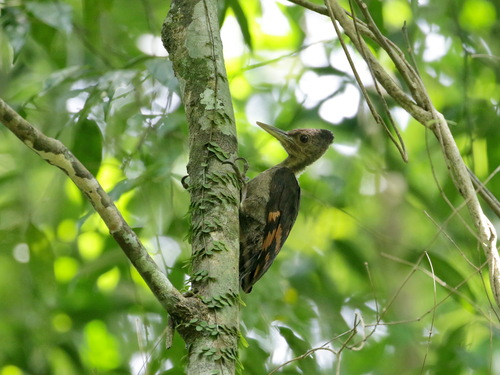
Rufous Piculet

Rufous Piculet

Sasia abnormis

Silhouette: Pepe Reigada · PhyloPic

LCLeast ConcernNTVUENCR
Daily sighting probability <5% · Rare
at Kinabalu Park

In 3 days <5% in a week ~10%

35 Verified sightings at Kinabalu Park From 2019 to 2026
968 In all 10 parks
May Best month
🌅 Crepuscular When it's spotted

About the Rufous Piculet

The rufous piculet (Sasia abnormis) is a species of bird in the family Picidae. It is found in Brunei, Indonesia, Malaysia, Myanmar, and Thailand. Its natural habitats are subtropical or tropical moist lowland forests and subtropical or tropical moist montane forests. This species is one of the world's smallest woodpeckers and is the smallest woodpecker found outside the Americas. In this species the length can range from 8 to 10 cm (3 to 4 in) and the average body mass is around 9.2 g (0.32 oz).

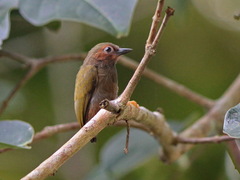
The rufous piculet is a very small bird with short wings and an almost non-existent tail, ranging in length from 8 to 10 cm (3 to 4 in). The upper parts are generally green tinted with bronze, and the underparts rufous, orange or cinnamon, with paler flanks. The mantle and back are olive, the wings are brownish above, and the underwings are buff. The stumpy tail is blackish above, edged with olive. The sexes are different; the male has a yellow or golden patch on the forehead whereas the female has a bronze patch. They also differ in that the female has a larger beak. The upper mandible in both sexes is blackish and the lower mandible yellowish. The iris is reddish and there... Wikipedia →

Sounds

Call0:05

Malaysia · 2026

© Ding Li Yong · XC1076862 · CC BY-NC-ND 4.0

Song0:16

Thailand · 2022

© Somkiat Pakapinyo (Chai) · XC716672 · CC BY-NC-SA 4.0

Drumming0:17

Malaysia · 2009

© Mike Nelson · XC46582 · CC BY-NC-SA 3.0

Global Distribution

Parks Where Found

# Park Country Daily sighting probability
1 Danum Valley Conservation Area 🇲🇾 Malaysia
~20%
2 Tanjung Puting National Park 🇮🇩 Indonesia
~20%
3 Sepilok 🇲🇾 Malaysia
~10%
4 Taman Negara National Park 🇲🇾 Malaysia
~10%
5 Khao Luang National Park 🇹🇭 Thailand
~10%
6 Gunung Leuser National Park 🇮🇩 Indonesia
~10%
7 Way Kambas National Park 🇮🇩 Indonesia
~10%
8 Kinabatangan Wildlife Sanctuary 🇲🇾 Malaysia
<5%
9 Khao Sok National Park 🇹🇭 Thailand
<5%
10 Kinabalu Park 🇲🇾 Malaysia
<5%

Before you go

What are the chances of seeing a Rufous Piculet in Kinabalu Park?

Rare

Under 5% of wildlife watchers report a Rufous Piculet sighting in Kinabalu Park on a given day, based on 35 verified sightings from GBIF citizen-science data from 2019 to 2026. It is the 155th most-seen of the 247 birds we can rate there. Over three days the chance rises to under 5%, and over a week to about 10%, if each day is a fresh chance.

When is the best time to see a Rufous Piculet in Kinabalu Park?

Any time of year

In every month with enough records, under 5% of wildlife watchers report a Rufous Piculet in Kinabalu Park on a given day, so our monthly data shows no clear season.

What time of day is best to see a Rufous Piculet?

Between 3 and 6 am

Across all the parks we cover, that three-hour window holds the most Rufous Piculet sightings with a recorded time, and about 6 in 10 of them come between 6 pm and 6 am: it is most active around dawn and dusk.

Is Kinabalu Park the best place to see a Rufous Piculet?

10th of 10

Of the 10 parks where we can rate Rufous Piculet sightings, Kinabalu Park ranks 10th at under 5%. The best odds are in Danum Valley Conservation Area (Malaysia, about 20%), Tanjung Puting National Park (Indonesia, about 20%) and Sepilok (Malaysia, about 10%).

Which relatives of the Rufous Piculet live in Kinabalu Park?

Same family: Picidae

The closest relatives of the Rufous Piculet that you can see in Kinabalu Park (family Picidae, Woodpeckers) are Maroon Woodpecker (about 20%) and Checker-throated Woodpecker (about 20%), with each one's daily chance of a sighting.

Where does the Rufous Piculet sighting chance come from?

GBIF citizen-science records

It is estimated from how often the Rufous Piculet is recorded against all the birds logged in Kinabalu Park (35 verified sightings from 2019 to 2026), calibrated against known sighting rates. Figures are rounded to the nearest 10% because citizen-science data supports honest approximations, not decimals, and months with records from fewer than five people show "—". How it works.

← Back to Kinabalu Park