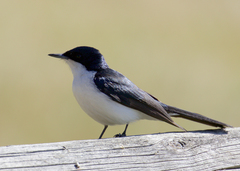
Restless Flycatcher

Restless Flycatcher

Myiagra inquieta

Silhouette: Sheatherius · PhyloPic

LCLeast ConcernNTVUENCR Endemic
Daily sighting probability <5% · Rare
at Kosciuszko National Park

In 3 days ~10% in a week ~20%

14 Verified sightings at Kosciuszko National Park From 2019 to 2026
225 In all 7 parks
March Best month
☀️ Diurnal When it's spotted

About the Restless Flycatcher

The restless flycatcher (Myiagra inquieta) or restless myiagra is a passerine bird in the family Monarchidae; it is also known as the razor grinder or scissors grinder because of its distinctive call. It is a native of eastern and southern Australia. Populations in New Guinea and northern Australia, which were at one time considered to be a subspecies, are now accepted as a separate species, the paperbark flycatcher (Myiagra nana). It is a small to medium-sized bird and has similar colouring to the willie wagtail.

Also known colloquially as razor grinder, scissors grinder, dishlicker or dishwasher on account of its unusual call, the restless flycatcher was first described by ornithologist John Latham in 1801 under the binomial name Turdus inquietus. Its specific epithet is derived from the Latin inquietus 'restless'. Populations from northern Australia and New Guinea, formerly considered a distinctive subspecies, are now separated as the paperbark flycatcher (Myiagra nana), with which it forms a superspecies.

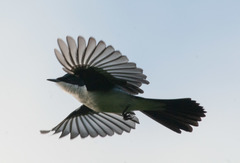
It is about 20 cm (8 in) long, with a glossy dark blue crest, a grey-blue back and white underparts. It is similar to the willie... Wikipedia →

Sounds

Song0:26

Australia · 2025

© Peter Boesman · XC1066721 · CC BY-NC-ND 4.0

Recording0:09

Australia · 2024

© Drew Davison · XC895592 · CC BY-NC-ND 4.0

Flight call0:24

Australia · 2019

© Marc Anderson · XC460767 · CC BY-NC-ND 4.0

Global Distribution

Parks Where Found

# Park Country Daily sighting probability
1 Flinders Chase 🇦🇺 Australia
~10%
2 Hattah-Kulkyne National Park 🇦🇺 Australia
<5%
3 Kosciuszko National Park 🇦🇺 Australia
<5%
4 Springbrook National Park 🇦🇺 Australia
<5%
5 Grampians National Park 🇦🇺 Australia
<5%
6 Blue Mountains National Park 🇦🇺 Australia
<5%
7 Lamington National Park 🇦🇺 Australia
<5%

Cities Where Found

# City Country Daily sighting probability
1 Brisbane 🇦🇺 Australia
<5%
2 Sydney 🇦🇺 Australia
<5%

Before you go

What are the chances of seeing a Restless Flycatcher in Kosciuszko National Park?

Rare

Under 5% of wildlife watchers report a Restless Flycatcher sighting in Kosciuszko National Park on a given day, based on 14 verified sightings from GBIF citizen-science data from 2019 to 2026. It is the 96th most-seen of the 127 birds we can rate there. Over three days the chance rises to about 10%, and over a week to about 20%, if each day is a fresh chance.

When is the best time to see a Restless Flycatcher in Kosciuszko National Park?

March and September–October

In those months about 10% of wildlife watchers report a Restless Flycatcher in Kosciuszko National Park on a given day, against under 5% in April–May, July–August and November–February, the lowest months. June has too few records to rate.

What time of day is best to see a Restless Flycatcher?

Between 10 am and 1 pm

Across all the parks we cover, that three-hour window holds the most Restless Flycatcher sightings with a recorded time, and nearly all of them come between 6 am and 6 pm: it is a daytime animal.

Is Kosciuszko National Park the best place to see a Restless Flycatcher?

3rd of 7

Of the 7 parks where we can rate Restless Flycatcher sightings, Kosciuszko National Park ranks 3rd at under 5%. The best odds are in Flinders Chase (Australia, about 10%) and Hattah-Kulkyne National Park (Australia, under 5%).

Which relatives of the Restless Flycatcher live in Kosciuszko National Park?

Same genus: Myiagra

The closest relatives of the Restless Flycatcher that you can see in Kosciuszko National Park (genus Myiagra, Myiagra Flycatchers) are Satin Flycatcher (about 10%) and Leaden Flycatcher (about 10%), with each one's daily chance of a sighting.

Where does the Restless Flycatcher sighting chance come from?

GBIF citizen-science records

It is estimated from how often the Restless Flycatcher is recorded against all the birds logged in Kosciuszko National Park (14 verified sightings from 2019 to 2026), calibrated against known sighting rates. Figures are rounded to the nearest 10% because citizen-science data supports honest approximations, not decimals, and months with records from fewer than five people show "—". How it works.

← Back to Kosciuszko National Park