Black File Snake

Black File Snake

Gracililima nyassae

Silhouette: SeismicShrimp · PhyloPic

LCLeast ConcernNTVUENCR
Daily sighting probability <5% · Rare
at Kruger National Park

In 3 days ~10% in a week ~20%

6 Verified sightings at Kruger National Park From 2019 to 2026
6 In 1 park
January Best month
🌙 Nocturnal When it's spotted

About the Black File Snake

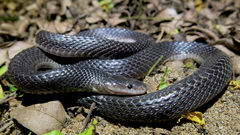
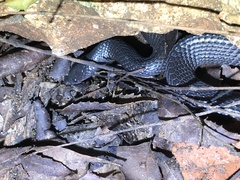
The black file snake (Gracililima nyassae), also known commonly as the dwarf file snake or the Nyassa file snake, is a species of snake in the subfamily Lamprophiinae of the family Lamprophiidae. The species is endemic to Africa.

Gracililima nyassae is the only species in the genus Gracililima. The species was previously placed in the genera Gonionotophis, Mehelya, and Simocephalus. The generic name, Gracililima is from Latin gracili- meaning "slender" + lima meaning "file". The specific name, nyassae, refers to the type locality, "Lake Nyassa" (= Lake Malawi).

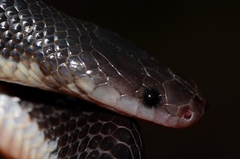
G. nyassae is found in Botswana, Burundi, Democratic Republic of the Congo, Eswatini, Kenya, Malawi, Mozambique, Namibia, Rwanda, Somalia, South Africa, Tanzania, Zambia, and Zimbabwe. G. nyassae is a small snake. The female may attain a snout-to-vent length (SVL) of 52 cm (20 in). The male is shorter, around 44 cm (17 in) SVL. Dorsally it is dark brown or purplish brown, with pink skin showing between the scales. Unlike the Common File snake, this snake lacks the light dorsal stripe but has the characteristic triangular body, Ventrally it is black to dark... Wikipedia →

Global Distribution

Parks Where Found

# Park Country Daily sighting probability
1 Kruger National Park 🇿🇦 South Africa
<5%

More parks will be added in future updates.

Before you go

What are the chances of seeing a Black File Snake in Kruger National Park?

Rare

Under 5% of wildlife watchers report a Black File Snake sighting in Kruger National Park on a given day, based on 6 verified sightings from GBIF citizen-science data from 2019 to 2026. It is the 59th most-seen of the 62 reptiles we can rate there. Over three days the chance rises to about 10%, and over a week to about 20%, if each day is a fresh chance.

When is the best time to see a Black File Snake in Kruger National Park?

April and December–January

In those months about 10% of wildlife watchers report a Black File Snake in Kruger National Park on a given day, against under 5% in February–March and May–November, the lowest months. Those are among Kruger National Park's wettest months, with about 70 mm of rain a month against almost none in August.

What time of day is best to see a Black File Snake?

Between 8 and 11 pm

Across all the parks we cover, that three-hour window holds the most Black File Snake sightings with a recorded time, and about 7 in 10 of them come between 6 pm and 6 am: it is mostly seen at night.

Where else can you see a Black File Snake?

Only Kruger National Park, in our data

Kruger National Park is the only park on Wallace's Line with enough records to rate Black File Snake sightings: under 5% of wildlife watchers there report one on a given day.

Which relatives of the Black File Snake live in Kruger National Park?

Same family: Lamprophiidae

The closest relatives of the Black File Snake that you can see in Kruger National Park (family Lamprophiidae, Lamprophiid Snakes) are Brown House Snake (about 10%) and Cape Wolf Snake (about 10%), with each one's daily chance of a sighting.

Where does the Black File Snake sighting chance come from?

GBIF citizen-science records

It is estimated from how often the Black File Snake is recorded against all the reptiles logged in Kruger National Park (6 verified sightings from 2019 to 2026), calibrated against known sighting rates. Figures are rounded to the nearest 10% because citizen-science data supports honest approximations, not decimals, and months with records from fewer than five people show "—". How it works.

← Back to Kruger National Park