
Brown House Snake

Brown House Snake

Boaedon capensis

Silhouette: SeismicShrimp · PhyloPic

LCLeast ConcernNTVUENCR
Daily sighting probability ~10% · With luck
at Kruger National Park

In 3 days ~30% in a week ~60%

54 Verified sightings at Kruger National Park From 2019 to 2026
87 In all 4 parks
January Best month
🌅 Crepuscular When it's spotted

About the Brown House Snake

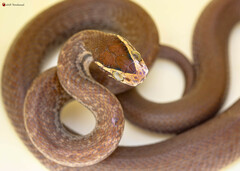
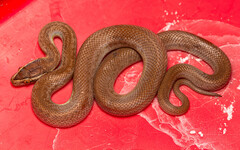
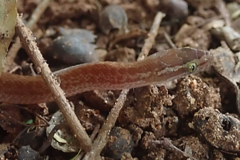
Boaedon capensis, the Cape house snake, also known as the brown house snake, is a species of lamprophiid from Botswana, South Africa (from KwaZulu-Natal all the way through to the Western Cape), Mozambique, Zambia and Zimbabwe. They are a non-venomous lamprophiid. This species was previously grouped in the genus Lamprophis but is regrouped with the genus Boaedon.

Cape house snakes are usually dark brown on top, but the colour varies greatly from almost black through brown to olive green. The stripes that stretch from the rostral scale through the eye to the back of the head are very strong, thick, and bold. This species may have a lateral stripe running down the flanks, often resembling the links of a chain. They also sometimes have lateral stripes running along either side of the spine. Linking lines between the lateral striping is not uncommon. These body markings tend to be a paler brown/cream in colour on top of the often dark, chocolate-brown base tones. These markings normally fade two-thirds of the way down the body until only the base colour remains, but there are exceptions to the rule. Individuals without pattern are often found in the wild. These individuals... Wikipedia →

Global Distribution

Parks Where Found

# Park Country Daily sighting probability
1 iSimangaliso Wetland Park 🇿🇦 South Africa
~10%
2 Kruger National Park 🇿🇦 South Africa
~10%
3 Addo Elephant National Park 🇿🇦 South Africa
~10%
4 Garden Route National Park 🇿🇦 South Africa
<5%

Cities Where Found

# City Country Daily sighting probability
1 Lusaka 🇿🇲 Zambia
~30%
2 Harare 🇿🇼 Zimbabwe
~20%
3 Pretoria 🇿🇦 South Africa
~20%
4 Johannesburg 🇿🇦 South Africa
~20%
5 Durban 🇿🇦 South Africa
~10%
6 Cape Town 🇿🇦 South Africa
~10%

Zoos & Centres Where Found

# Zoo / Centre Country
1 National Zoological Garden of South Africa 🇿🇦 South Africa In captivity
2 Oregon Zoo 🇺🇸 United States In captivity
3 Budapest Zoo & Botanical Garden 🇭🇺 Hungary In captivity
4 Little Rock Zoo 🇺🇸 United States In captivity
5 Tierpark Gettorf 🇩🇪 Germany In captivity

Before you go

What are the chances of seeing a Brown House Snake in Kruger National Park?

With luck

About 10% of wildlife watchers report a Brown House Snake sighting in Kruger National Park on a given day, based on 54 verified sightings from GBIF citizen-science data from 2019 to 2026. It is the 22nd most-seen of the 62 reptiles we can rate there. Over three days the chance rises to about 30%, and over a week to about 60%, if each day is a fresh chance.

When is the best time to see a Brown House Snake in Kruger National Park?

January

In that month about 20% of wildlife watchers report a Brown House Snake in Kruger National Park on a given day, against under 5% in July, the lowest month. That is one of Kruger National Park's wettest months, with about 95 mm of rain against almost none in August.

What time of day is best to see a Brown House Snake?

Between 5 and 8 pm

Across all the parks we cover, that three-hour window holds the most Brown House Snake sightings with a recorded time, and about 7 in 10 of them come between 6 am and 6 pm: it is most active around dawn and dusk.

Is Kruger National Park the best place to see a Brown House Snake?

Among the best

Of the 4 parks where we can rate Brown House Snake sightings, Kruger National Park ranks 2nd at about 10%, level with the leaders once rounded. The best odds are in iSimangaliso Wetland Park (South Africa, about 10%).

Where does the Brown House Snake sighting chance come from?

GBIF citizen-science records

It is estimated from how often the Brown House Snake is recorded against all the reptiles logged in Kruger National Park (54 verified sightings from 2019 to 2026), calibrated against known sighting rates. Figures are rounded to the nearest 10% because citizen-science data supports honest approximations, not decimals, and months with records from fewer than five people show "—". How it works.

← Back to Kruger National Park