Cape Wolf Snake

Cape Wolf Snake

Lycophidion capense

Silhouette: SeismicShrimp · PhyloPic

LCLeast ConcernNTVUENCR
Daily sighting probability ~10% · With luck
at Kruger National Park

In 3 days ~20% in a week ~30%

15 Verified sightings at Kruger National Park From 2019 to 2026
33 In all 4 parks
October Best month
☀️🌙 Day & Night When it's spotted

About the Cape Wolf Snake

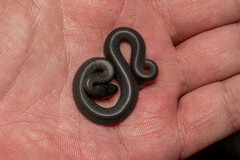
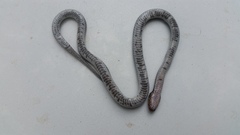
The Cape wolf snake (Lycophidion capense) is a species of oviparous, nonvenomous snake which occurs over a wide area of Southern, Central, and East Africa. Though docile and harmless, it may be confused with the very venomous stiletto snake.

Lycophidion capense jacksoni (Boulenger, 1893) Lycophidion capense loveridgei Laurent, 1968 Nota bene: A trinomial authority in parentheses indicates that the subspecies was originally described in a genus other than Lycophidion.

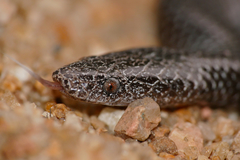
Adults regularly reach 40 cm in length, but some grow to 64 cm. It has a flattened, tapering head and marbled eye. The brown or black lateral and dorsal scales are tipped white, while the ventral scales are all-white. Long recurved fangs are present on the upper as well as lower jaws, for which they are named.

They are widely distributed but prefer damp locations, with lowland forest and fynbos being preferred habitats. They feed mostly on geckos and skinks which they bite and kill by constriction. They are believed to reach... Wikipedia →

Global Distribution

Parks Where Found

# Park Country Daily sighting probability
1 Gorongosa National Park 🇲🇿 Mozambique
~20%
2 iSimangaliso Wetland Park 🇿🇦 South Africa
~10%
3 Kruger National Park 🇿🇦 South Africa
~10%
4 Garden Route National Park 🇿🇦 South Africa
<5%

Before you go

What are the chances of seeing a Cape Wolf Snake in Kruger National Park?

With luck

About 10% of wildlife watchers report a Cape Wolf Snake sighting in Kruger National Park on a given day, based on 15 verified sightings from GBIF citizen-science data from 2019 to 2026. It is the 44th most-seen of the 62 reptiles we can rate there. Over three days the chance rises to about 20%, and over a week to about 30%, if each day is a fresh chance.

When is the best time to see a Cape Wolf Snake in Kruger National Park?

May, September–October and December–January

In those months about 10% of wildlife watchers report a Cape Wolf Snake in Kruger National Park on a given day, against under 5% in February–April, June–August and November, the lowest months.

What time of day is best to see a Cape Wolf Snake?

Between 7 and 10 pm

Across all the parks we cover, that three-hour window holds the most Cape Wolf Snake sightings with a recorded time, and about 6 in 10 of them come between 6 am and 6 pm: it is seen both by day and at night.

Is Kruger National Park the best place to see a Cape Wolf Snake?

3rd of 4

Of the 4 parks where we can rate Cape Wolf Snake sightings, Kruger National Park ranks 3rd at about 10%. The best odds are in Gorongosa National Park (Mozambique, about 20%) and iSimangaliso Wetland Park (South Africa, about 10%).

Where does the Cape Wolf Snake sighting chance come from?

GBIF citizen-science records

It is estimated from how often the Cape Wolf Snake is recorded against all the reptiles logged in Kruger National Park (15 verified sightings from 2019 to 2026), calibrated against known sighting rates. Figures are rounded to the nearest 10% because citizen-science data supports honest approximations, not decimals, and months with records from fewer than five people show "—". How it works.

← Back to Kruger National Park