Crested Bustard

Crested Bustard

Lophotis ruficrista

Daily sighting probability ~20% · Possible
at Kruger National Park

In 3 days ~50% in a week ~80%

2,470 Verified sightings at Kruger National Park From 2019 to 2026
3,612 In all 9 parks
October Best month
☀️ Diurnal When it's spotted

About the Crested Bustard

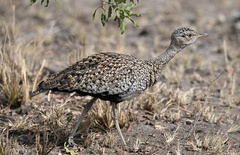
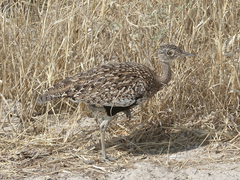
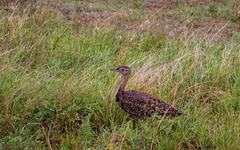
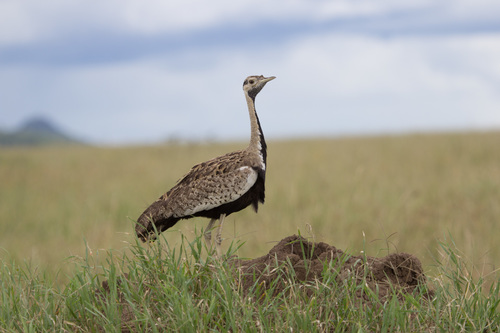
The red-crested korhaan or red-crested bustard (Lophotis ruficrista) is a species of bird in the family Otididae. It is found in Angola, Botswana, Eswatini, Mozambique, Namibia, South Africa, Zambia, and Zimbabwe. The red-crested korhaan grows up to 50 cm (1.6 ft) in length with a maximal weight of 680 g (1.5 lb).

The feathering of the wings folded on the back is marked by V-formed patterns of a light cream color with some white at the sides. Breast feathers are black. Legs are pale yellow and feet gray. One syntype specimen of Otis ruficrista Smith (Rep. Exped. Centr. Afr., 1836, p.56.) is held in the collections of National Museums Liverpool at World Museum, with accession number D56 (male adult). The specimen was collected in the "Country between Latakoo and the Tropic of Capricorn", South Africa by Andrew Smith. The specimen was purchased at the sale of Smith's South Africa Museum (Lot 89, 6 June 1838) and came to the Liverpool national collection via the 13th Earl of Derby's collection which was bequeathed to the people of Liverpool in 1851. There is a further syntype specimen in the bird collection at the Natural History Museum at Tring.

��2... Wikipedia →

Sounds

Recording0:30

South Africa · 2024

© Sascha Schumann · iNaturalist · CC BY-NC 4.0

Recording0:08

South Africa · 2017

© Jaunne-Marelize Van Tonder · iNaturalist · CC BY-NC 4.0

Recording0:09

South Africa · 2025

© Luke Goddard · iNaturalist · CC BY-NC 4.0

Global Distribution

Parks Where Found

# Park Country Daily sighting probability
1 Etosha National Park 🇳🇦 Namibia
~30%
2 Hwange National Park 🇿🇼 Zimbabwe
~30%
3 Kruger National Park 🇿🇦 South Africa
~20%
4 Gonarezhou National Park 🇿🇼 Zimbabwe
~20%
5 Waterberg Plateau Park 🇳🇦 Namibia
~20%
6 Chobe National Park 🇧🇼 Botswana
~10%
7 Moremi Game Reserve 🇧🇼 Botswana
~10%
8 Kgalagadi Transfrontier Park 🇿🇦 South Africa
~10%
9 Pilanesberg National Park 🇿🇦 South Africa
<5%

Before you go

What are the chances of seeing a Crested Bustard in Kruger National Park?

Possible

About 20% of wildlife watchers report a Crested Bustard sighting in Kruger National Park on a given day, based on 2,470 verified sightings from GBIF citizen-science data from 2019 to 2026. It is the 85th most-seen of the 464 birds we can rate there. Over three days the chance rises to about 50%, and over a week to about 80%, if each day is a fresh chance.

When is the best time to see a Crested Bustard in Kruger National Park?

October

In that month about 40% of wildlife watchers report a Crested Bustard in Kruger National Park on a given day, against about 10% in March–April and June, the lowest months.

What time of day is best to see a Crested Bustard?

Between 2 and 5 pm

Across all the parks we cover, that three-hour window holds the most Crested Bustard sightings with a recorded time, and about 9 in 10 of them come between 6 am and 6 pm: it is a daytime animal.

Is Kruger National Park the best place to see a Crested Bustard?

3rd of 9

Of the 9 parks where we can rate Crested Bustard sightings, Kruger National Park ranks 3rd at about 20%. The best odds are in Etosha National Park (Namibia, about 30%) and Hwange National Park (Zimbabwe, about 30%).

Which relatives of the Crested Bustard live in Kruger National Park?

Same family: Otididae

The closest relatives of the Crested Bustard that you can see in Kruger National Park (family Otididae, Bustards) are Kori Bustard (about 10%) and Black-bellied Bustard (about 10%), with each one's daily chance of a sighting.

Where does the Crested Bustard sighting chance come from?

GBIF citizen-science records

It is estimated from how often the Crested Bustard is recorded against all the birds logged in Kruger National Park (2,470 verified sightings from 2019 to 2026), calibrated against known sighting rates. Figures are rounded to the nearest 10% because citizen-science data supports honest approximations, not decimals, and months with records from fewer than five people show "—". How it works.

← Back to Kruger National Park