
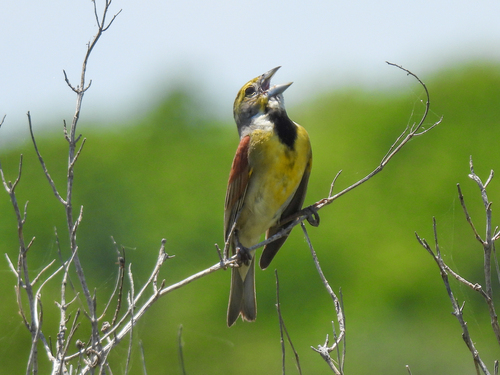
Blue Seedeater

Blue Seedeater

Amaurospiza concolor

Silhouette: Sheatherius · PhyloPic

Daily sighting probability <5% · Rare
at La Amistad International Park (Panama)

In 3 days <5%

57 Verified sightings at La Amistad International Park (Panama) From 2019 to 2026
225 In all 7 parks
June Best month
☀️ Diurnal When it's spotted

About the Blue Seedeater

The blue seedeater (Amaurospiza concolor) or Cabanis's seedeater is a species of bird in the cardinal family that is found in southern Mexico and Central America. The Ecuadorian seedeater (Amaurospiza aequatorialis) was formerly considered a subspecies of the blue seedeater.

The blue seedeater was formally described in 1861 by the German ornithologist Jean Cabanis based on a specimen that had been collected in Costa Rica. Cabanis placed the species in a new genus Amaurospiza and coined the binomial name Amaurospiza concolor. The specific epithet is Latin meaning "uniform", "similar in colour" or "plain".

The blue seedeater was formerly considered to be conspecific with the Ecuadorian seedeater. Most authorities now treat the Ecuadorian seedeateras a separate species. This is based largely on the results of molecular phylogenetic studies that were published in 2014 and 2023. Confusingly, as of January 2024, BirdLife International uses the scientific name A. moesta for blue seedeater. The BirdLife account encompasses what are now the blue, Ecuadorian, and blackish-blue seedeaters.

Two subspecies are recognised: Wikipedia →

Sounds

Call0:25

Mexico · 2016

© Manuel Grosselet · XC331207 · CC BY-NC-SA 4.0

Song0:28

Mexico · 2015

© Richard Hoyer · XC256629 · CC BY-NC-SA 4.0

Call0:16

Panama · 2008

© Ken Allaire · XC24183 · CC BY-NC-ND 2.5

Global Distribution

Parks Where Found

# Park Country Daily sighting probability
1 Montes Azules Biosphere Reserve 🇲🇽 Mexico
~10%
2 Cañón del Sumidero National Park 🇲🇽 Mexico
~10%
3 Volcán Barú National Park 🇵🇦 Panama
<5%
4 Chirripó National Park 🇨🇷 Costa Rica
<5%
5 La Amistad International Park (Panama) 🇵🇦 Panama
<5%
6 Poás Volcano National Park 🇨🇷 Costa Rica
<5%
7 Braulio Carrillo National Park 🇨🇷 Costa Rica
<5%

Cities Where Found

# City Country Daily sighting probability
1 San José 🇨🇷 Costa Rica
<5%

Before you go

What are the chances of seeing a Blue Seedeater in La Amistad International Park (Panama)?

Rare

Under 5% of wildlife watchers report a Blue Seedeater sighting in La Amistad International Park (Panama) on a given day, based on 57 verified sightings from GBIF citizen-science data from 2019 to 2026. It is the 508th most-seen of the 657 birds we can rate there. Over three days the chance rises to under 5%, if each day is a fresh chance.

When is the best time to see a Blue Seedeater in La Amistad International Park (Panama)?

Any time of year

In every month with enough records, under 5% of wildlife watchers report a Blue Seedeater in La Amistad International Park (Panama) on a given day, so our monthly data shows no clear season.

What time of day is best to see a Blue Seedeater?

Between 8 and 11 am

Across all the parks we cover, that three-hour window holds the most Blue Seedeater sightings with a recorded time, and about 9 in 10 of them come between 6 am and 6 pm: it is a daytime animal.

Which relatives of the Blue Seedeater live in La Amistad International Park (Panama)?

Same family: Cardinalidae

The closest relatives of the Blue Seedeater that you can see in La Amistad International Park (Panama) (family Cardinalidae, Cardinals and Allies) are Flame-colored Tanager (about 30%), Summer Tanager (about 20%) and Blue-black Grosbeak (about 10%), with each one's daily chance of a sighting.

Where does the Blue Seedeater sighting chance come from?

GBIF citizen-science records

It is estimated from how often the Blue Seedeater is recorded against all the birds logged in La Amistad International Park (Panama) (57 verified sightings from 2019 to 2026), calibrated against known sighting rates. Figures are rounded to the nearest 10% because citizen-science data supports honest approximations, not decimals, and months with records from fewer than five people show "—". How it works.

← Back to La Amistad International Park (Panama)