Black-collared Barbet

Black-collared Barbet

Lybius torquatus

Silhouette: PhyloPic

LCLeast ConcernNTVUENCR
Daily sighting probability ~10% · With luck
at Lake Mburo National Park

In 3 days ~30% in a week ~60%

154 Verified sightings at Lake Mburo National Park From 2019 to 2026
5,760 In all 19 parks
July Best month
☀️ Diurnal When it's spotted

About the Black-collared Barbet

The black-collared barbet (Lybius torquatus) is a species of bird in the family Lybiidae which is native to sub-Saharan Africa. Indigenous names include Rooikophoutkapper in Afrikaans, isiKhulukhulu and isiQonQotho in Zulu, and Isinagogo in Xhosa.

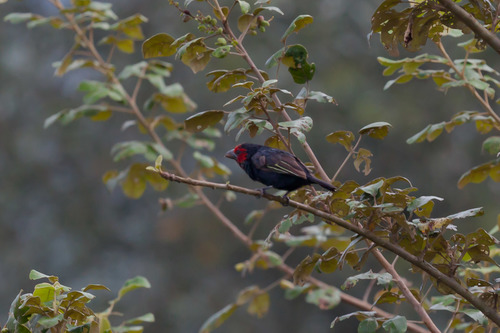
It is found in Sub-Saharan Africa through Angola, Botswana, Burundi, Democratic Republic of the Congo, Eswatini, Kenya, Lesotho, Malawi, Mozambique, Namibia, Rwanda, South Africa, Tanzania, Uganda, Zambia, and Zimbabwe. The black-collared barbet usually is about 20–25 cm long, plump-looking and has a large head. It also has the heavy bill fringed with bristles that is characteristic of the genus Lybius. This barbet has a very obvious black collar and head which gives reference to its name. It also has a fire-engine red coloring around the eyes and beak. It has morphologically variable coloring because there is a replacement of a red head with a black head. It also has a more intense color and is larger than other barbets. This bird is also sexually monomorphic, which means that there is generally no phenotypic difference between the males and females of this species. The morphology, size and behavior are basically... Wikipedia →

Sounds

Aberrant0:11

South Africa · 2024

© Daan van der Hoeven · XC935295 · CC BY-NC-SA 4.0

Duet0:17

Zambia · 2024

© Dries Van de Loock · XC932695 · CC BY-NC-ND 4.0

Call0:23

Zambia · 2023

© Marc Anderson · XC890684 · CC BY-NC-ND 4.0

Global Distribution

Parks Where Found

# Park Country Daily sighting probability
1 Kafue National Park 🇿🇲 Zambia
~50%
2 uMkhuze Game Reserve 🇿🇦 South Africa
~50%
3 Gonarezhou National Park 🇿🇼 Zimbabwe
~40%
4 Pilanesberg National Park 🇿🇦 South Africa
~40%
5 Kruger National Park 🇿🇦 South Africa
~40%
6 iSimangaliso Wetland Park 🇿🇦 South Africa
~20%
7 Hluhluwe-Imfolozi Park 🇿🇦 South Africa
~20%
8 Moremi Game Reserve 🇧🇼 Botswana
~20%
9 Lake Mburo National Park 🇺🇬 Uganda
~10%
10 Lower Zambezi National Park 🇿🇲 Zambia
~10%
11 Addo Elephant National Park 🇿🇦 South Africa
~10%
12 South Luangwa National Park 🇿🇲 Zambia
~10%
13 Mana Pools National Park 🇿🇼 Zimbabwe
~10%
14 Liwonde National Park 🇲🇼 Malawi
~10%
15 Chobe National Park 🇧🇼 Botswana
~10%
16 Ruaha National Park 🇹🇿 Tanzania
~10%
17 Garden Route National Park 🇿🇦 South Africa
~10%
18 Hwange National Park 🇿🇼 Zimbabwe
<5%
19 Akagera National Park 🇷🇼 Rwanda
<5%

Cities Where Found

# City Country Daily sighting probability
1 Durban 🇿🇦 South Africa
~50%
2 Pretoria 🇿🇦 South Africa
~50%
3 Johannesburg 🇿🇦 South Africa
~40%
4 Lusaka 🇿🇲 Zambia
~30%
5 Harare 🇿🇼 Zimbabwe
~30%
6 Maputo 🇲🇿 Mozambique
~30%
7 Lilongwe 🇲🇼 Malawi
~10%

Zoos & Centres Where Found

# Zoo / Centre Country
1 Tierpark Hagenbeck 🇩🇪 Germany In captivity
2 Monkeyland 🇿🇦 South Africa In captivity
3 Birds of Eden 🇿🇦 South Africa In captivity

Before you go

What are the chances of seeing a Black-collared Barbet in Lake Mburo National Park?

With luck

About 10% of wildlife watchers report a Black-collared Barbet sighting in Lake Mburo National Park on a given day, based on 154 verified sightings from GBIF citizen-science data from 2019 to 2026. It is the 116th most-seen of the 362 birds we can rate there. Over three days the chance rises to about 30%, and over a week to about 60%, if each day is a fresh chance.

When is the best time to see a Black-collared Barbet in Lake Mburo National Park?

March, July, September and November

In those months about 20% of wildlife watchers report a Black-collared Barbet in Lake Mburo National Park on a given day, against under 5% in May, the lowest month.

What time of day is best to see a Black-collared Barbet?

Between 8 and 11 am

Across all the parks we cover, that three-hour window holds the most Black-collared Barbet sightings with a recorded time, and nearly all of them come between 6 am and 6 pm: it is a daytime animal.

Which relatives of the Black-collared Barbet live in Lake Mburo National Park?

Same genus: Lybius

The closest relatives of the Black-collared Barbet that you can see in Lake Mburo National Park (genus Lybius, Typical African Barbets) are Double-Toothed Barbet (about 20%), White-headed Barbet (about 10%) and Red-faced Barbet (about 10%), with each one's daily chance of a sighting.

Where does the Black-collared Barbet sighting chance come from?

GBIF citizen-science records

It is estimated from how often the Black-collared Barbet is recorded against all the birds logged in Lake Mburo National Park (154 verified sightings from 2019 to 2026), calibrated against known sighting rates. Figures are rounded to the nearest 10% because citizen-science data supports honest approximations, not decimals, and months with records from fewer than five people show "—". How it works.

← Back to Lake Mburo National Park