Rakali

Rakali

Hydromys chrysogaster

Silhouette: Rachel T Mason · PhyloPic

LCLeast ConcernNTVUENCR
Daily sighting probability ~10% · With luck
at Lamington National Park

In 3 days ~20% in a week ~30%

12 Verified sightings at Lamington National Park From 2019 to 2026
42 In all 4 parks
June Best month
☀️ Diurnal When it's spotted

About the Rakali

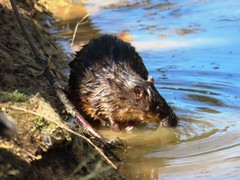
The rakali (Hydromys chrysogaster), also known as the rabe, the "Australian otter" or water-rat, is an Australian native rodent first scientifically described in 1804. Adoption of the Ngarrindjeri name rakali is intended to foster a positive public attitude by Environment Australia.

One of four described species in the genus Hydromys, it is the only one with a range extending beyond New Guinea. Having adapted to and colonised a unique niche of a semiaquatic and nocturnal lifestyle, this species lives in burrows on the banks of rivers, lakes and estuaries and feeds on aquatic insects, fish, crustaceans, mussels, snails, frogs, cane toads, bird's eggs and small water birds.

Rakali have a body length of 23–37 cm (9–15 in), weigh 340–1,275 g (12–45 oz), and have a thick tail measuring around 24–35 cm (9–14 in). Females are generally smaller than males but tail lengths are normally the same. They have partially webbed hind legs, waterproof fur, a flattened head, a long blunt nose, many whiskers and small ears and eyes. The body is streamlined with a skull that is large, flat and elongated, with two molars on the upper and lower jaw, similar to the water mouse. They are black to brown in colour with an orange to white belly, and dark tail with a white tip.

Long considered a nuisance animal, rakali were hunted for their soft fur, particularly in the Depression of the 1930s, when a ban was placed on imported pelts such as the American muskrat. With their numbers under threat, a protection order was issued in 1938. However, they were still subject to destruction permits from 1938 to 1957 due to their effect on irrigation banks and alleged damage to fishing nets. Additionally, from 1957 to 1967 a number of licensed seasons were also held for this reason. Wikipedia →

Sounds

Recording1:00

Australia · 2026

© stephenwwalsh · iNaturalist · CC BY-NC 4.0

Recording0:08

Australia · 2024

© lkosack · iNaturalist · CC BY-NC 4.0

Global Distribution

Parks Where Found

# Park Country Daily sighting probability
1 Kosciuszko National Park 🇦🇺 Australia
~20%
2 Daintree National Park 🇦🇺 Australia
~10%
3 Lamington National Park 🇦🇺 Australia
~10%
4 Blue Mountains National Park 🇦🇺 Australia
~10%

Cities Where Found

# City Country Daily sighting probability
1 Brisbane 🇦🇺 Australia
~10%
2 Melbourne 🇦🇺 Australia
~10%
3 Sydney 🇦🇺 Australia
<5%

Zoos & Centres Where Found

# Zoo / Centre Country
1 Yerevan Zoo 🇦🇲 Armenia In captivity
2 London Zoo 🇬🇧 United Kingdom In captivity
3 Frankfurt Zoological Garden 🇩🇪 Germany In captivity

Before you go

What are the chances of seeing a Rakali in Lamington National Park?

With luck

About 10% of wildlife watchers report a Rakali sighting in Lamington National Park on a given day, based on 12 verified sightings from GBIF citizen-science data from 2019 to 2026. It is the 26th most-seen of the 26 mammals we can rate there. Over three days the chance rises to about 20%, and over a week to about 30%, if each day is a fresh chance.

When is the best time to see a Rakali in Lamington National Park?

January–February, April–August and November

In those months about 10% of wildlife watchers report a Rakali in Lamington National Park on a given day, against under 5% in March, September–October and December, the lowest months.

What time of day is best to see a Rakali?

Between 2 and 5 pm

Across all the parks we cover, that three-hour window holds the most Rakali sightings with a recorded time, and about 9 in 10 of them come between 6 am and 6 pm: it is a daytime animal.

Is Lamington National Park the best place to see a Rakali?

3rd of 4

Of the 4 parks where we can rate Rakali sightings, Lamington National Park ranks 3rd at about 10%. The best odds are in Kosciuszko National Park (Australia, about 20%) and Daintree National Park (Australia, about 10%).

Which relatives of the Rakali live in Lamington National Park?

Same family: Muridae

The closest relatives of the Rakali that you can see in Lamington National Park (family Muridae, Old World Mice and Rats) are Fawn-footed Melomys (about 20%), Bush Rat (about 20%) and Australian Swamp Rat (about 10%), with each one's daily chance of a sighting.

Where does the Rakali sighting chance come from?

GBIF citizen-science records

It is estimated from how often the Rakali is recorded against all the mammals logged in Lamington National Park (12 verified sightings from 2019 to 2026), calibrated against known sighting rates. Figures are rounded to the nearest 10% because citizen-science data supports honest approximations, not decimals, and months with records from fewer than five people show "—". How it works.

← Back to Lamington National Park