Plumed Whistling Duck

Plumed Whistling Duck

Dendrocygna eytoni

Silhouette: Sheatherius · PhyloPic

LCLeast ConcernNTVUENCR
Daily sighting probability ~20% · Possible
at Litchfield National Park

In 3 days ~50% in a week ~80%

65 Verified sightings at Litchfield National Park From 2019 to 2026
939 In all 2 parks
November Best month
☀️ Diurnal When it's spotted

About the Plumed Whistling Duck

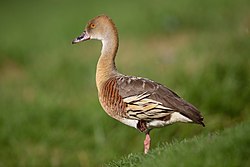
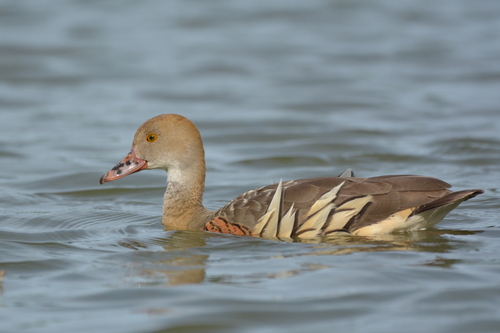
The plumed whistling duck (Dendrocygna eytoni), also called the grass whistling duck, is a species of bird in the whistling duck subfamily of the family Anatidae. It is resident and breeds in Australia, in a broad arc covering the northern half and most of the eastern third of the continent. There are also non-breeding and seasonally uncertain populations in New Zealand, the Solomon Islands, Indonesia and Papua New Guinea. It is a predominantly brown-coloured duck with a long neck and characteristic plumes arising from its flanks. The sexes are similar in appearance.

Described by English naturalist Thomas Campbell Eyton in 1838, its specific epithet honours its namer. Its generic name is derived from the Ancient Greek terms dendron "tree", and kuknos (via Latin cygnus) "swan". Alternate common names include; Eyton's plumed, red-legged or whistling tree-duck, and grey or red-legged whistler.

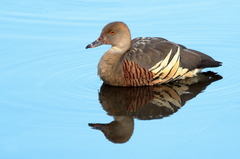
Measuring 42–60 cm (16.5–23.5 in) and weighing around one kilogram (2.2 lb), it is a long-necked duck with brown upperparts, paler underparts and a white rump. The chest is a chestnut colour with thin black bars, while long black-margined plumes arise from its flanks... Wikipedia →
Sounds

Call0:48

Australia · 2025

© Peter Boesman · XC1066527 · CC BY-NC-ND 4.0

Flight call1:23

Australia · 2022

© James Lambert · XC749868 · CC BY-NC-ND 4.0

Call0:22

Australia · 2022

© Drew Davison · XC720422 · CC BY-NC-ND 4.0

Global Distribution

Parks Where Found

# Park Country Daily sighting probability
1 Kakadu National Park 🇦🇺 Australia
~40%
2 Litchfield National Park 🇦🇺 Australia
~20%

Cities Where Found

# City Country Daily sighting probability
1 Brisbane 🇦🇺 Australia
<5%

Zoos & Centres Where Found

# Zoo / Centre Country
1 Disney's Animal Kingdom 🇺🇸 United States In captivity
2 Busch Gardens Tampa 🇺🇸 United States In captivity
3 Tierpark Berlin 🇩🇪 Germany In captivity
4 Zoo Miami 🇺🇸 United States In captivity
5 Sedgwick County Zoo 🇺🇸 United States In captivity
6 Slimbridge Wetland Centre 🇬🇧 United Kingdom In captivity
7 Cape May County Park & Zoo 🇺🇸 United States In captivity
8 Healesville Sanctuary 🇦🇺 Australia In captivity
9 Taronga Zoo 🇦🇺 Australia In captivity
10 Cleland Wildlife Park 🇦🇺 Australia In captivity
11 Parc Zoologique et Botanique de Mulhouse 🇫🇷 France In captivity
12 Melbourne Zoo 🇦🇺 Australia In captivity
13 ABQ BioPark Zoo 🇺🇸 United States In captivity
14 Perth Zoo 🇦🇺 Australia In captivity
15 Cologne Zoological Garden 🇩🇪 Germany In captivity
16 Phillip Island Wildlife Park 🇦🇺 Australia In captivity
17 Bird Paradise 🇸🇬 Singapore In captivity
18 Rainforest Wild Asia 🇸🇬 Singapore In captivity
19 Featherdale Sydney Wildlife Park 🇦🇺 Australia In captivity
20 Sea Life Sydney Aquarium 🇦🇺 Australia In captivity
21 Wild Life Sydney 🇦🇺 Australia In captivity
22 Caversham Wildlife Park 🇦🇺 Australia In captivity
23 Cologne Zoo Aquarium 🇩🇪 Germany In captivity
24 Domaine des Oiseaux 🇫🇷 France In captivity
25 Ranger Red’s Zoo & Conservation Park 🇦🇺 Australia In captivity
26 San Antonio Aquarium 🇺🇸 United States In captivity
27 The Lair 🇦🇺 Australia In captivity
28 Warrawong Wildlife Sanctuary 🇦🇺 Australia In captivity
29 Wildlife Habitat Port Douglas 🇦🇺 Australia In captivity

Before you go

What are the chances of seeing a Plumed Whistling Duck in Litchfield National Park?

Possible

About 20% of wildlife watchers report a Plumed Whistling Duck sighting in Litchfield National Park on a given day, based on 65 verified sightings from GBIF citizen-science data from 2019 to 2026. It is the 40th most-seen of the 110 birds we can rate there. Over three days the chance rises to about 50%, and over a week to about 80%, if each day is a fresh chance.

When is the best time to see a Plumed Whistling Duck in Litchfield National Park?

November

In that month about 40% of wildlife watchers report a Plumed Whistling Duck in Litchfield National Park on a given day, against about 10% in February–May and July, the lowest months.

What time of day is best to see a Plumed Whistling Duck?

Between 9 am and noon

Across all the parks we cover, that three-hour window holds the most Plumed Whistling Duck sightings with a recorded time, and about 9 in 10 of them come between 6 am and 6 pm: it is a daytime animal.

Is Litchfield National Park the best place to see a Plumed Whistling Duck?

2nd of 2

Of the 2 parks where we can rate Plumed Whistling Duck sightings, Litchfield National Park ranks 2nd at about 20%. The best odds are in Kakadu National Park (Australia, about 40%).

Where does the Plumed Whistling Duck sighting chance come from?

GBIF citizen-science records

It is estimated from how often the Plumed Whistling Duck is recorded against all the birds logged in Litchfield National Park (65 verified sightings from 2019 to 2026), calibrated against known sighting rates. Figures are rounded to the nearest 10% because citizen-science data supports honest approximations, not decimals, and months with records from fewer than five people show "—". How it works.

← Back to Litchfield National Park