Spangled Drongo

Spangled Drongo

Dicrurus bracteatus

Silhouette: Ferran Sayol · PhyloPic

LCLeast ConcernNTVUENCR
Daily sighting probability ~50% · Likely
at Litchfield National Park

In 3 days ~90% in a week >90%

201 Verified sightings at Litchfield National Park From 2019 to 2026
2,825 In all 9 parks
October Best month
☀️ Diurnal When it's spotted

About the Spangled Drongo

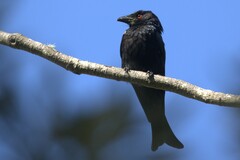
The spangled drongo (Dicrurus bracteatus) is a bird of the family Dicruridae. It is the only drongo to be found in Australia, where it can be recognised by its black, iridescent plumage and its characteristic forked tail. It feeds on insects and small vertebrates. It has complex and varied calls and is a mimic of the sounds it hears. It arrives in Queensland in late spring and breeds high in an isolated tree, producing three to five young each year.

Its basically black plumage is iridescent with blue and purple highlights. Its eyes are crimson. The most remarkable characteristic of its appearance is its tail, which is described by Morcombe as "long, outcurved and forked" and on first examination looks like its feathers are crossed over – like crossing your fingers. Young drongos lack the highlights and spots and their eyes are dark brown.

The spangled drongo displays uninhibited and sometimes comical behaviour as it swoops and perches in search of insects, small birds, and occasionally, small skinks. When it seasonally visits urban areas, it is easily tamed by throwing small pieces of raw meat into the air, when it will accurately swoop and catch... Wikipedia →

Sounds

Call0:13

Indonesia · 2026

© Ding Li Yong · XC1166600 · CC BY-NC-ND 4.0

Song0:45

Australia · 2025

© Étienne Leroy · XC1072045 · CC BY-NC-SA 4.0

Duet1:29

Australia · 2022

© James Lambert · XC767379 · CC BY-NC-ND 4.0

Global Distribution

Parks Where Found

# Park Country Daily sighting probability
1 Daintree National Park 🇦🇺 Australia
~60%
2 Litchfield National Park 🇦🇺 Australia
~50%
3 Kakadu National Park 🇦🇺 Australia
~40%
4 Noosa National Park 🇦🇺 Australia
~30%
5 Springbrook National Park 🇦🇺 Australia
~20%
6 Raja Ampat 🇮🇩 Indonesia
~10%
7 Lamington National Park 🇦🇺 Australia
~10%
8 Nitmiluk National Park 🇦🇺 Australia
<5%
9 Royal National Park 🇦🇺 Australia
<5%

Cities Where Found

# City Country Daily sighting probability
1 Brisbane 🇦🇺 Australia
~20%
2 Sydney 🇦🇺 Australia
<5%

Zoos & Centres Where Found

# Zoo / Centre Country
1 Cincinnati Zoo and Botanical Garden 🇺🇸 United States In captivity
2 Featherdale Sydney Wildlife Park 🇦🇺 Australia In captivity
3 Birdworld Kuranda 🇦🇺 Australia In captivity
4 Kuranda Koala Gardens 🇦🇺 Australia In captivity

Before you go

What are the chances of seeing a Spangled Drongo in Litchfield National Park?

Likely

About 50% of wildlife watchers report a Spangled Drongo sighting in Litchfield National Park on a given day, based on 201 verified sightings from GBIF citizen-science data from 2019 to 2026. It is the 3rd most-seen of the 110 birds we can rate there. Over three days the chance rises to about 90%, and over a week to over 90%, if each day is a fresh chance.

When is the best time to see a Spangled Drongo in Litchfield National Park?

October

In that month about 70% of wildlife watchers report a Spangled Drongo in Litchfield National Park on a given day, against about 30% in November, the lowest month. That is one of Litchfield National Park's driest months, with about 70 mm of rain against 400 mm in January.

What time of day is best to see a Spangled Drongo?

Between 8 and 11 am

Across all the parks we cover, that three-hour window holds the most Spangled Drongo sightings with a recorded time, and nearly all of them come between 6 am and 6 pm: it is a daytime animal.

Is Litchfield National Park the best place to see a Spangled Drongo?

2nd of 9

Of the 9 parks where we can rate Spangled Drongo sightings, Litchfield National Park ranks 2nd at about 50%. The best odds are in Daintree National Park (Australia, about 60%). All parks ranked.

Which relatives of the Spangled Drongo live in Litchfield National Park?

Same order: Passeriformes

The closest relatives of the Spangled Drongo that you can see in Litchfield National Park (order Passeriformes, Perching Birds) are Torresian Crow (about 60%), Varied Triller (about 50%) and White-bellied Cuckooshrike (about 50%), with each one's daily chance of a sighting.

Where does the Spangled Drongo sighting chance come from?

GBIF citizen-science records

It is estimated from how often the Spangled Drongo is recorded against all the birds logged in Litchfield National Park (201 verified sightings from 2019 to 2026), calibrated against known sighting rates. Figures are rounded to the nearest 10% because citizen-science data supports honest approximations, not decimals, and months with records from fewer than five people show "—". How it works.

← Back to Litchfield National Park