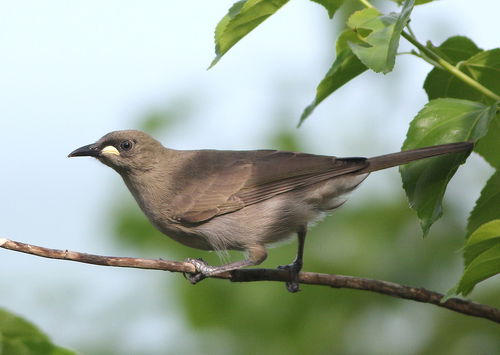
Varied Triller

Varied Triller

Lalage leucomela

Silhouette: PhyloPic

LCLeast ConcernNTVUENCR
Daily sighting probability ~50% · Likely
at Litchfield National Park

In 3 days ~90% in a week >90%

178 Verified sightings at Litchfield National Park From 2019 to 2026
1,995 In all 6 parks
July Best month
☀️ Diurnal When it's spotted

About the Varied Triller

The varied triller (Lalage leucomela) like its better-known relative the white-winged triller, is a smaller member of the cuckoo-shrike family, Campephagidae. Varied trillers prefer warm, reasonably moist environments and are found in New Guinea and the Bismarck Archipelago, along much of the tropical and sub-tropical coastal hinterland of eastern Australia, from about the Sydney area to the tip of Cape York Peninsula, in the moister part of the Kimberley, and throughout the Top End.

Common to very common in the north, they are uncommon to rare in the colder south. Typical habitat is rainforest, vine forest, riverine thickets, eucalypt forest and woodland, with a particular preference for the border areas between closed and open forests.

Varied trillers work their way slowly and methodically through foliage at any level (sometimes on the ground), searching in pairs or small groups for insects and fruit, and making repeated rolling contact calls almost continuously.

An alternative name is Pied Caterpillar-eater (Karua Leucomela) The Mussau triller (L. conjuncta) was formerly considered a subspecies. ABID Images On the HBW Internet... Wikipedia →

Sounds

Song0:13

Australia · 2023

© Marc Anderson · XC816433 · CC BY-NC-ND 4.0

Call0:43

Papua New Guinea · 2022

© Iain Woxvold · XC750398 · CC BY-NC-SA 4.0

Song0:13

Australia · 2022

© James Lambert · XC759729 · CC BY-NC-ND 4.0

Global Distribution

Parks Where Found

# Park Country Daily sighting probability
1 Litchfield National Park 🇦🇺 Australia
~50%
2 Daintree National Park 🇦🇺 Australia
~50%
3 Kakadu National Park 🇦🇺 Australia
~40%
4 Noosa National Park 🇦🇺 Australia
~10%
5 Springbrook National Park 🇦🇺 Australia
~10%
6 Lamington National Park 🇦🇺 Australia
<5%

Cities Where Found

# City Country Daily sighting probability
1 Brisbane 🇦🇺 Australia
~10%

Before you go

What are the chances of seeing a Varied Triller in Litchfield National Park?

Likely

About 50% of wildlife watchers report a Varied Triller sighting in Litchfield National Park on a given day, based on 178 verified sightings from GBIF citizen-science data from 2019 to 2026. It is the 3rd most-seen of the 110 birds we can rate there. Over three days the chance rises to about 90%, and over a week to over 90%, if each day is a fresh chance.

When is the best time to see a Varied Triller in Litchfield National Park?

July

In that month about 70% of wildlife watchers report a Varied Triller in Litchfield National Park on a given day, against about 30% in November, the lowest month. That is one of Litchfield National Park's driest months, with almost no rain against 400 mm in January.

What time of day is best to see a Varied Triller?

Between 8 and 11 am

Across all the parks we cover, that three-hour window holds the most Varied Triller sightings with a recorded time, and about 9 in 10 of them come between 6 am and 6 pm: it is a daytime animal.

Is Litchfield National Park the best place to see a Varied Triller?

Yes

Of the 6 parks where we can rate Varied Triller sightings, Litchfield National Park has the highest daily chance: about 50%. Next come Daintree National Park (Australia, about 50%) and Kakadu National Park (Australia, about 40%).

Where does the Varied Triller sighting chance come from?

GBIF citizen-science records

It is estimated from how often the Varied Triller is recorded against all the birds logged in Litchfield National Park (178 verified sightings from 2019 to 2026), calibrated against known sighting rates. Figures are rounded to the nearest 10% because citizen-science data supports honest approximations, not decimals, and months with records from fewer than five people show "—". How it works.

← Back to Litchfield National Park