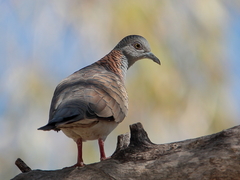

Bar-shouldered Dove

Bar-shouldered Dove

Geopelia humeralis

Silhouette: Sheatherius · PhyloPic

LCLeast ConcernNTVUENCR
Daily sighting probability ~60% · Likely
at Litchfield National Park

In 3 days ~90% in a week >90%

224 Verified sightings at Litchfield National Park From 2019 to 2026
4,011 In all 10 parks
May Best month
☀️ Diurnal When it's spotted

About the Bar-shouldered Dove

The bar-shouldered dove (Geopelia humeralis) is a species of long tailed dove native to Australia and Southern New Guinea. It is protected under the National Parks and Wildlife Act 1974. It is a medium-sized pigeon varying in size from 26–30 cm (10–12 in). Its voice is a distinctive and melodious "cook-a-wook" or "coolicoo".

The dove has a blue-grey breast with chequered brown-bronze wings. The nape is similar to that of the peaceful dove in that the nape feathers are striated but differs in that the bar-shouldered dove does not have striated throat feathers like the peaceful dove. Furthermore, the nape feathers are copper in colour. These doves are also often confused with the introduced and common spotted turtle dove. The eye ring tends to be grey but red-brown when breeding. The juveniles are duller in colour.

Doves are often found in pairs, groups or large loose flocks and are seen commonly feeding on the ground feeding on seeds. Flight is direct and swift and wings whistle while the birds are in flight. Bar-shouldered doves are usually found in thick vegetation where water is present, damp gullies, forests and gorges, mangroves, plantations, swamps... Wikipedia →

Sounds

Song0:43

Australia · 2025

© Peter Boesman · XC1066572 · CC BY-NC-ND 4.0

Call0:21

Australia · 2022

© James Lambert · XC767374 · CC BY-NC-ND 4.0

Song0:19

Australia · 2021

© Marc Anderson · XC816821 · CC BY-NC-ND 4.0

Global Distribution

Parks Where Found

# Park Country Daily sighting probability
1 Nitmiluk National Park 🇦🇺 Australia
~70%
2 Kakadu National Park 🇦🇺 Australia
~70%
3 Litchfield National Park 🇦🇺 Australia
~60%
4 Daintree National Park 🇦🇺 Australia
~50%
5 Springbrook National Park 🇦🇺 Australia
~20%
6 Noosa National Park 🇦🇺 Australia
~10%
7 Blue Mountains National Park 🇦🇺 Australia
~10%
8 Booderee National Park 🇦🇺 Australia
<5%
9 Lamington National Park 🇦🇺 Australia
<5%
10 Royal National Park 🇦🇺 Australia
<5%

Cities Where Found

# City Country Daily sighting probability
1 Brisbane 🇦🇺 Australia
~30%
2 Sydney 🇦🇺 Australia
<5%

Zoos & Centres Where Found

# Zoo / Centre Country
1 Australia Zoo 🇦🇺 Australia In captivity
2 Zoo Pilsen 🇨🇿 Czechia In captivity
3 Kyabram Fauna Park 🇦🇺 Australia In captivity
4 Cleland Wildlife Park 🇦🇺 Australia In captivity
5 Currumbin Wildlife Sanctuary 🇦🇺 Australia In captivity
6 Perth Zoo 🇦🇺 Australia In captivity
7 Bird Paradise 🇸🇬 Singapore In captivity
8 Rainforest Wild Asia 🇸🇬 Singapore In captivity
9 African Dawn Bird and Wildlife Sanctuary 🇿🇦 South Africa In captivity
10 Featherdale Sydney Wildlife Park 🇦🇺 Australia In captivity
11 Ipswich Nature Centre 🇦🇺 Australia In captivity
12 Castellar Zoo 🇪🇸 Spain In captivity
13 Fauna Reserve 🇦🇺 Australia In captivity
14 Birdworld Kuranda 🇦🇺 Australia In captivity
15 Kuranda Koala Gardens 🇦🇺 Australia In captivity
16 Ranger Red’s Zoo & Conservation Park 🇦🇺 Australia In captivity

Before you go

What are the chances of seeing a Bar-shouldered Dove in Litchfield National Park?

Likely

About 60% of wildlife watchers report a Bar-shouldered Dove sighting in Litchfield National Park on a given day, based on 224 verified sightings from GBIF citizen-science data from 2019 to 2026. It is the 2nd most-seen of the 110 birds we can rate there. Over three days the chance rises to about 90%, and over a week to over 90%, if each day is a fresh chance.

When is the best time to see a Bar-shouldered Dove in Litchfield National Park?

January and May

In those months about 70% of wildlife watchers report a Bar-shouldered Dove in Litchfield National Park on a given day, against about 40% in October and November, the lowest months. Those are among Litchfield National Park's wettest months, with about 210 mm of rain a month against almost none in July.

What time of day is best to see a Bar-shouldered Dove?

Between 6 and 9 am

Across all the parks we cover, that three-hour window holds the most Bar-shouldered Dove sightings with a recorded time, and about 9 in 10 of them come between 6 am and 6 pm: it is a daytime animal.

Is Litchfield National Park the best place to see a Bar-shouldered Dove?

3rd of 10

Of the 10 parks where we can rate Bar-shouldered Dove sightings, Litchfield National Park ranks 3rd at about 60%. The best odds are in Nitmiluk National Park (Australia, about 70%) and Kakadu National Park (Australia, about 70%). All parks ranked.

Where does the Bar-shouldered Dove sighting chance come from?

GBIF citizen-science records

It is estimated from how often the Bar-shouldered Dove is recorded against all the birds logged in Litchfield National Park (224 verified sightings from 2019 to 2026), calibrated against known sighting rates. Figures are rounded to the nearest 10% because citizen-science data supports honest approximations, not decimals, and months with records from fewer than five people show "—". How it works.

← Back to Litchfield National Park